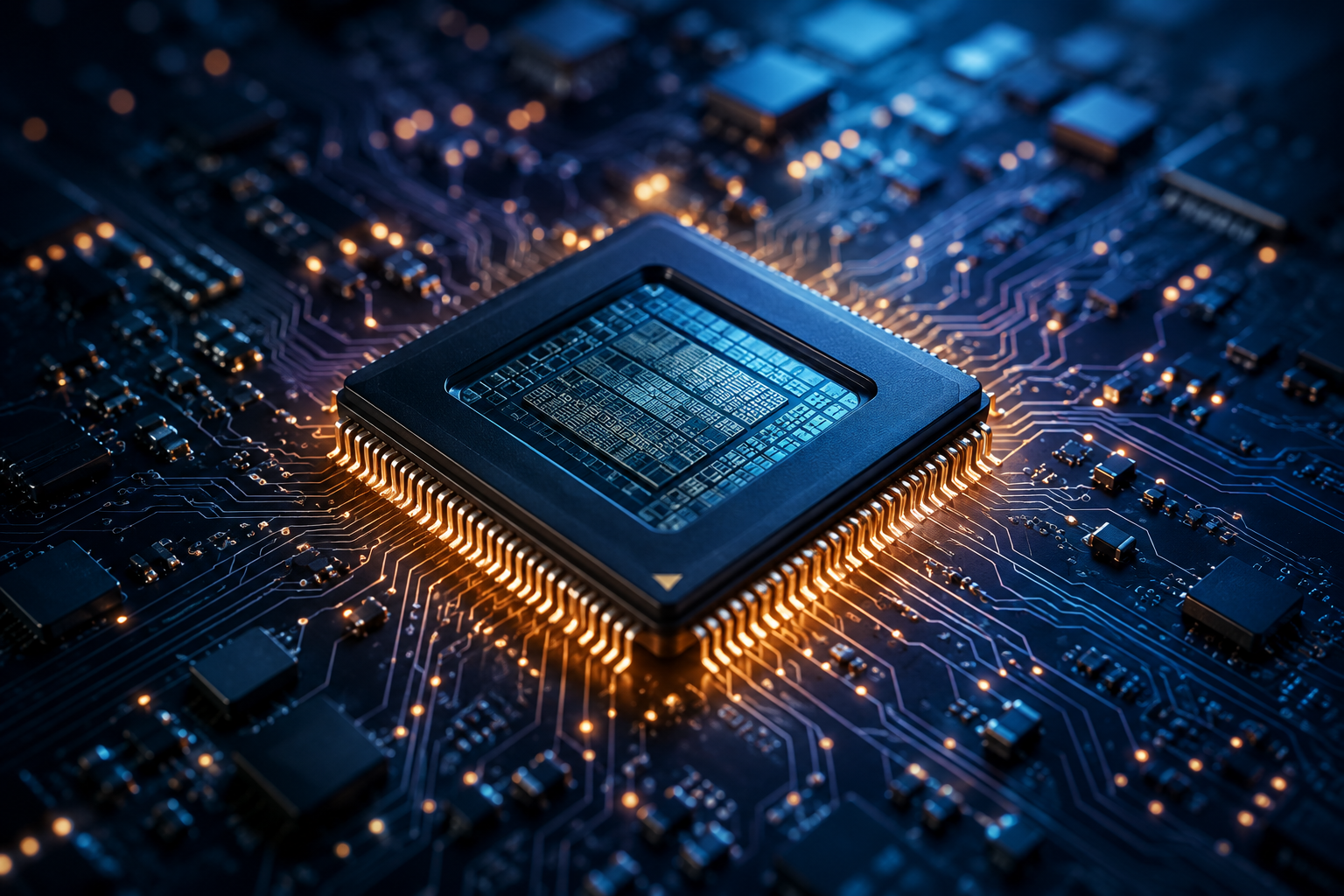

Modern life would be almost impossible without semiconductors. Every smartphone, computer, television, car, medical device, gaming console, and even many household appliances rely on these tiny but incredibly powerful components. Although they are often hidden inside electronic devices, semiconductors are the foundation of the digital world and one of the most important technological inventions in human history.
Despite their importance, many people have only a vague idea of what semiconductors actually are. The name itself sounds highly technical, yet the underlying concept is surprisingly straightforward. Once you understand what makes a semiconductor unique, it becomes much easier to appreciate how virtually every modern electronic device is able to process information, store data, and perform complex calculations.
What Is a Semiconductor?
A semiconductor is a material whose ability to conduct electricity lies somewhere between that of a conductor and an insulator. Conductors, such as copper and silver, allow electricity to flow very easily, while insulators like rubber, glass, and plastic resist the flow of electricity almost completely.
Semiconductors occupy the middle ground. Under certain conditions, they conduct electricity, while under others they behave almost like insulators. This ability to precisely control the movement of electrical current makes semiconductors incredibly useful for electronic circuits.
Rather than simply allowing electricity to pass through, semiconductors can regulate, amplify, or completely stop the flow of electrical current. This controllability is what makes them the building blocks of modern electronics.
Silicon: The Most Important Semiconductor
Although several materials can function as semiconductors, silicon is by far the most widely used.
Silicon is one of the most abundant elements on Earth and is found primarily in sand and quartz. After undergoing extensive purification, silicon crystals are manufactured into extremely thin circular wafers. These wafers become the foundation upon which billions of microscopic electronic components are built.
The semiconductor industry has spent decades perfecting silicon manufacturing because it offers an excellent balance of performance, cost, durability, and reliability.
Why Pure Silicon Is Not Enough
Pure silicon is useful, but its real power comes from carefully modifying its atomic structure through a process known as doping.
During manufacturing, tiny amounts of other elements are added to the silicon crystal. Although these impurities make up only a minute fraction of the material, they dramatically change how electricity flows through it.
Some added elements provide extra electrons, making electrical current flow more easily. Others create tiny gaps where electrons can move into, producing different electrical behavior.
By combining these specially treated regions, engineers create structures that can precisely control electrical current.
The Magic of the P-N Junction
One of the most important discoveries in electronics is the P-N junction.
A P-type semiconductor contains an abundance of positively behaving charge carriers called holes, while an N-type semiconductor contains excess electrons. When these two materials are joined together, something remarkable happens.
An electric field naturally forms at the boundary between them, creating a region that controls whether electricity can pass.
Depending on the direction of the applied voltage, the junction either allows current to flow or blocks it almost entirely. This simple behavior forms the basis of the diode, one of the most fundamental electronic components ever invented.
Without the P-N junction, modern electronics simply would not exist.
From Diodes to Transistors
While diodes allow electricity to flow in only one direction, transistors take semiconductor technology to an entirely different level.
A transistor acts as an electronic switch or amplifier. It can turn electrical current on or off using an extremely small control signal. This ability allows electronic circuits to make decisions, store information, and perform calculations.
Every time you press a key on your keyboard, open an app on your phone, or stream a video online, billions of transistors are switching on and off at astonishing speeds.
Modern computer processors contain tens of billions of microscopic transistors, each operating billions of times every second.
How Computers Think Using Semiconductors
Computers process information using only two electrical states: on and off.
These two states represent the binary digits 1 and 0, which form the language of computers.
Each transistor functions as a tiny switch that represents one of these two states. By combining billions of transistors into incredibly complex circuits, engineers create processors capable of performing mathematical calculations, storing information, displaying graphics, running artificial intelligence models, and executing software.
Every website you visit, every photo you edit, and every game you play ultimately depends on these microscopic semiconductor switches working together.
Semiconductors Are Everywhere
Although most people associate semiconductors with computers, they are found in almost every modern technology.
Cars contain dozens of semiconductor chips that control engines, safety systems, navigation, entertainment, and battery management. Medical equipment uses semiconductors to monitor patients and perform advanced imaging. Smartphones depend on them for processing power, cameras, wireless communication, and touchscreens. Even household appliances such as washing machines, refrigerators, and microwave ovens use semiconductor chips to improve efficiency and automation.
As everyday products become smarter and more connected, the importance of semiconductors continues to grow.
Why Semiconductors Matter
The remarkable thing about semiconductors is not just their ability to conduct electricity, but their ability to control it with extraordinary precision.
They allow engineers to build circuits that perform logical operations, remember information, communicate wirelessly, sense the environment, generate light, and convert energy with remarkable efficiency.
Without semiconductors, there would be no smartphones, internet, GPS navigation, digital cameras, cloud computing, artificial intelligence, or modern telecommunications.
Nearly every technological breakthrough of the past several decades has depended on continuous improvements in semiconductor design and manufacturing.
The Future of Semiconductor Technology
As technology advances, engineers continue to make semiconductor components smaller, faster, and more energy-efficient. Researchers are exploring entirely new materials, including gallium nitride, silicon carbide, and even atomically thin materials such as graphene, to overcome the physical limitations of traditional silicon.
These innovations promise faster computers, more efficient electric vehicles, smarter medical devices, improved renewable energy systems, and increasingly capable artificial intelligence.
The race to develop better semiconductors has become one of the most important technological competitions in the world because these tiny components now power nearly every aspect of modern society.
Conclusion
Semiconductors may be invisible to most people, but they are among the most significant inventions in human history. Their unique ability to precisely control electrical current makes them the foundation of every modern electronic device, from simple calculators to the world’s most advanced supercomputers.
Although the science behind semiconductors involves atomic physics and advanced engineering, the basic idea is elegantly simple. By carefully controlling how electricity moves through specially designed materials, engineers have created the tiny switches that make the digital age possible. Every message you send, every website you visit, and every smart device you use depends on billions of semiconductors quietly working together behind the scenes.
Subscribe for free and receive a six-part email course that walks you through the process of turning your expertise into a product, helping you move beyond selling your time for money.
Member discussion