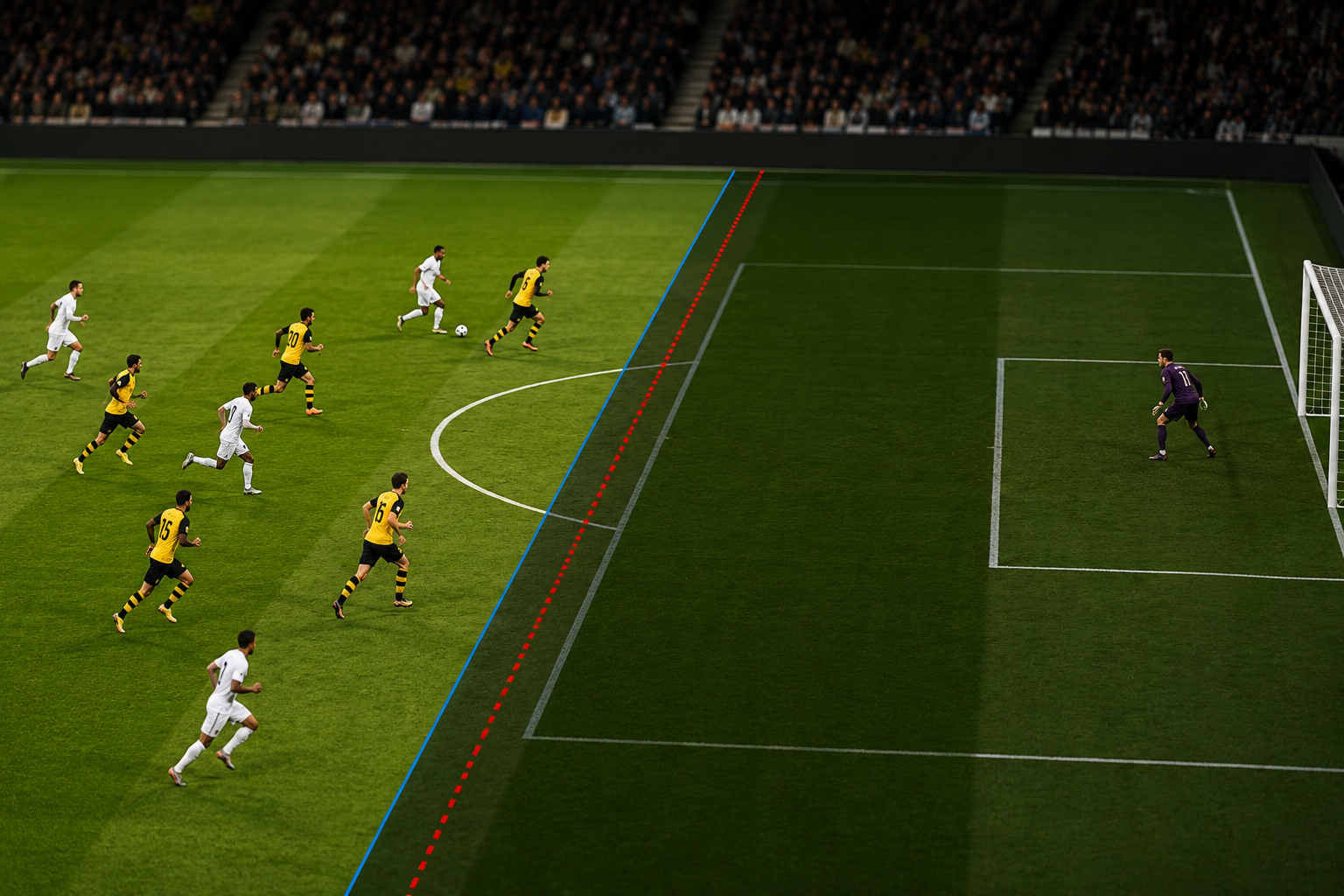

For newcomers to soccer, no rule causes more confusion than offside. It can stop an exciting attack in an instant, cancel a spectacular goal, and spark heated debates among players, coaches, commentators, and fans. Yet despite its reputation, the offside rule is based on a simple principle: preventing attackers from gaining an unfair advantage by waiting close to the opponent’s goal.
Once you understand the purpose behind the rule, it becomes much easier to recognize during a match.
Why Does the Offside Rule Exist?
Imagine if an attacker simply stood next to the opposing goalkeeper for the entire game, waiting for a teammate to kick the ball forward. Defenders would have little chance of stopping them, and the game would quickly lose much of its strategy and excitement.
The offside rule prevents this type of “goal hanging.” It encourages teams to build attacks through passing, movement, and teamwork rather than relying on players waiting near the goal.
The result is a faster, more tactical, and more balanced game.
When Is a Player Offside?
A player is in an offside position if, at the exact moment a teammate plays or touches the ball, all three of the following conditions are true:
- They are in the opponent’s half of the field.
- They are nearer to the opponent’s goal line than both the ball and the second-last defender.
- They become involved in active play.
The “second-last defender” is usually the last outfield player because the goalkeeper is often the closest defender to the goal. However, the goalkeeper does not have to be one of those two defenders, which is why the law refers specifically to the second-last defender rather than the goalkeeper.
Simply standing in an offside position is not an offence by itself.
Active Play
A player is only penalized if they become actively involved after being in an offside position.
This includes:
- Receiving or playing the ball.
- Challenging an opponent for the ball.
- Blocking an opponent’s vision or movement.
- Gaining an advantage from a rebound or deflection.
If an offside player makes no attempt to participate and does not interfere with play, the game continues.
This distinction is one of the reasons the rule can appear confusing during live matches.
The Exact Moment That Matters
Perhaps the most important part of the offside law is timing.
Officials judge a player’s position at the precise instant the ball is played by their teammate—not when the receiving player controls it.
An attacker may appear several meters ahead of the defense when they receive the pass, but if they were level with the defenders when the ball was kicked, they are onside.
Likewise, a player who starts running too early can be offside even if the defenders later catch up.
What Does “Level” Mean?
One of soccer’s most important principles is that being level with the second-last defender is considered onside.
Modern technology allows officials to measure these positions with incredible precision, often down to just a few centimeters.
This is why television broadcasts sometimes show virtual lines being drawn across the field before a decision is confirmed.
Situations That Are Never Offside
There are several situations where the offside rule does not apply.
A player cannot be offside when receiving the ball directly from:
- A goal kick.
- A throw-in.
- A corner kick.
These exceptions encourage attacking play and simplify restarts.
What Happens After an Offside Offence?
If the referee or assistant referee determines that a player has committed an offside offence, play is stopped.
The opposing team is awarded an indirect free kick from the position where the offside offence occurred.
Unlike a direct free kick, a team cannot score directly from an indirect free kick without another player touching the ball first.
The Role of the Assistant Referee
The officials most responsible for spotting offside are the assistant referees, who run along each touchline carrying a flag.
Their position is carefully maintained alongside the second-last defender throughout the match, giving them the best possible view of attacking movements.
When they believe an offside offence has occurred, they raise the flag after the attacking move has developed.
At higher levels of the game, assistants are often instructed to delay raising the flag during close situations, allowing the attack to finish before play is stopped. This reduces the chance of incorrectly ending a legitimate scoring opportunity.
How VAR Has Changed Offside Decisions
The introduction of the Video Assistant Referee (VAR) has transformed how offside decisions are made in professional soccer.
When a goal is scored, VAR can review the attacking phase using multiple camera angles and digital offside lines to determine the exact positions of both attackers and defenders at the moment the ball was played.
Although this technology has improved accuracy, it has also led to controversial decisions where goals are ruled out because an attacker was offside by only a few centimeters.
These extremely close calls continue to generate debate among fans and experts alike.
Common Misunderstandings
Many people believe a player is offside simply because they are the closest player to the goal.
That is not true.
Others think the goalkeeper must always be the last defender. In reality, any two defenders count, regardless of which players they are.
Another common misconception is that a player can be offside anywhere on the field. In fact, players cannot be offside while in their own half.
Understanding these details makes watching soccer much easier.
Why the Rule Is Essential
Without the offside rule, defenders would struggle to organize their teams, attackers could wait permanently near the goal, and much of the game’s tactical depth would disappear.
The offside law rewards intelligent movement, perfectly timed runs, accurate passing, and coordinated teamwork. It forces both attackers and defenders to think several steps ahead, creating one of the sport’s most fascinating tactical battles.
Although it remains one of soccer’s most debated rules, offside is fundamental to preserving the balance, fairness, and excitement that make the game so compelling.
Subscribe for free and receive a six-part email course that walks you through the process of turning your expertise into a product, helping you move beyond selling your time for money.
Member discussion