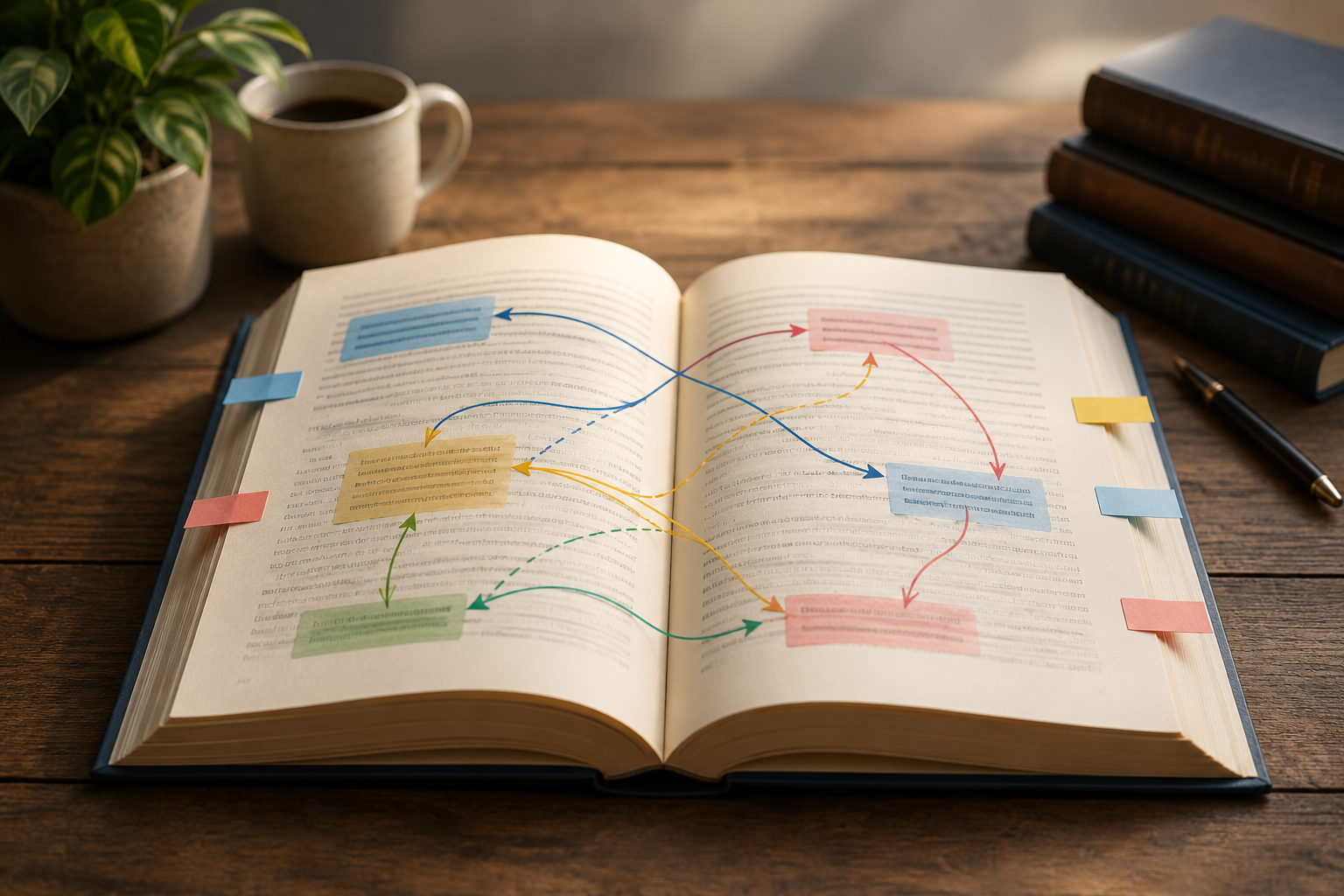

Writing a book is about more than presenting information chapter by chapter. The best books create connections between ideas, allowing readers to see how different concepts build upon one another. One of the simplest yet most powerful tools for achieving this is cross-referencing.
Cross-references guide readers to related sections elsewhere in the book, reminding them of concepts they have already learned or pointing them toward information they will need later. Done well, they make your book feel like a cohesive whole rather than a collection of independent chapters.
Cross-referencing not only improves the reader’s experience but also reinforces your message, prevents unnecessary repetition, and demonstrates that your book has been carefully planned.
What Is a Cross-Reference?
A cross-reference is simply a pointer to another relevant part of your book.
Instead of explaining the same concept repeatedly, you briefly remind readers where they can find a more detailed explanation. Likewise, if an upcoming chapter expands on an idea you’ve only introduced, you can prepare readers by pointing them forward.
For example, if you mention reader psychology in your introduction but explain it fully in Chapter 4, you might write:
“We’ll explore this concept in much greater detail in Chapter 4.”
Similarly, if Chapter 9 builds upon a framework introduced earlier, you could write:
“If you need a refresher on the Five-Step Framework, return to Chapter 2 before continuing.”
These simple references help readers navigate your book naturally.
Why Cross-Referencing Matters
Books often revisit important themes from different perspectives. Without cross-references, readers may struggle to remember earlier explanations or wonder why an idea suddenly reappears.
Cross-references create continuity. They remind readers that ideas are interconnected rather than isolated. This gives your book greater structure and makes complex topics easier to follow.
They also reduce unnecessary repetition. Instead of rewriting several pages every time a concept becomes relevant, you can briefly refer readers back to the original explanation. This keeps your writing concise while still providing access to all the necessary information.
For readers who do not read your book from beginning to end—which is particularly common with business books, self-help books, and reference works—cross-references become even more valuable. They guide readers toward related material they might otherwise overlook.
Backward References
Backward references point readers to something they have already encountered.
These are useful when later chapters build upon earlier ideas or when readers may need a quick reminder before continuing.
Examples include:
“As we discussed in Chapter 3…”
“You’ll remember from the previous chapter that…”
“Refer back to the worksheet on page 42 before completing this exercise.”
Backward references reinforce important concepts without forcing readers to reread large sections of text.
Forward References
Forward references prepare readers for material that appears later in the book.
Rather than interrupting the current discussion with too much detail, you briefly acknowledge that a fuller explanation is coming.
For example:
“We’ll examine this technique in detail in Chapter 7.”
“Don’t worry if this seems unclear right now—we’ll explore it fully later in the book.”
Forward references create anticipation while helping readers trust that their questions will eventually be answered.
Cross-Referencing Supporting Material
Cross-references do not have to point only to chapters.
If your book includes workbooks, templates, checklists, downloadable resources, appendices, or online material, referencing them at the appropriate moment significantly improves usability.
For example:
“Download the accompanying worksheet to complete this exercise.”
“See Appendix A for a complete checklist.”
“The template discussed here is available in the accompanying workbook.”
These references encourage readers to engage more deeply with your material and increase the practical value of your book.
Keep References Helpful, Not Distracting
Cross-references should support the reading experience rather than interrupt it.
Avoid referring readers elsewhere every few paragraphs. Too many references make readers feel as though they are constantly jumping around instead of making progress.
Instead, reserve cross-references for genuinely important concepts that readers may benefit from revisiting or exploring further.
A good rule of thumb is to ask yourself whether the reference genuinely helps the reader understand the current topic. If it does, include it. If it merely repeats information for the sake of completeness, it is probably unnecessary.
Wait Until Your Book Is Finished
One common mistake is trying to insert page numbers while still writing.
During the editing process, chapters grow, shrink, and move around. Page numbers change constantly, making early cross-references obsolete almost immediately.
Instead, use placeholders while drafting, such as:
“See Chapter X.”
“Refer to the section on Reader Psychology.”
“See the framework introduced earlier.”
Only after the final layout has been completed should you replace placeholders with actual chapter numbers or page numbers.
Think Like a Reader
Perhaps the best way to decide where cross-references belong is to imagine yourself reading the book for the first time.
Where might someone naturally have a question? Which earlier concept would help them understand this chapter? Which later section expands on an idea you’ve only introduced briefly?
Every cross-reference should answer one of those questions.
Rather than thinking of them as technical notes, think of them as signposts along a journey. Just as road signs reassure travellers that they are heading in the right direction, cross-references reassure readers that your ideas are connected and that guidance is always close at hand.
Final Thoughts
Cross-referencing may seem like a small detail, but it has a surprisingly large impact on the quality of a book. It strengthens the overall structure, reduces repetition, improves navigation, and helps readers connect ideas across chapters.
Most importantly, effective cross-references show that your book has been designed with the reader in mind. They create a smoother reading experience, encourage deeper understanding, and make your work feel polished and professional. When used thoughtfully and sparingly, cross-references become one of the simplest ways to elevate your writing from a collection of chapters into a cohesive and well-crafted book.
Subscribe for free and receive a six-part email course that walks you through the process of turning your expertise into a product, helping you move beyond selling your time for money.
Member discussion