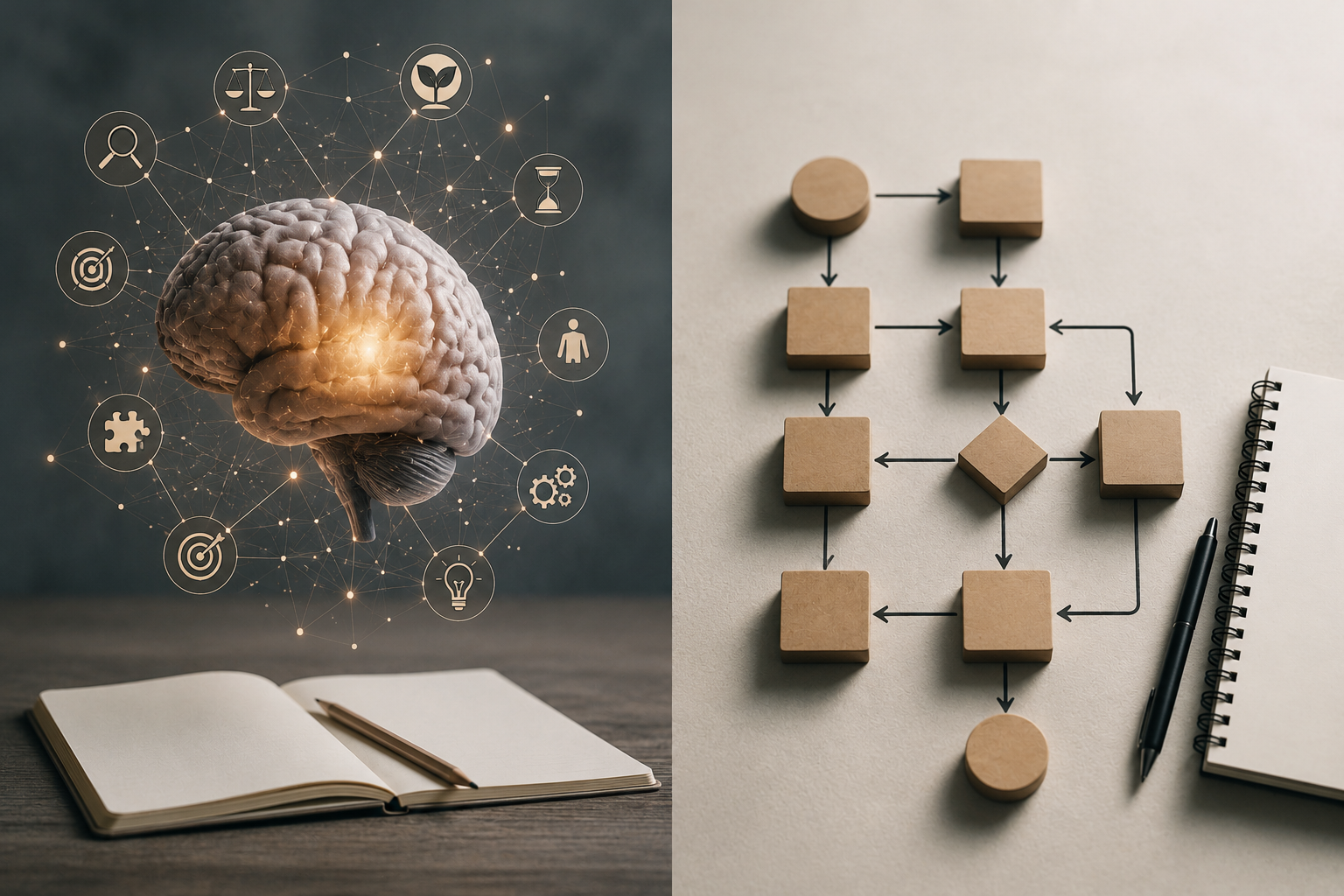

The world is full of concepts designed to help us think more clearly, solve problems more effectively, and make better decisions. Two of the most popular are mental models and frameworks. These terms are often used interchangeably, but they are not the same thing. While both improve the quality of our thinking, they serve different purposes and operate at different levels.
Understanding the distinction is more than a matter of terminology. Once you know when to use a mental model and when to use a framework, you’ll approach problems with greater clarity, avoid common thinking traps, and develop more effective solutions. Rather than competing with one another, mental models and frameworks complement each other, creating a powerful toolkit for both personal and professional growth.
What Is a Mental Model?
A mental model is a way of understanding how something works. It is a simplified representation of reality that helps you interpret situations, predict outcomes, and make sense of complexity. Mental models act like cognitive lenses, shaping how you perceive the world around you.
Because reality is incredibly complex, our brains rely on mental models to simplify information. Instead of analyzing every situation from scratch, we apply patterns we’ve learned through experience, observation, and study. Some mental models come naturally, while others are developed intentionally through education and practice.
One of the most well-known examples is First Principles Thinking, which encourages breaking a problem down into its most fundamental truths before building a solution from the ground up. Another is the Circle of Competence, which reminds us to recognize the limits of our expertise before making important decisions. Other examples include Opportunity Cost, Second-Order Thinking, Inversion, and the Pareto Principle. Each offers a different perspective for examining the same situation.
Notice that none of these models tell you exactly what to do. Instead, they change the way you think about a problem.
What Is a Framework?
A framework is a structured process or system for solving a specific type of problem. Unlike a mental model, which influences your thinking, a framework guides your actions. It provides a sequence of steps, questions, or stages that help you move from problem to solution in a consistent and repeatable way.
Frameworks are particularly valuable because they reduce uncertainty. Rather than wondering what to do next, you follow an established structure that has proven useful for a particular purpose.
For example, the Design Thinking framework guides innovation through stages such as empathizing with users, defining the problem, generating ideas, building prototypes, and testing solutions. The SWOT Analysis framework helps evaluate strengths, weaknesses, opportunities, and threats. The Business Model Canvas organizes the key components of a business into a single visual framework, while the GROW Model provides coaches with a structured process for helping clients achieve their goals.
Each framework is designed to accomplish a particular task by providing an organized path forward.
The Key Difference
The simplest way to distinguish the two is this: a mental model changes how you think, while a framework changes how you work.
Mental models influence your judgment, perception, and reasoning. They help you ask better questions, recognize patterns, and avoid cognitive biases. Frameworks, on the other hand, organize your actions by giving you a practical method to follow.
Imagine you’re preparing to build a house. Your mental models help you understand principles such as stability, efficiency, and long-term durability. They influence how you evaluate different construction methods and materials. Your framework is the actual blueprint and construction plan that tells you what to do first, what comes next, and how everything fits together.
Without mental models, you may follow the blueprint without understanding why it works. Without a framework, you may understand the principles but struggle to turn them into a finished result.
How Mental Models and Frameworks Work Together
The real power comes from combining both. Mental models improve the quality of your thinking, while frameworks improve the quality of your execution.
Imagine you’re launching a new business. You might use First Principles Thinking to question industry assumptions and identify what customers truly value. You could apply Opportunity Cost to evaluate where your limited resources will have the greatest impact. The Circle of Competence helps you recognize where you have expertise and where you should seek advice.
Once you’ve developed your thinking, you can use frameworks such as Lean Startup, the Business Model Canvas, or Design Thinking to organize your ideas into actionable plans. The mental models shape the strategy, while the frameworks provide the roadmap for implementation.
This combination allows you to think creatively while acting systematically.
Why People Confuse Them
The confusion often arises because both mental models and frameworks improve decision-making. Both are frequently taught in business schools, leadership programs, and personal development books. Both can help solve problems more effectively.
However, they operate at different levels.
A mental model is flexible and can be applied across countless situations. The same mental model may help you make decisions about investing, parenting, leadership, writing, or relationships. A framework is usually designed for a more specific purpose. While some frameworks can be adapted, they generally work best within a particular context.
You might use the same mental model every day without realizing it, whereas you typically select a framework based on the task you are trying to accomplish.
Which Is More Important?
Asking whether mental models or frameworks are more important is a bit like asking whether a map is more important than the ability to read it. One without the other is far less effective.
If you rely only on frameworks, you may become excellent at following processes but struggle when situations fall outside the expected pattern. If you rely only on mental models, you may generate brilliant insights without having a reliable method for putting those ideas into practice.
The most effective thinkers develop a rich collection of mental models while also learning frameworks that allow them to execute consistently. They know when to challenge assumptions and when to follow a structured process. They understand that good thinking and good execution are partners, not competitors.
Building Your Personal Thinking Toolbox
Developing better thinking is not about collecting as many mental models or frameworks as possible. It is about understanding which tool fits the problem in front of you.
As you continue learning, you’ll discover that every new mental model expands the way you see the world, while every new framework expands your ability to create results. Together, they form a powerful thinking toolbox that helps you navigate complexity with greater confidence, solve problems more effectively, and make wiser decisions.
The next time you encounter a challenge, ask yourself two questions. First, which mental model can help me understand this situation more clearly? Second, which framework can help me turn that understanding into action? The answer to those questions will often determine not only the quality of your decisions, but also the quality of your results.
Member discussion