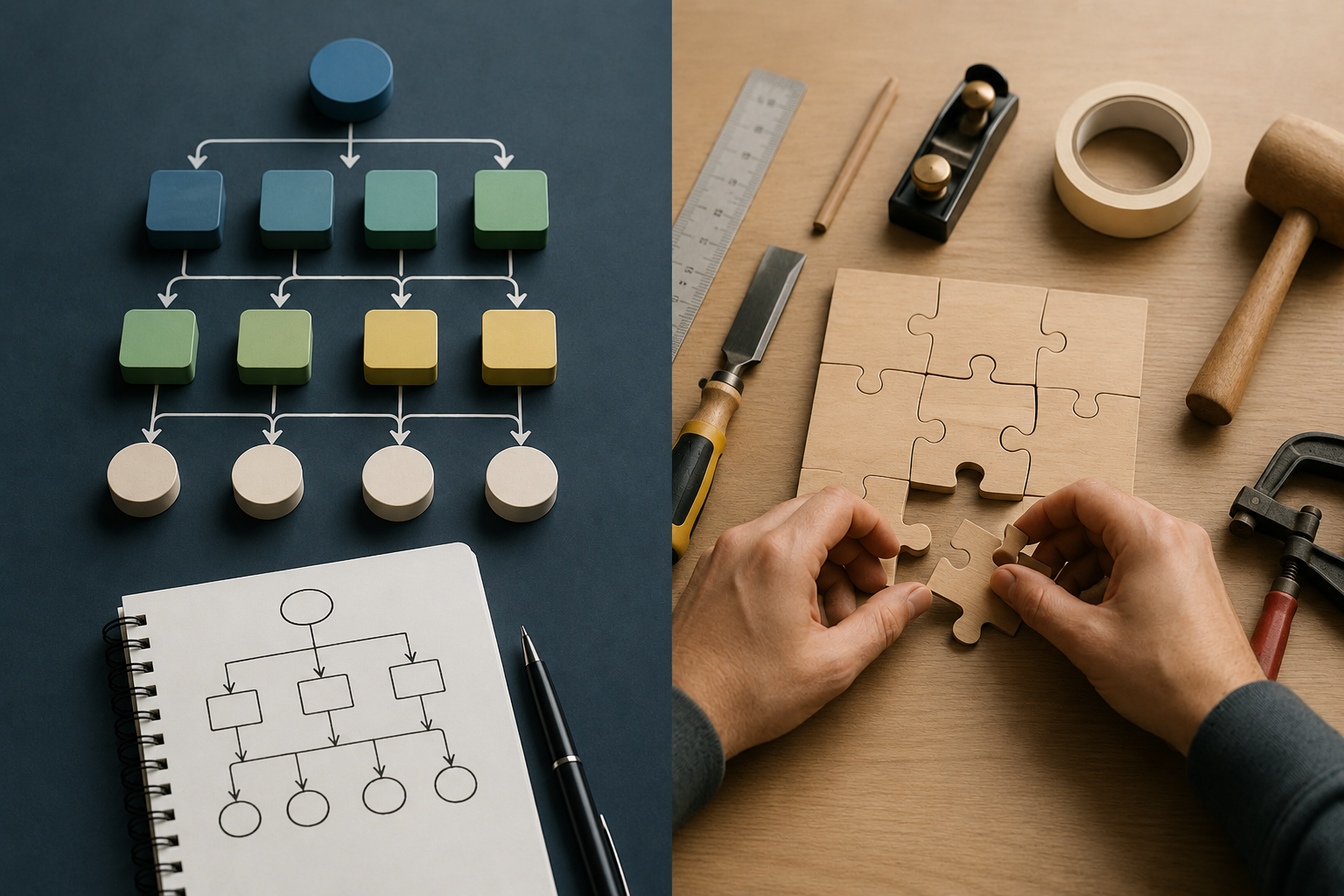

If you’ve spent any time learning about productivity, business, innovation, or personal development, you’ve probably encountered both frameworks and methods. Like many concepts in the world of thinking and problem-solving, these two terms are often used interchangeably. Yet they describe very different things.
Understanding the distinction can help you choose the right tool for the right situation. A framework gives you the structure for approaching a problem, while a method provides the specific technique for completing a task. When used together, they transform abstract ideas into practical action, allowing you to move from understanding a problem to solving it effectively.
What Is a Framework?
A framework is a structured way of organizing your thinking or guiding your work. It provides an overall structure that helps you navigate a particular type of problem without prescribing every individual action. Rather than telling you exactly how to complete a task, a framework outlines the stages, components, or questions that should be considered along the way.
Think of a framework as the architecture of a building. It defines the overall shape and shows how the different parts fit together, but it doesn’t specify every tool or technique that will be used during construction.
Many well-known business and innovation tools are frameworks. Design Thinking guides innovators through understanding users, defining problems, generating ideas, creating prototypes, and testing solutions. The Business Model Canvas helps entrepreneurs visualize the key components of a business. SWOT Analysis organizes strategic thinking by examining strengths, weaknesses, opportunities, and threats. Each framework creates structure without dictating every action.
Frameworks are valuable because they help us avoid overlooking important elements. They reduce complexity by breaking large challenges into manageable parts while still leaving room for creativity and flexibility.
What Is a Method?
A method is a specific way of performing a task or achieving an outcome. It provides clear instructions or techniques for completing one part of a process. Methods are practical, actionable, and often repeatable.
If a framework is the blueprint for a building, a method is the technique used to lay bricks, install electrical wiring, or pour concrete. It explains exactly how something should be done.
For example, the Five Whys is a method for identifying the root cause of a problem by repeatedly asking “Why?” until the underlying issue becomes clear. The Pomodoro Technique is a method for managing time through focused work intervals followed by short breaks. The Cornell Note-Taking Method provides a structured way to organize notes for improved learning and recall. Brainstorming, mind mapping, and A/B testing are all examples of methods because they describe specific techniques rather than complete systems.
Methods excel when you know exactly what needs to be accomplished and simply need an effective way to do it.
The Key Difference
The easiest way to understand the difference is this: a framework tells you what to consider, while a method tells you how to do it.
A framework organizes your approach. It helps you see the bigger picture, identify the important components, and determine the sequence of work. A method focuses on execution by providing concrete techniques that move you through one step of that framework.
Imagine you’re writing a book. Your framework might divide the project into planning, outlining, drafting, editing, and publishing. Within the outlining stage, you might use the mind mapping method to generate ideas. During editing, you might use a proofreading method to systematically identify errors. The framework manages the overall process, while the methods help you complete each individual stage.
In other words, frameworks provide direction, while methods provide action.
How Frameworks and Methods Work Together
The relationship between frameworks and methods is complementary rather than competitive. Most successful projects require both.
Consider Design Thinking as an example. The framework guides you through empathizing with users, defining the problem, generating ideas, building prototypes, and testing solutions. Within each stage, different methods become useful. During the empathy phase, you might conduct user interviews or observations. During ideation, you could use brainstorming or SCAMPER. During testing, you might perform usability testing or collect structured feedback.
The framework provides the roadmap, while the methods help you travel each section of the journey.
This relationship exists in almost every discipline. Coaches use coaching frameworks while applying questioning methods. Project managers use project management frameworks while employing scheduling methods. Writers use storytelling frameworks while relying on research, outlining, or editing methods.
Why People Confuse Them
The confusion often arises because many popular tools contain elements of both. Some frameworks include recommended methods, while some methods naturally fit within larger frameworks. As a result, the boundaries can appear blurred.
Another reason is that both improve productivity and problem-solving. When people experience success using a particular tool, they may not distinguish whether it was the structure of the framework or the effectiveness of the method that produced the results.
Understanding the distinction allows you to become more flexible. Instead of treating every tool as an isolated solution, you learn to combine frameworks and methods according to the challenge you’re facing.
Which Is More Important?
Neither is inherently more important because they solve different problems.
Without a framework, you may become highly skilled at performing individual tasks while lacking an overall direction. You might execute perfectly but work on the wrong things or overlook critical aspects of the problem.
Without methods, your framework remains little more than a plan. You know where you want to go but lack the practical techniques needed to make progress.
The strongest problem solvers combine a well-chosen framework with appropriate methods. The framework keeps them focused on the larger objective, while the methods allow them to execute each step effectively.
Building Your Personal Toolkit
As you continue learning, you’ll discover countless frameworks and methods across business, psychology, education, leadership, and personal development. Rather than trying to memorize them all, focus on understanding their purpose.
Ask yourself whether you need structure or execution. If you’re unsure where to begin or want to organize a complex challenge, a framework is likely the better choice. If you already know what needs to be done but need an effective way to accomplish it, a method will usually serve you better.
The most effective thinkers don’t rely on a single tool. They develop a collection of frameworks that help them organize complexity and a library of methods that help them take action. Together, they create a practical system for thinking clearly, solving problems confidently, and turning ideas into meaningful results.
Member discussion