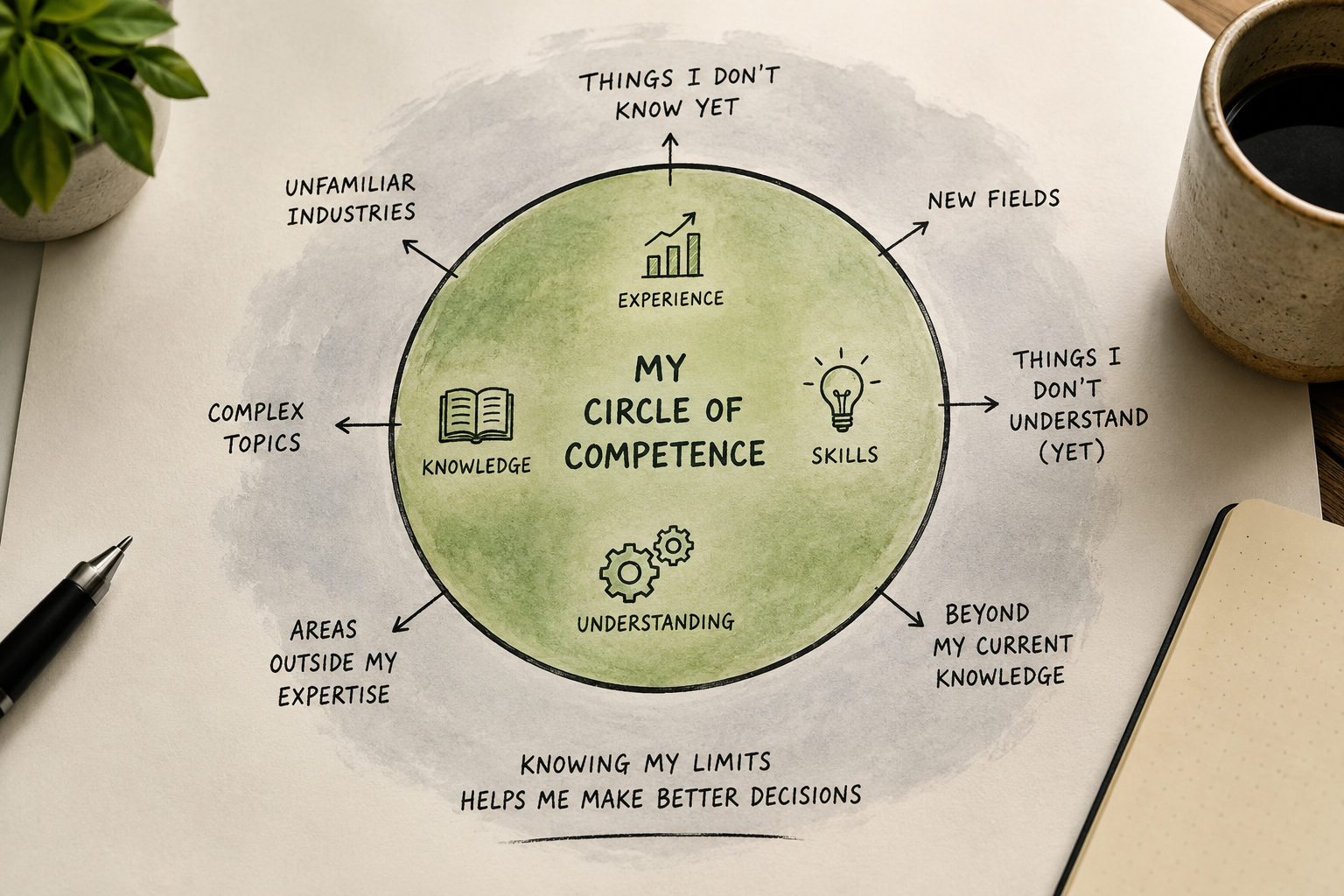

We often admire people who seem to have an opinion about everything. They confidently discuss politics, investing, business, technology, health, psychology, and countless other topics as though they were experts in them all. In today’s world of social media and instant information, confidence is frequently mistaken for competence. Yet some of the world’s most successful thinkers have embraced a very different philosophy. Instead of trying to know everything, they focus intensely on understanding the boundaries of what they truly know. This idea is known as the Circle of Competence, and it is one of the most powerful mental models for making better decisions.
Popularized by legendary investors Warren Buffett and Charlie Munger, the Circle of Competence is based on a remarkably simple principle: you do not need to understand everything to succeed. You only need to understand where your knowledge is reliable, where it begins to fade, and to have the humility to recognize the difference.
What Is the Circle of Competence?
Imagine drawing a circle on a blank sheet of paper. Inside that circle lies everything you genuinely understand. These are the subjects, industries, skills, and experiences where your knowledge has been built through years of learning, observation, and practice. Within this circle, you can make informed decisions because you understand not only the facts but also the nuances, risks, and patterns that others might overlook.
Outside the circle lies everything else. This is not necessarily knowledge you will never acquire, but knowledge you do not yet possess deeply enough to rely on. The size of your circle is far less important than knowing exactly where its boundaries are. Someone with a relatively small but clearly defined circle will often make far better decisions than someone who believes they understand everything but continually ventures into areas where their confidence exceeds their competence.
One of the greatest dangers in decision-making is not ignorance itself. Ignorance can be corrected through learning. The real danger is believing you understand something when you actually do not. This false confidence leads people to take unnecessary risks, overlook critical details, and make decisions based on incomplete understanding.
Why We Overestimate Our Knowledge
Human beings naturally like certainty. Admitting that we do not know something can feel uncomfortable because it challenges our identity and our desire to appear knowledgeable. As a result, we often convince ourselves that reading a few articles, watching a handful of videos, or listening to several podcasts has made us competent in a subject that actually requires years of experience.
This tendency is reinforced by the modern information age. Never before has so much knowledge been available with so little effort. While access to information is a tremendous advantage, information alone is not expertise. Knowing facts is very different from understanding how those facts interact in complex, real-world situations.
The Circle of Competence reminds us that there is a profound difference between familiarity and mastery. Simply recognizing terminology or understanding basic concepts does not mean we are equipped to make high-quality decisions within that field.
The Power of Staying Inside Your Circle
At first glance, limiting yourself to your Circle of Competence might seem restrictive. In reality, it is incredibly liberating. Instead of constantly trying to become an expert in everything, you focus your energy where it creates the greatest value. Decisions become clearer because they are based on genuine understanding rather than guesswork.
Consider an entrepreneur who has spent years mastering digital marketing. They understand customer behavior, branding, advertising, and online sales because they have repeatedly applied these skills in real businesses. When making marketing decisions, they can rely on their experience rather than assumptions. However, if that same entrepreneur suddenly begins investing heavily in biotechnology companies without understanding the science, regulation, or industry dynamics, they have stepped far outside their Circle of Competence. The probability of making poor decisions increases dramatically, regardless of how intelligent they may be.
Recognizing these boundaries is not a sign of weakness. It is a sign of wisdom.
Expanding Your Circle
The Circle of Competence is not meant to remain fixed throughout your life. One of its greatest strengths is that it can continuously expand. Every book you study carefully, every project you complete, every skill you practice, and every lesson you learn gradually enlarges the circle.
The important distinction is that expansion happens intentionally. Rather than assuming competence after minimal exposure, you earn it through sustained learning and experience. As your understanding deepens, areas that once lay outside your circle gradually move inside it.
This process requires patience because genuine expertise cannot be rushed. There are no shortcuts to wisdom. However, every hour invested in learning compounds over time, allowing your Circle of Competence to grow in meaningful and lasting ways.
The Difference Between Curiosity and Competence
One common misunderstanding is that recognizing your Circle of Competence means limiting your curiosity. In fact, the opposite is true. Curiosity is what allows the circle to grow. You should remain endlessly curious about new subjects, ask questions, read widely, and explore unfamiliar ideas.
The key is distinguishing curiosity from competence.
You may be fascinated by neuroscience, economics, architecture, or artificial intelligence without yet being qualified to make significant decisions in those fields. Curiosity encourages exploration, while competence requires demonstrated understanding. Confusing the two often leads people to act with confidence before they have developed the necessary knowledge.
Applying the Circle of Competence to Everyday Life
Although this mental model is frequently discussed in investing, it applies equally well to nearly every aspect of life. Career decisions, business strategies, financial planning, relationships, and even personal development all benefit from understanding where your expertise begins and ends.
When faced with an important decision, ask yourself a few simple questions. Am I making this decision based on genuine understanding or on assumptions? Have I gained enough experience to recognize the hidden risks? Am I relying on evidence, or am I merely repeating what I have heard from others? If the answer is uncertain, it may be time to seek additional knowledge or consult someone whose Circle of Competence includes the area you are navigating.
This approach does not make you less capable. It makes your decisions far more reliable because they are grounded in reality rather than overconfidence.
Humility as a Competitive Advantage
Perhaps the greatest lesson of the Circle of Competence is that humility is not a limitation but a competitive advantage. The willingness to say, “I don’t know,” creates space for learning. It protects us from costly mistakes and encourages us to seek better information before acting.
Ironically, those who openly acknowledge the limits of their knowledge often become the most knowledgeable people in the room. Because they recognize what they do not yet understand, they remain lifelong learners. They continue asking questions, refining their thinking, and expanding their competence year after year.
A Mental Model for Lifelong Learning
The Circle of Competence is ultimately about self-awareness. It teaches us that success is not achieved by pretending to know everything but by knowing exactly where our knowledge is dependable and where it still needs to grow. It encourages intellectual honesty, disciplined learning, and thoughtful decision-making in a world that often rewards confidence over competence.
As your Circle of Competence expands throughout your life, you will naturally become more capable, more confident, and more effective. Yet the true measure of wisdom will never be how much you know. It will be how clearly you recognize the boundary between what you know, what you are still learning, and what you have yet to discover.
Member discussion