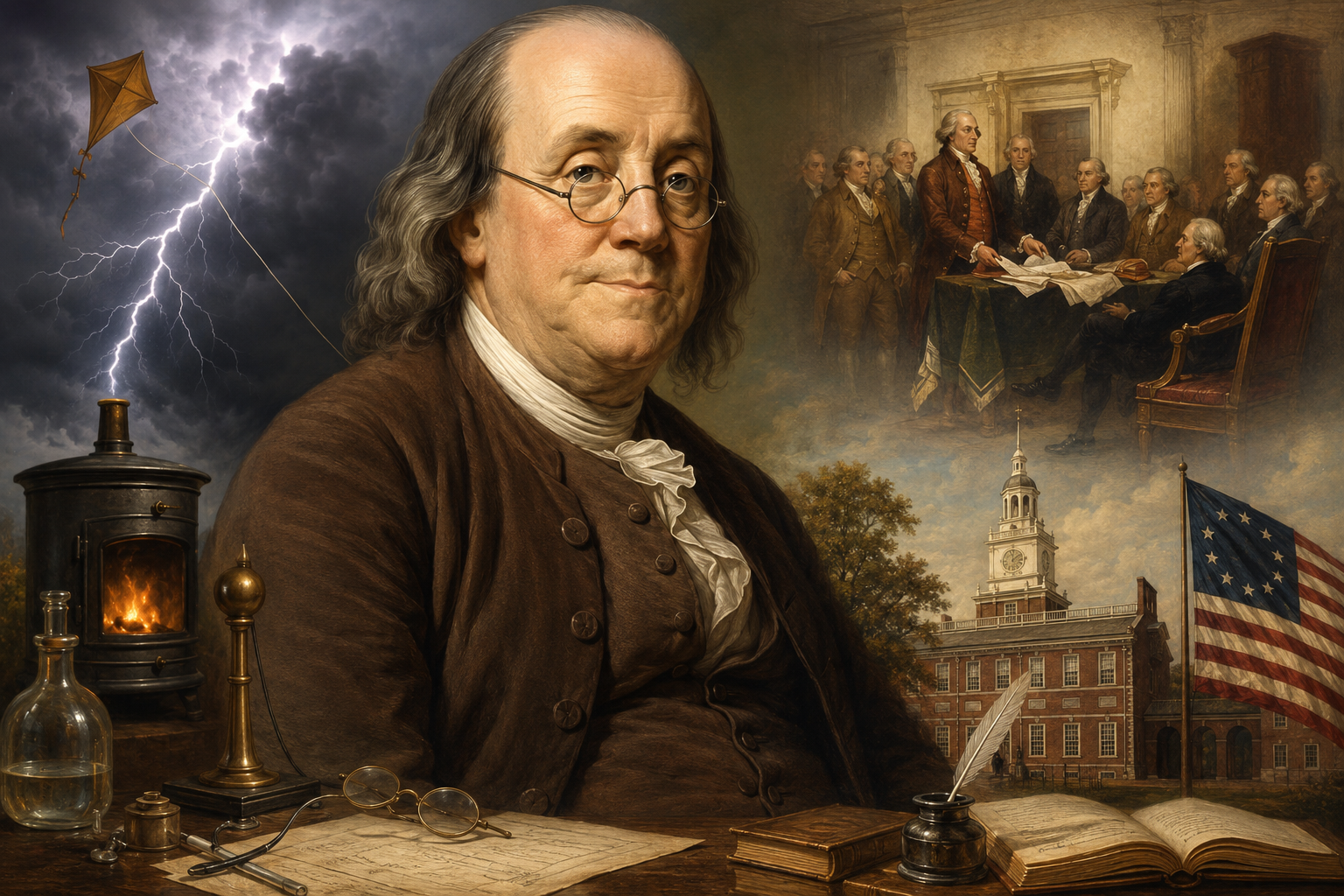

Benjamin Franklin remains one of the most influential figures in American history. Renowned for his extraordinary versatility, Franklin excelled as a writer, inventor, scientist, diplomat, publisher, entrepreneur, and political leader. His contributions helped shape the United States during its formative years while his scientific discoveries and practical inventions continue to influence modern society.
Early Life
Benjamin Franklin was born on January 17, 1706, in Boston, Massachusetts, then part of the British colonies in North America. He was the fifteenth of seventeen children born to Josiah Franklin, a candle and soap maker, and Abiah Folger Franklin.
Although Franklin received only two years of formal education, he possessed an insatiable curiosity and became largely self-educated. He developed a lifelong passion for reading and learning, spending countless hours studying literature, philosophy, science, and history.
At the age of twelve, Franklin became an apprentice to his older brother James, a printer. This experience introduced him to the world of publishing and writing, skills that would define much of his early career.
Career as a Printer and Writer
After moving to Philadelphia, Franklin established himself as one of the city’s leading printers. He published newspapers, pamphlets, and books while building a successful printing business.
In 1732, he began publishing Poor Richard’s Almanack under the pseudonym Richard Saunders. The annual publication quickly became famous for its practical advice, weather forecasts, humorous observations, and memorable sayings. Many of Franklin’s proverbs, such as “Early to bed and early to rise, makes a man healthy, wealthy, and wise,” remain well known today.
Franklin also founded one of America’s earliest public libraries and promoted literacy and education throughout the colonies.
Scientific Achievements
Franklin’s scientific work earned him international recognition. Fascinated by electricity, he conducted numerous experiments that transformed scientific understanding of the subject.
His most famous experiment, traditionally associated with flying a kite during a thunderstorm, demonstrated that lightning is a form of electricity. While historians debate the exact details of the event, Franklin’s electrical research led to groundbreaking discoveries and established important scientific terminology still used today.
Among his contributions were concepts such as positive and negative electrical charge, as well as the conservation of electrical charge.
Inventions
Unlike many inventors, Franklin refused to patent his creations because he believed knowledge should benefit everyone.
His most notable inventions include:
- The lightning rod, which protects buildings from lightning strikes.
- Bifocal glasses, allowing users to see both near and distant objects without changing spectacles.
- The Franklin stove, designed to heat homes more efficiently while using less fuel.
- The glass armonica, a musical instrument admired by many composers of the eighteenth century.
- Flexible urinary catheters, developed to improve comfort for medical patients.
These innovations reflected Franklin’s practical approach to solving everyday problems.
Public Service and Politics
Franklin devoted much of his life to public service. He served in numerous civic roles in Pennsylvania and helped establish organizations that improved public safety, education, and healthcare.
His achievements included helping to found:
- Philadelphia’s first public library.
- The city’s first volunteer fire department.
- One of the first public hospitals in the American colonies.
- Educational institutions that later became the University of Pennsylvania.
Franklin believed that communities prospered when citizens worked together for the common good.
Role in the American Revolution
During the growing conflict between the American colonies and Great Britain, Franklin emerged as one of the leading advocates for independence.
He served on the committee responsible for drafting the Declaration of Independence in 1776 alongside Thomas Jefferson, John Adams, Roger Sherman, and Robert Livingston. Franklin’s experience and diplomacy proved invaluable throughout the revolutionary period.
Diplomatic Success
One of Franklin’s greatest accomplishments came during his service as the American ambassador to France.
His charm, intelligence, and diplomatic skill helped secure French financial and military support during the American Revolutionary War. France’s assistance proved decisive in the colonies’ victory over Britain.
Franklin also helped negotiate the Treaty of Paris in 1783, officially ending the Revolutionary War and recognizing the independence of the United States.
The United States Constitution
Even in his eighties, Franklin remained active in public affairs. He attended the Constitutional Convention in Philadelphia in 1787, where delegates drafted the United States Constitution.
Although he occasionally disagreed with aspects of the document, Franklin urged delegates to support it, recognizing that compromise was essential to creating a stable government.
His wisdom and ability to unite differing viewpoints earned him widespread respect.
Personal Beliefs
Franklin valued education, reason, tolerance, hard work, and civic responsibility. He advocated religious freedom and encouraged scientific inquiry throughout his life.
He also became increasingly opposed to slavery in his later years, eventually serving as president of an abolitionist society that called for the gradual end of slavery in America.
Legacy
Benjamin Franklin died on April 17, 1790, at the age of 84. Approximately 20,000 people attended his funeral, making it one of the largest public gatherings in early American history.
Today, Franklin’s legacy can be seen throughout American society. His portrait appears on the U.S. $100 bill, numerous schools, institutions, streets, and cities bear his name, and his scientific and political achievements continue to be celebrated worldwide.
More than two centuries after his death, Benjamin Franklin remains a symbol of curiosity, innovation, public service, and lifelong learning. His remarkable ability to excel across multiple disciplines demonstrates the power of education, perseverance, and a commitment to improving society. Few individuals have left such a lasting impact on science, politics, and everyday life, making Franklin one of history’s most extraordinary figures.
Subscribe for free and receive a six-part email course that walks you through the process of turning your expertise into a product, helping you move beyond selling your time for money.
Member discussion