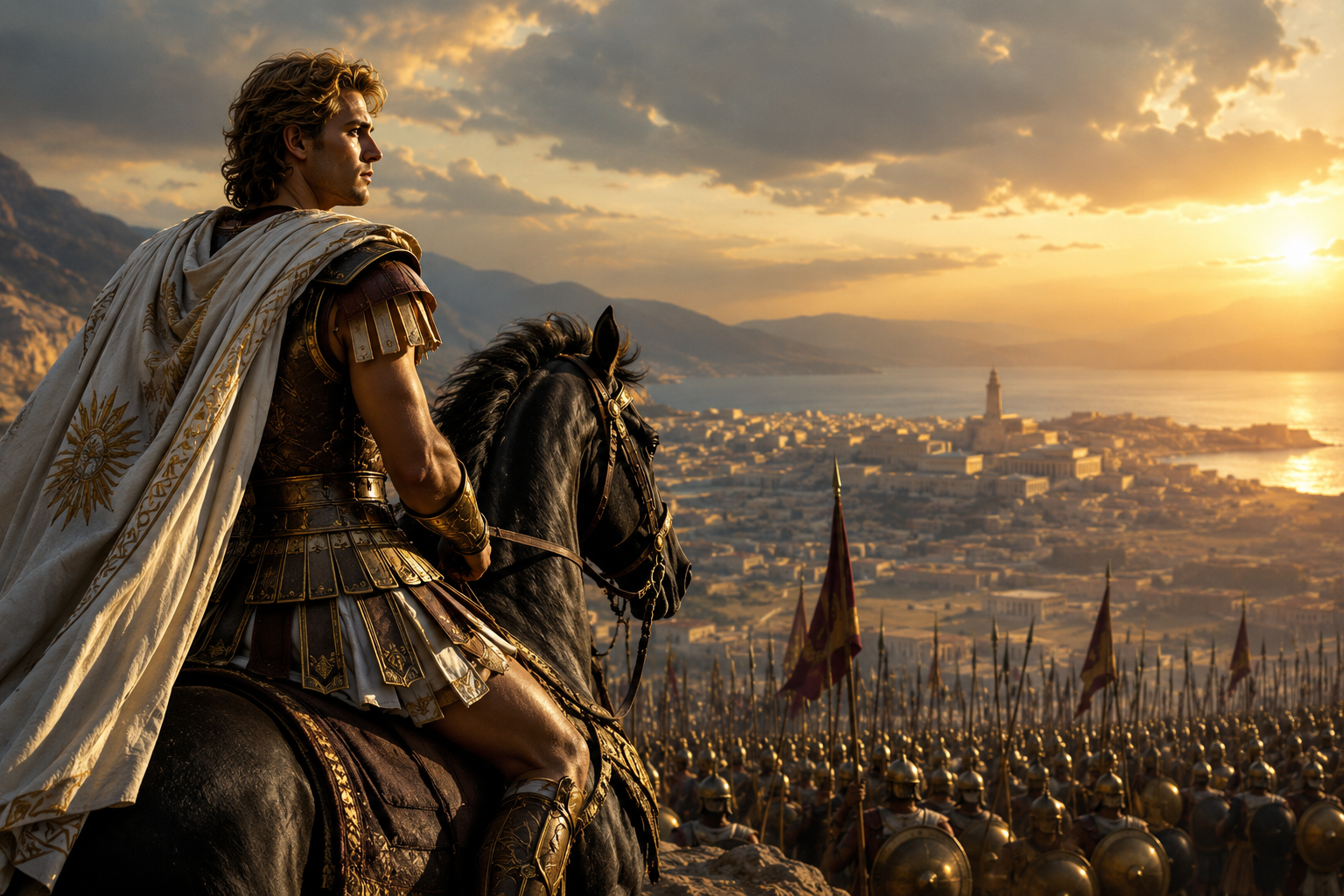

Few individuals have left a mark on history as profound as Alexander the Great. More than 2,300 years after his death, his name is still synonymous with greatness, ambition, and extraordinary achievement.
But what exactly made him “the Great”?
The answer isn’t simply that he won battles. Many rulers have conquered lands. Alexander did something far rarer—he transformed the ancient world in ways that shaped politics, culture, science, language, and civilization for centuries to come.
A Conqueror Unlike Any Before Him
Alexander became king of the ancient kingdom of Macedon at just twenty years old after the assassination of his father, Philip II of Macedon.
Most young rulers would have spent years securing their kingdom. Alexander immediately set out to conquer the greatest empire on Earth: the Achaemenid Empire.
Within little more than a decade, he defeated armies that vastly outnumbered his own. His campaigns carried him across modern-day Greece, Turkey, Egypt, Syria, Iraq, Iran, Afghanistan, Pakistan, and into northwestern India.
His empire stretched over 5,000 kilometers (3,000 miles), making it one of the largest empires the world had ever seen. Remarkably, he achieved all of this before turning thirty-three.
Military Genius
Alexander is still studied in military academies today. He possessed an extraordinary ability to adapt his tactics to changing circumstances. Instead of relying on overwhelming numbers, he emphasized speed, coordination, intelligence gathering, and decisive leadership.
Unlike many kings, Alexander fought alongside his soldiers on the front lines. He repeatedly risked his own life, inspiring fierce loyalty among his army.
He also mastered logistics—keeping tens of thousands of soldiers supplied while marching across deserts, mountains, and unfamiliar territories.
His victories at battles such as Battle of Issus and Battle of Gaugamela remain classic examples of defeating larger forces through superior strategy.
He Didn’t Just Conquer—He Connected Worlds
Alexander’s greatest legacy may not be the empire he built, but the cultures he brought together.
Instead of simply ruling conquered peoples through fear, he often adopted local customs, respected regional traditions, and encouraged cooperation between different civilizations. He founded more than twenty cities, many named Alexandria.
The most famous, Alexandria, became one of the greatest centers of learning in human history. Its famous library attracted scholars from across the known world, preserving and expanding knowledge in mathematics, astronomy, philosophy, medicine, and literature.
By connecting Greece with Egypt, Persia, and parts of Asia, Alexander helped create what historians call the Hellenistic Age—a period when ideas, technologies, art, and scientific knowledge spread more freely than ever before.
The Spread of Greek Culture
Alexander’s conquests spread the Greek language throughout much of the ancient world. This common language allowed merchants, philosophers, scientists, and scholars from different regions to communicate more easily. Greek philosophy, architecture, mathematics, literature, and political thought influenced civilizations far beyond Greece itself.
Centuries later, many important scientific discoveries and philosophical works were still being written in Greek because of the world Alexander helped create.
Vision Beyond Warfare
Alexander seemed driven by something greater than wealth alone. He dreamed of creating a unified world where East and West were no longer enemies but partners.
He encouraged marriages between Greeks and Persians—including marrying Persian princesses himself—and appointed local leaders to positions of authority.
Although not all of these policies were popular among his own soldiers, they reflected an unusually broad vision for his time.
His Greatest Weakness
Alexander’s extraordinary ambition also carried a cost. He constantly pushed farther into unknown lands, despite growing exhaustion among his troops. Eventually, after years of campaigning, his army refused to march deeper into India. Alexander reluctantly turned back.
Only a few years later, at the age of thirty-two, he died unexpectedly in Babylon. The exact cause remains uncertain, with historians proposing illness, infection, or other natural causes.
Without a clear successor, his empire quickly fractured among his generals. Ironically, the empire itself proved temporary. Its influence did not.
Why History Still Calls Him “The Great”
Alexander’s greatness was never measured solely by the territory he conquered. Many conquerors built empires that disappeared. Alexander reshaped civilization.
He accelerated the exchange of cultures, ideas, technologies, and knowledge across three continents. His campaigns helped lay the foundations for centuries of scientific advancement, international trade, and cultural exchange.
His military innovations influenced commanders for over two thousand years. His vision helped create one of history’s most intellectually vibrant eras. His name became a symbol of ambition, leadership, and the belief that one person could alter the course of history.
Whether admired as a visionary leader or criticized as an ambitious conqueror, Alexander’s impact is undeniable. Few people have changed the world as dramatically in so short a life. That is why history remembers him—not simply as Alexander, but as Alexander the Great.
Member discussion