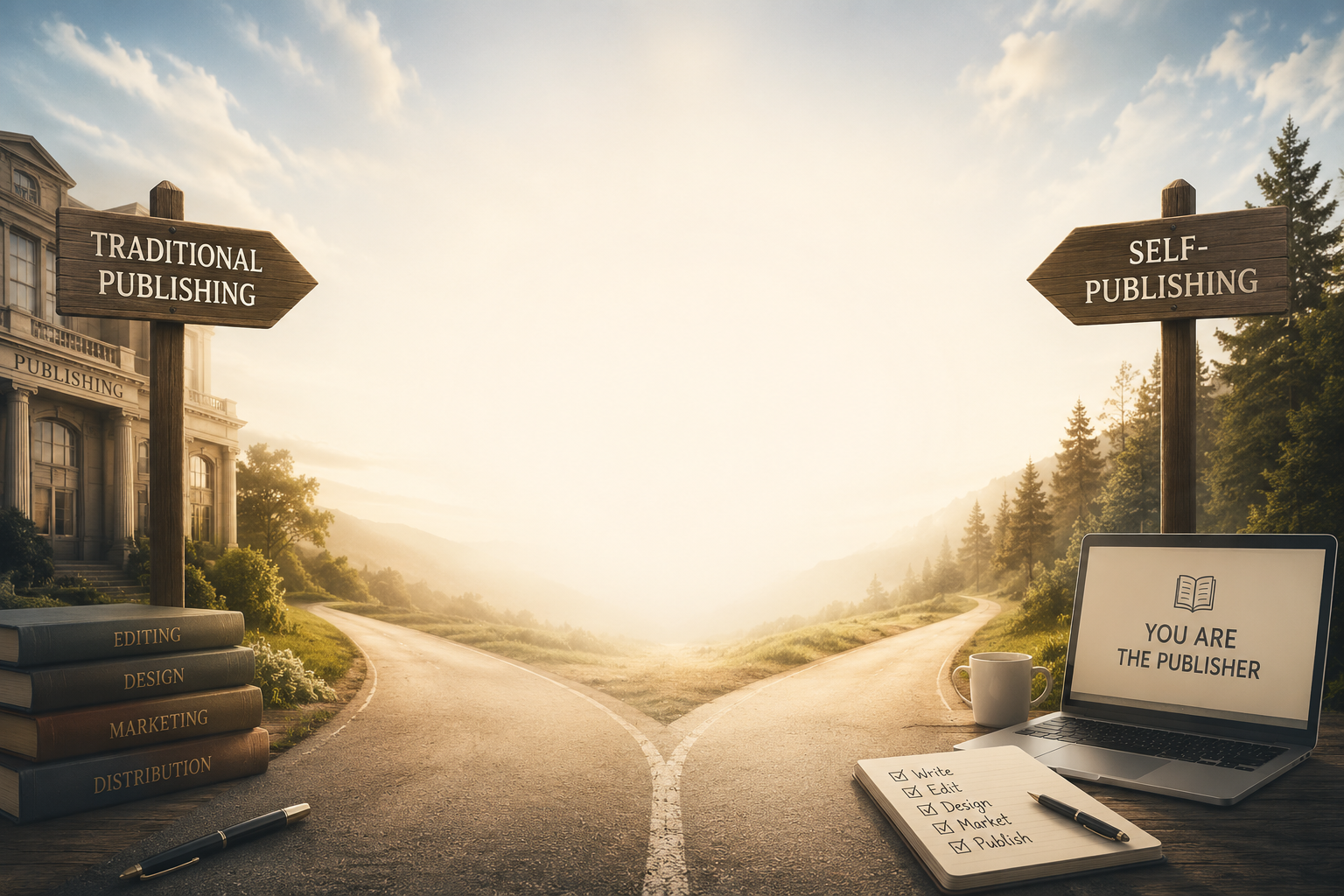

For many aspiring authors, finishing a manuscript feels like reaching the summit of a mountain. Months or even years of planning, writing, editing, and rewriting finally culminate in a completed book. Yet, as exhilarating as that achievement is, another equally important question quickly follows: how should the book be published?
Today’s publishing landscape offers more opportunities than ever before. Gone are the days when securing a contract with a traditional publishing house was the only viable route to seeing a book on bookstore shelves. Advances in digital technology, print-on-demand services, and online retailers have empowered writers to publish independently, giving rise to an entirely new generation of successful self-published authors.
Neither route is inherently superior. Instead, each offers a distinct set of advantages, challenges, and expectations. The best choice depends on an author’s goals, budget, creative preferences, business mindset, and long-term ambitions. Understanding the realities of both traditional publishing and self-publishing can help writers make an informed decision that aligns with their vision for their work.
Understanding Traditional Publishing
Traditional publishing follows a model that has shaped the literary world for centuries. In this system, an author submits a manuscript—often through a literary agent—to a publishing house. If the publisher believes the book has commercial potential, they offer the author a publishing contract.
Once the agreement is signed, the publisher assumes responsibility for producing and distributing the book. Professional editors refine the manuscript, designers create the cover and interior layout, marketers develop promotional campaigns, and sales teams work to place the title in bookstores, libraries, and online retailers.
From the author’s perspective, traditional publishing often represents validation. Having industry professionals invest in a manuscript can be incredibly rewarding, as it signals confidence in both the book and the writer’s future potential.
However, this path is also highly competitive. Large publishers receive thousands of submissions every year while accepting only a small percentage. Many excellent books are rejected, not because of poor quality, but because they may not fit current market trends or the publisher’s commercial strategy.
The Advantages of Traditional Publishing
One of the greatest strengths of traditional publishing is the professional support that accompanies every stage of production. Authors benefit from experienced editors who improve structure, pacing, grammar, and readability. Designers ensure that covers meet industry standards, while production teams handle formatting and printing with precision.
Financial investment is another significant advantage. Traditional publishers typically cover all production costs, including editing, cover design, typesetting, printing, and distribution. In many cases, authors also receive an advance against future royalties, providing income before the book reaches readers.
Distribution is another area where traditional publishers excel. Established publishing houses have longstanding relationships with booksellers, wholesalers, libraries, educational institutions, and international distributors. This network greatly increases the likelihood that a book will appear in physical bookstores and public libraries, something that can be considerably more difficult for independently published authors to achieve.
Credibility also plays an important role. Books published through respected publishing houses often receive greater attention from reviewers, literary awards, newspapers, and major media outlets. While exceptional self-published books certainly receive recognition, traditional publishers still carry considerable influence within the literary industry.
Perhaps equally important is the opportunity for career development. A successful traditionally published book can lead to future contracts, foreign translation rights, audiobook deals, film adaptations, and expanded professional networks that might otherwise take years to establish independently.
The Drawbacks of Traditional Publishing
Despite its prestige, traditional publishing comes with notable disadvantages that prospective authors should carefully consider.
The submission process itself is often lengthy and uncertain. Writers may spend months—or even years—querying literary agents, waiting for responses, revising manuscripts, and navigating multiple rounds of submissions before receiving an offer. Many authors receive dozens or even hundreds of rejections before securing representation.
Creative control is also significantly reduced. Publishers generally have the final say on book covers, titles, release dates, pricing, formatting, and marketing strategy. While many publishers work collaboratively with authors, business considerations frequently outweigh personal preferences.
Royalty rates are another point of consideration. Because the publisher assumes financial risk and manages production, authors receive only a percentage of each sale. Although the exact figures vary by contract and format, royalties are generally much lower than those earned through self-publishing.
Publishing timelines can also test an author’s patience. Even after signing a contract, it is common for eighteen months or more to pass before the book officially launches. Editing, production schedules, seasonal catalogues, and marketing plans all contribute to these extended timelines.
Finally, the rights granted within publishing contracts deserve careful scrutiny. Depending on the agreement, publishers may retain rights to various editions, international territories, translations, or adaptations for many years. Authors should always understand exactly which rights they are licensing and under what conditions.
Understanding Self-Publishing
Self-publishing places the author firmly in the driver’s seat. Instead of seeking approval from publishers, writers independently oversee every aspect of bringing a book to market.
Modern publishing platforms have made this process remarkably accessible. Authors can upload professionally formatted manuscripts, commission custom covers, publish ebooks and paperbacks, and make their work available to readers worldwide with relatively little technical knowledge.
However, accessibility should not be mistaken for simplicity. Self-publishing transforms the author into both writer and publisher, requiring decisions that extend far beyond the manuscript itself.
The Advantages of Self-Publishing
Perhaps the greatest appeal of self-publishing is complete creative freedom.
Authors retain control over every decision, including the manuscript, title, cover design, formatting, pricing, publication date, marketing strategy, and future revisions. If changes become necessary after publication, updated editions can often be released within days rather than months.
Higher royalty rates represent another compelling advantage. Because there is no traditional publisher taking a substantial share of sales, authors generally receive a much larger percentage of each book sold. For writers with an engaged readership, this can result in significantly higher long-term earnings.
Publishing speed is another major benefit. Once editing and production are complete, a book can be available for purchase within hours or days rather than years. This flexibility is particularly valuable for authors writing topical nonfiction, educational resources, or books tied to current events.
Ownership of intellectual property is equally important. Self-published authors typically retain all rights to their work, allowing them to negotiate audiobook deals, foreign translations, merchandise, or film adaptations without requiring publisher approval.
Self-publishing also enables writers to serve niche audiences that traditional publishers may consider too specialised. Books covering highly focused interests, local history, technical expertise, or unique personal experiences often find enthusiastic readerships despite limited mainstream appeal.
The Challenges of Self-Publishing
With complete control comes complete responsibility.
Every aspect of production must either be handled personally or outsourced to professionals. Editing, proofreading, cover design, formatting, ISBN registration, marketing, advertising, and distribution all require time, financial investment, and careful planning.
Quality is another significant consideration. Readers increasingly expect independently published books to meet the same professional standards as traditionally published titles. Poor editing, amateur cover design, or formatting errors can quickly damage credibility and limit sales, regardless of how strong the underlying story may be.
Marketing often becomes the author’s largest ongoing commitment. While traditional publishers do not guarantee bestseller status, they generally possess industry relationships and promotional resources that most independent authors must build from scratch. Successful self-published writers frequently spend as much time learning digital marketing, social media promotion, email newsletters, and advertising platforms as they do writing.
Financial risk should not be overlooked either. Professional editing, cover design, formatting, and promotional campaigns can require a considerable upfront investment. While these costs may eventually be recovered through book sales, there is no guarantee of commercial success.
Finally, independent authors may encounter barriers in certain areas of the publishing industry. Some literary awards, major review publications, and physical bookstores continue to prioritise traditionally published books, although these distinctions have become less pronounced as self-publishing has matured.
Which Route Offers Greater Success?
Success in publishing is measured in many different ways.
For some writers, success means seeing their novel displayed in national bookstores and receiving recognition from respected literary institutions. For others, success means maintaining creative independence, building a loyal readership, and earning a sustainable income while retaining ownership of their work.
Traditional publishing can provide greater visibility and industry support, but acceptance is never guaranteed. Self-publishing offers immediate opportunity and complete autonomy, yet requires entrepreneurial skills alongside writing talent.
Interestingly, many contemporary authors no longer view these paths as mutually exclusive. Hybrid authors publish some books through traditional publishers while independently releasing others. This flexible approach allows them to enjoy the benefits of both systems depending on the goals of each individual project.
Questions Every Author Should Ask
Before deciding which publishing route to pursue, it is worth reflecting on a few important questions.
How much creative control do you want over your book? Are you comfortable investing your own money in professional production? Do you enjoy marketing and building a personal brand, or would you prefer to focus primarily on writing? Is your priority reaching bookstore shelves, or connecting directly with readers online? Are you prepared for a potentially lengthy submission process, or would you rather publish on your own schedule?
There are no universally correct answers. Every author’s circumstances, personality, and aspirations are unique.
Final Thoughts
The publishing industry has evolved dramatically over the past two decades, creating opportunities that previous generations of writers could scarcely have imagined. Traditional publishing remains a respected and highly desirable route, offering professional expertise, established distribution networks, and industry credibility. Self-publishing, meanwhile, has emerged as a powerful alternative that grants authors unprecedented control, ownership, and earning potential.
Ultimately, the decision is less about choosing the “better” option and more about choosing the option that best aligns with your goals. A writer seeking widespread bookstore distribution and the support of an experienced publishing team may find traditional publishing to be the ideal fit. Conversely, an entrepreneurial author who values creative freedom, faster publication, and direct engagement with readers may thrive in the self-publishing world.
Whichever path an author chooses, one truth remains constant: the quality of the writing itself is still the foundation of every successful book. A compelling story, a well-researched work of nonfiction, or a memorable collection of ideas will always have the greatest chance of finding readers, regardless of how it reaches the marketplace. In the end, publishing is simply the bridge between an author’s imagination and the audience waiting to discover it.
Ready to begin your self-publishing journey?
From manuscript to marketplace, I’m here to help you every step of the way.
Get in Touch
Member discussion