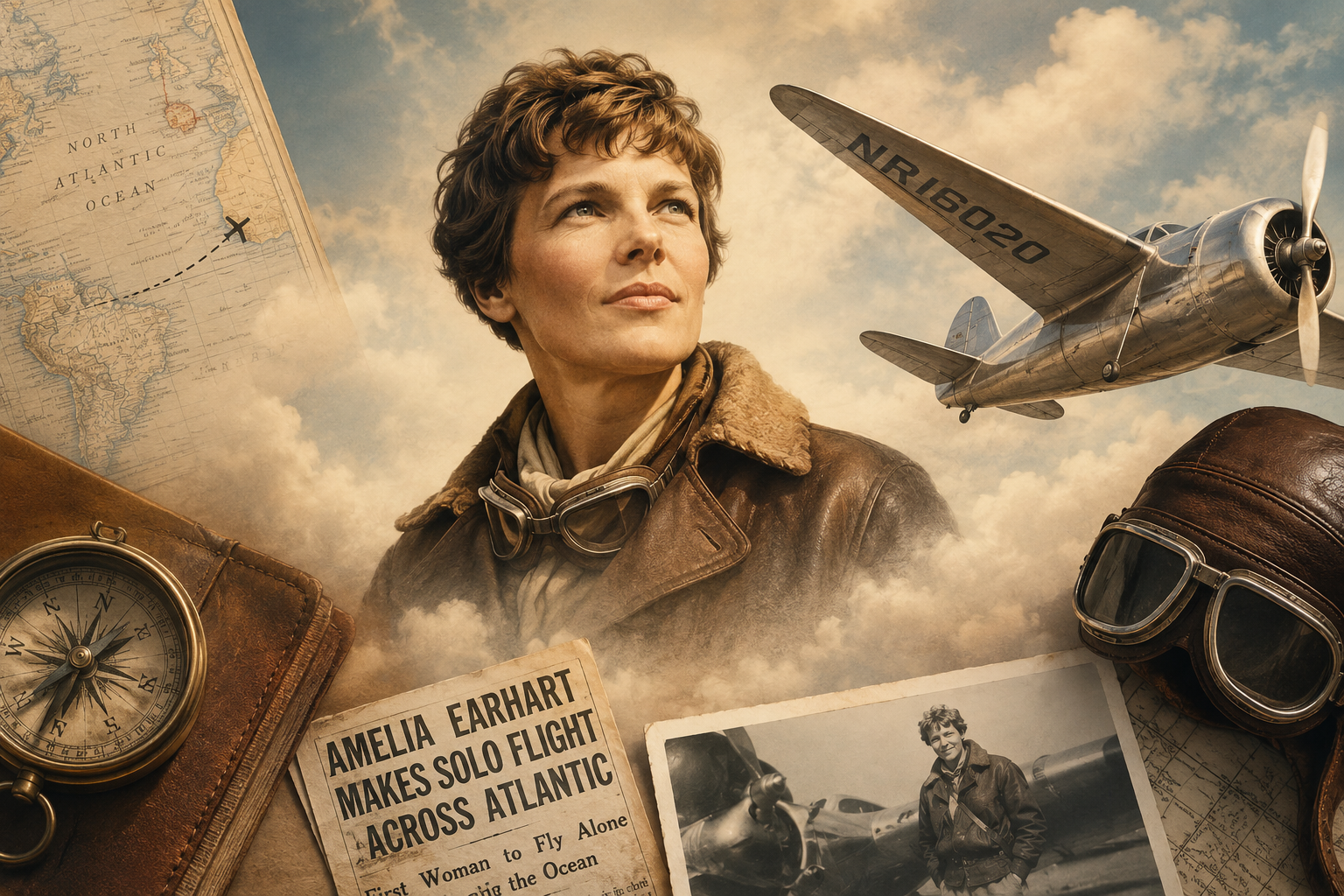

Few names in aviation history are as instantly recognizable as Amelia Earhart. More than just a skilled pilot, Earhart became a global icon whose courage, determination, and adventurous spirit transformed the way the world viewed both aviation and the role of women in society. During a period when flying was still a dangerous and relatively new technology, she willingly embraced the risks of exploration, pushing both herself and her aircraft to remarkable achievements. Her accomplishments extended beyond setting records; she challenged social expectations, encouraged women to pursue ambitious careers, and demonstrated that perseverance could overcome even the strongest barriers.
Although Amelia Earhart disappeared during her attempt to fly around the world in 1937, her story did not end with her mysterious final flight. Instead, her life became a lasting symbol of courage, curiosity, and determination. More than eight decades later, she continues to inspire pilots, engineers, explorers, scientists, and dreamers across the globe. Her legacy reminds us that true pioneers are remembered not simply for where they travelled, but for the paths they created for others to follow.
Early Life and the Formation of an Adventurous Spirit
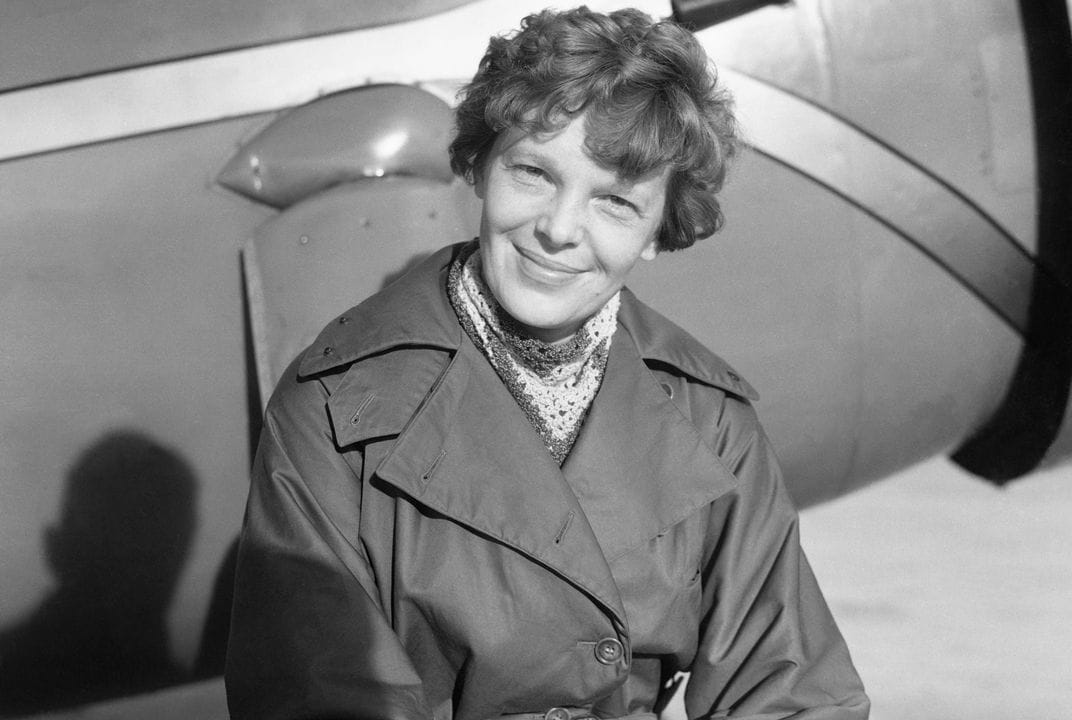
Amelia Mary Earhart was born on July 24, 1897, in Atchison, Kansas, United States. Unlike many girls of her era, she was encouraged to be curious and independent. She enjoyed climbing trees, hunting rats with a rifle, building homemade roller coasters, and exploring the outdoors. These activities reflected an adventurous personality that would later define her career as an aviator.
Her childhood was not without challenges. Her father’s struggle with alcoholism caused financial instability, forcing the family to move frequently. Despite these hardships, Earhart developed resilience and self-confidence from an early age. She learned that setbacks were temporary and that determination was often more important than comfort or security.
During the First World War, Earhart worked as a nurse’s aide at a military hospital in Canada. There she cared for wounded soldiers returning from the battlefields of Europe. Witnessing the bravery of pilots and the growing importance of military aircraft sparked her interest in aviation, although she had not yet imagined herself becoming a pilot.
Everything changed in December 1920 when she attended an air show in California. A short ten-minute flight with pilot Frank Hawks transformed her life. Earhart later recalled that as soon as the aircraft lifted from the ground, she knew she had found her passion. From that moment onward, flying became her life’s ambition.
Learning to Fly
Learning to fly during the early 1920s was expensive and uncommon, particularly for women. Amelia Earhart refused to let financial limitations stand in her way. She worked various jobs, including as a truck driver, photographer, and stenographer, saving every dollar she could to pay for flying lessons.
Her instructor, Anita “Neta” Snook, was one of the few female pilots in America and became an important mentor. Under Snook’s guidance, Earhart developed impressive flying skills and quickly demonstrated natural talent in the cockpit.
In 1921, Earhart purchased her first airplane, a bright yellow Kinner Airster that she affectionately nicknamed “The Canary.” Owning her own aircraft allowed her to gain valuable flying experience and build confidence through countless hours in the air.
Only one year later, she achieved her first significant aviation milestone by flying to an altitude of 14,000 feet, setting a women’s altitude record. While later records would surpass this achievement, it marked the beginning of her growing reputation as an exceptional pilot capable of accomplishing extraordinary feats.
Breaking Barriers in Aviation
The 1920s and 1930s were a period of rapid development in aviation. Air travel was still considered dangerous, and pilots who completed long-distance flights were viewed as heroes. However, the aviation world remained overwhelmingly dominated by men, with women often discouraged from pursuing careers as pilots.
Amelia Earhart challenged these attitudes through both her achievements and her determination to compete on equal terms. Rather than asking for special treatment, she insisted that women possessed the same intelligence, courage, and capability as men. She believed that success should be measured by ability rather than gender.
In 1928, Earhart became the first woman to cross the Atlantic Ocean by airplane as part of a three-person crew. Although she did not pilot the aircraft during that journey, the achievement brought her international recognition. Earhart appreciated the honour but admitted she wanted to earn her fame through her own flying rather than by simply being a passenger.
That opportunity arrived four years later.
The Historic Solo Flight Across the Atlantic
On May 20, 1932, Amelia Earhart departed Newfoundland, Canada, intending to fly alone across the Atlantic Ocean. No woman had ever completed such a journey solo. The only previous successful solo Atlantic crossing had been achieved by Charles Lindbergh five years earlier.
The flight proved far more dangerous than anticipated. Earhart encountered freezing temperatures, mechanical problems, strong winds, heavy clouds, and ice accumulating on the aircraft. At one point, she lost her altimeter, making it difficult to determine her altitude. Despite these challenges, she maintained remarkable composure and relied upon her training and judgment.
After nearly fifteen hours in the air, Earhart safely landed in a field near Londonderry, Northern Ireland. She had become the first woman—and only the second person ever—to fly solo across the Atlantic Ocean.
The achievement instantly made international headlines. Newspapers celebrated her courage, governments honoured her accomplishments, and she received numerous awards, including the Distinguished Flying Cross from the United States Congress. More importantly, her success demonstrated that women could accomplish the same extraordinary feats as men when given equal opportunities.
Championing Women’s Equality
Amelia Earhart never viewed her record-breaking flights as personal victories alone. She recognised that every achievement she accomplished could encourage other women to pursue careers previously considered impossible.
She became a powerful public speaker, travelling extensively to discuss aviation, education, and equal opportunity. Rather than presenting herself as extraordinary, she encouraged ordinary women to believe in their own abilities.
One of her most significant contributions was helping establish The Ninety-Nines, an international organisation for licensed female pilots founded in 1929. The organisation sought to provide networking opportunities, mentorship, professional development, and mutual support for women in aviation. Earhart later served as its first president, helping strengthen the organisation during its formative years.
The Ninety-Nines continues to operate today, supporting female pilots around the world and preserving Earhart’s vision of expanding opportunities in aviation.
Record-Breaking Flights Around the World
Following her Atlantic triumph, Earhart continued pursuing increasingly ambitious aviation challenges. She completed numerous record-setting flights across North America and became the first person to fly solo from Hawaii to California—a route many pilots considered even more dangerous than crossing the Atlantic because of the vast distance over open ocean.
She also completed solo flights between Los Angeles and Mexico City and from Mexico City to Newark, New Jersey, establishing additional speed and distance records.
These accomplishments reflected not only technical flying skill but also meticulous planning, careful navigation, and extraordinary mental resilience. Flying during the 1930s lacked many of the navigation technologies available today. Pilots relied heavily upon maps, compasses, weather forecasts, and visual landmarks. Every long-distance journey demanded careful preparation and considerable courage.
The Final Journey Around the World
In 1937, Amelia Earhart embarked upon what would become the most ambitious challenge of her career: flying around the world near the equator. Accompanied by experienced navigator Fred Noonan, she planned to travel approximately 29,000 miles, visiting numerous countries before returning to the United States.
The journey progressed successfully through South America, Africa, India, Southeast Asia, and Australia. By late June, Earhart and Noonan had completed most of the journey, leaving only the Pacific crossing before reaching home.
On July 2, 1937, they departed Lae, New Guinea, bound for tiny Howland Island in the central Pacific Ocean. Reaching the island required exceptional navigation accuracy because it was little more than a small strip of land surrounded by thousands of miles of open water.
Radio communications became increasingly difficult as the flight progressed. Earhart reported that fuel was running low and that she could not locate the island. Despite efforts by the United States Coast Guard cutter Itasca to guide the aircraft, contact was eventually lost.
Neither Amelia Earhart, Fred Noonan, nor their Lockheed Electra aircraft were ever conclusively found.
One of History’s Greatest Mysteries
The disappearance of Amelia Earhart remains one of the most enduring mysteries of the twentieth century. Numerous expeditions have searched the Pacific Ocean using increasingly sophisticated technology, yet definitive evidence of the aircraft’s final resting place has remained elusive.
Several theories have emerged over the decades. The most widely accepted explanation suggests that Earhart and Noonan exhausted their fuel while searching for Howland Island and crashed into the Pacific Ocean. Other theories propose that they landed on a remote island, while more speculative ideas have suggested capture or survival under different circumstances.
Although researchers continue investigating the mystery, no theory has been conclusively proven. The unanswered questions have contributed to Earhart’s enduring fascination in popular culture, documentaries, books, and scientific expeditions.
Lasting Influence and Legacy
Amelia Earhart’s greatest contribution extends far beyond aviation records. She fundamentally changed public perceptions of women’s capabilities during an era when gender roles were highly restrictive.
Her willingness to embrace risk, pursue excellence, and speak publicly about equality inspired countless women to enter aviation, engineering, science, medicine, and leadership positions. She demonstrated that courage and competence are not determined by gender but by preparation, determination, and resilience.
Her legacy also contributed to the advancement of aviation itself. Public enthusiasm generated by record-setting flights encouraged investment in aircraft technology, navigation systems, and commercial aviation. Earhart became one of the most influential ambassadors for flight during aviation’s formative decades.
Today, schools, airports, museums, scholarships, and research institutions bear her name. Her writings continue to be studied, and her example remains central to discussions about leadership, exploration, and perseverance.
Why Amelia Earhart Still Inspires the World
In an age where modern aircraft routinely cross oceans in a matter of hours using advanced satellite navigation, it can be easy to overlook just how extraordinary Amelia Earhart’s accomplishments truly were. She flew primitive aircraft through unpredictable weather with limited communication equipment, often relying upon little more than a compass, maps, and exceptional skill.
Yet the true source of her inspiration lies not merely in the distances she travelled but in the mindset she embodied. She believed that meaningful achievements required courage, preparation, and the willingness to embrace uncertainty. She accepted that failure was a possibility but refused to allow fear to prevent her from pursuing ambitious goals.
Her famous advice, “The most difficult thing is the decision to act; the rest is merely tenacity,” continues to resonate because it captures a timeless truth about human achievement. Every significant accomplishment begins with the courage to take the first step.
Conclusion
Amelia Earhart’s life was defined by curiosity, determination, and an unwavering commitment to pushing beyond accepted boundaries. From a young girl fascinated by adventure to one of history’s most celebrated aviators, she consistently demonstrated that perseverance and courage could overcome immense obstacles. Her pioneering flights expanded the possibilities of aviation while simultaneously opening doors for women around the world.
Although her final journey ended in mystery, her influence has never faded. She transformed aviation history, challenged outdated social norms, and became a universal symbol of exploration and resilience. Her story reminds us that true greatness is measured not only by personal achievement but also by the opportunities created for future generations. More than eighty years after her disappearance, Amelia Earhart continues to inspire millions to dream boldly, pursue knowledge fearlessly, and believe that the sky is never the limit.
Member discussion