
Soap is one of humanity’s oldest and most important inventions. It is something most of us use several times a day without giving it much thought, yet its ability to remove dirt, grease, and harmful microorganisms is the result of elegant chemistry that has been understood and refined over thousands of years.
At first glance, soap seems deceptively simple. Rub it on your hands, add water, rinse, and everything becomes clean. But if you look a little deeper, you’ll discover that soap solves one of nature’s most interesting challenges: helping water remove substances that it cannot dissolve on its own.
Understanding how soap works not only reveals an important piece of chemistry but also offers insight into why cleanliness plays such a vital role in health, hygiene, and everyday life.
A Brief History of Soap
People have been making soap for thousands of years. Ancient civilizations, including the Babylonians, Egyptians, Greeks, and Romans, all developed early forms of cleansing agents using combinations of animal fats, plant oils, and ashes. While these early soaps were often rough compared to modern products, they demonstrated an important discovery: combining fats with alkaline substances produced a material that could clean far more effectively than water alone.
Over centuries, soap making evolved from a household craft into an industrial process. Today, manufacturers use carefully controlled ingredients and production methods to create soaps that are gentler on the skin, more consistent in quality, and tailored for different purposes, from personal hygiene to household cleaning.
What Is Soap Made Of?
Although there are countless varieties of soap, the basic ingredients remain surprisingly simple.
Traditional soap begins with fats or oils. These may come from plants, such as olive oil, coconut oil, sunflower oil, or palm oil, or from animal fats. Each type of fat contributes different characteristics to the finished soap. Coconut oil, for example, creates abundant lather, while olive oil produces a gentle, moisturising bar.
The second essential ingredient is an alkali, usually sodium hydroxide for solid soap or potassium hydroxide for liquid soap. While these chemicals are highly caustic on their own, they undergo a chemical reaction that completely transforms them during soap making.
Water is also required, providing the medium in which the reaction takes place. Once the process is complete, additional ingredients such as fragrances, natural colourants, moisturisers, botanical extracts, or exfoliating particles may be added to enhance the soap’s appearance or performance.
The Process of Making Soap
The creation of soap depends on a chemical reaction known as saponification. Despite its scientific name, the concept is relatively straightforward.
Fats and oils are made up of molecules called triglycerides. When these molecules are mixed with an alkali under the right conditions, the chemical bonds holding them together begin to break apart. The reaction produces two entirely new substances: soap and glycerine.
Glycerine is a naturally occurring compound that attracts moisture, making it beneficial for keeping skin hydrated. Many handmade soaps retain this glycerine, while some commercial manufacturers remove it for use in cosmetics and other skincare products.
By the end of the process, the original oils and the alkali no longer exist in their original forms. Instead, they have been transformed into an entirely new substance with unique cleaning properties.
Why Water Alone Cannot Remove Grease
To understand why soap is necessary, it helps to understand water.
Water is an excellent solvent for many substances, including salt, sugar, and countless other compounds. However, it struggles to dissolve oils and fats because their molecular structures are fundamentally different.
This is why simply rinsing greasy hands under running water rarely removes cooking oil or butter. The grease clings stubbornly to your skin because water molecules cannot easily surround and carry it away.
Soap acts as a bridge between these two incompatible substances.
The Clever Design of a Soap Molecule
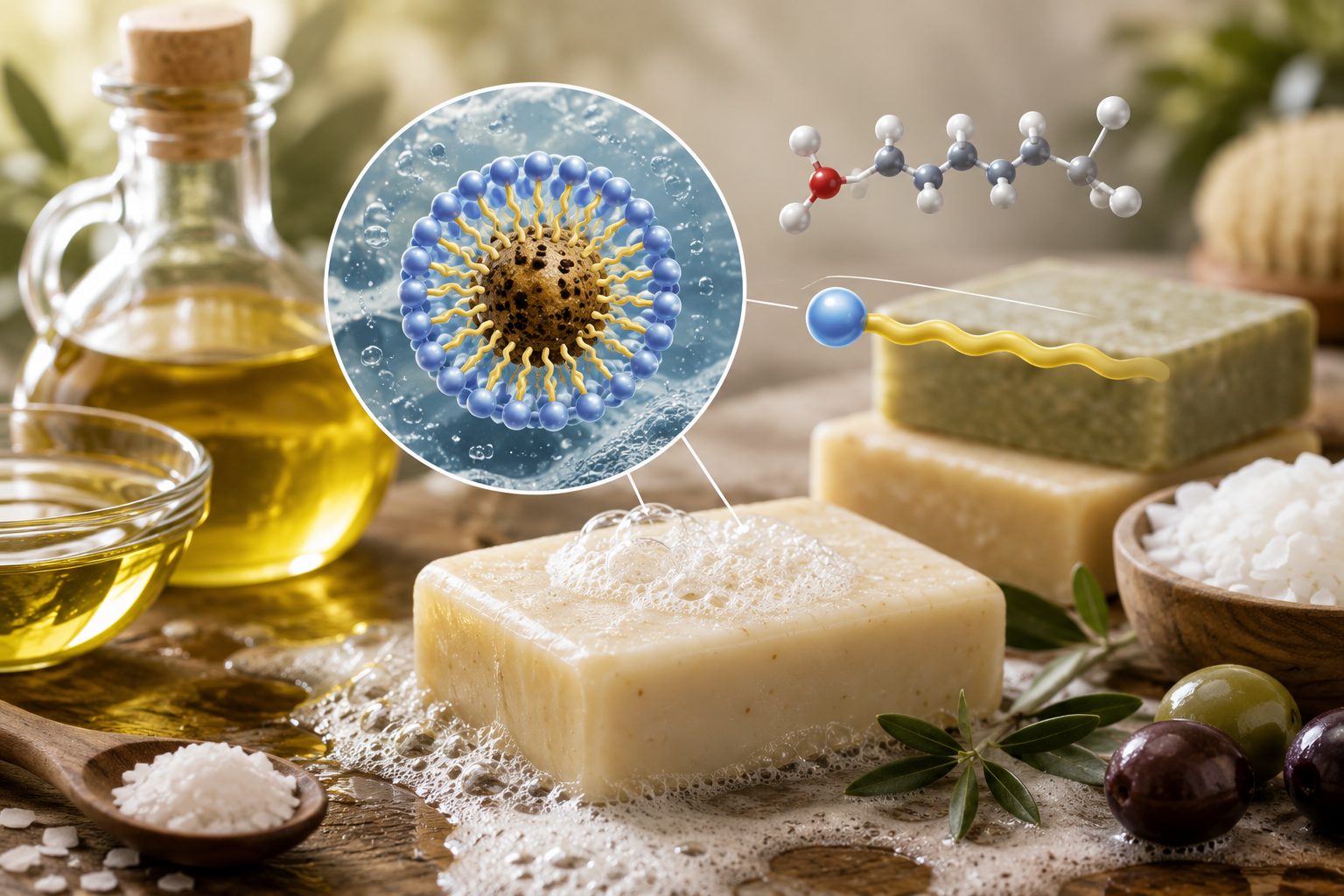
Every soap molecule has two distinct ends, each with a completely different personality.
One end is attracted to water. Scientists describe this end as hydrophilic, meaning “water-loving.”
The other end is attracted to oils and fats. This end is called hydrophobic, meaning “water-fearing,” although it is more accurate to think of it as oil-loving.
When soap is mixed with water, millions of these molecules begin organising themselves automatically. The oil-loving ends attach themselves to grease and dirt, while the water-loving ends remain in contact with the surrounding water.
This unique structure allows soap to connect substances that would otherwise refuse to mix.
How Soap Removes Dirt
As you rub soap over your skin, clothes, or dishes, the soap molecules surround tiny droplets of grease and oily dirt. These microscopic structures, known as micelles, trap the grease inside while presenting their water-attracting surfaces to the outside.
Once enclosed within these tiny spheres, the grease can finally be suspended in water.
Instead of remaining attached to your hands or dishes, the dirt becomes surrounded by soap molecules and is carried away when you rinse with clean water.
In effect, soap doesn’t destroy dirt. It simply lifts it from the surface and allows water to wash it away.
What About Germs?
Soap is equally important when dealing with bacteria and viruses.
Many harmful microorganisms are surrounded by protective outer membranes made largely from fats. Because soap interacts so effectively with oils, it can weaken or break apart these fatty membranes, making many microbes unable to survive.
Even when soap does not directly destroy a microorganism, the mechanical action of washing lifts microbes from the skin, allowing running water to remove them before they have an opportunity to spread.
This combination of chemistry and physical rinsing explains why thorough handwashing remains one of the most effective ways to reduce the transmission of infectious diseases.
Why Soap Creates Bubbles
Many people associate bubbles with cleanliness, but bubbles themselves are not what makes soap effective.
The foam produced by soap simply traps air within thin films of water and soap molecules. Although rich lather often feels satisfying, cleaning depends primarily on the soap molecules surrounding grease rather than on the amount of foam produced.
Some soaps are deliberately formulated to produce abundant bubbles because consumers enjoy the experience, while others generate very little foam yet clean just as effectively.
Why Different Soaps Feel Different
Not all soaps behave in exactly the same way because their ingredients vary.
A soap made primarily from coconut oil may produce large amounts of foam and excellent grease removal but can feel drying on sensitive skin. Olive oil soaps tend to create a creamier lather while leaving the skin feeling softer. Additional ingredients such as shea butter, aloe vera, glycerine, or essential oils further influence texture, fragrance, and moisturising properties.
These differences explain why certain soaps are preferred for facial cleansing, others for household cleaning, and others for industrial applications.
Soap and Modern Cleaning Products
Although many people use the words soap and detergent interchangeably, they are not the same.
Traditional soap is created through saponification using fats and an alkali. Modern detergents, by contrast, are manufactured using different chemical compounds designed to perform more effectively under certain conditions, such as hard water or lower temperatures.
Both rely on molecules with water-attracting and oil-attracting ends, but their chemical structures differ significantly.
Despite the rise of synthetic detergents, traditional soap remains popular because of its simplicity, biodegradability, and long history of safe use.
A Simple Solution Built on Elegant Chemistry
Soap demonstrates how powerful simple chemistry can be. By combining natural oils, an alkali, and water, humanity discovered a material capable of solving one of water’s greatest limitations. Through billions of tiny molecules working together, soap surrounds grease, loosens dirt, helps remove microorganisms, and allows everything to be rinsed away with clean water.
The next time you wash your hands, you’re witnessing an extraordinary molecular process that has protected human health for thousands of years. It is a reminder that some of the most remarkable scientific achievements are not always found in laboratories or advanced technologies. Sometimes they are sitting quietly beside the sink, performing elegant chemistry every single day.
Member discussion