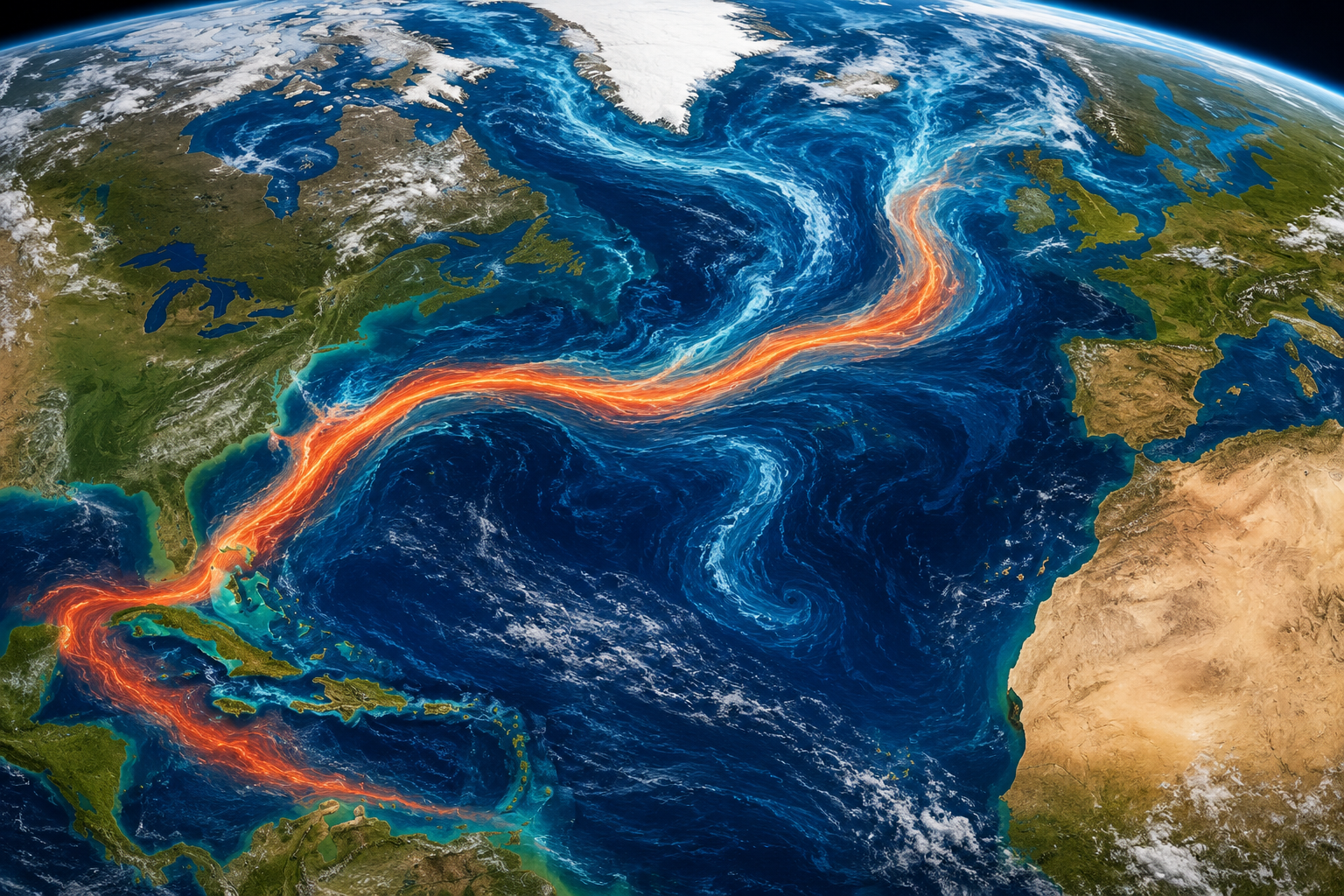

Hidden beneath the surface of the Atlantic Ocean is one of Earth’s most powerful natural systems—the Gulf Stream. Often described as a giant conveyor belt of warm water, this remarkable ocean current transports enormous amounts of heat from the tropics toward the North Atlantic, helping regulate weather, influence marine ecosystems, and shape climates across entire continents. Without the Gulf Stream and the larger Atlantic circulation of which it is a part, life in many regions of the world would look dramatically different.
Although it operates silently and invisibly to most people, the Gulf Stream is one of the planet’s most important climate engines. Scientists have studied it for centuries, yet it continues to reveal new insights into how our oceans and atmosphere work together to maintain Earth’s delicate climate balance.
Where the Gulf Stream Begins
The Gulf Stream originates in the warm tropical waters of the Gulf of Mexico and the Caribbean Sea. Strong sunlight heats these shallow waters throughout the year, creating vast reservoirs of warm, salty seawater.
Water exits the Gulf of Mexico through the narrow Florida Straits between Florida and Cuba, where it forms the Florida Current. As this current moves northward along the eastern coastline of the United States, it gathers additional water from surrounding currents and gradually becomes the powerful Gulf Stream.
Near Cape Hatteras in North Carolina, the current leaves the American coastline and flows northeast across the Atlantic Ocean, eventually influencing weather patterns thousands of kilometers away in Europe.
A River Within the Ocean
The Gulf Stream is often compared to a massive river flowing through the sea. At some locations, it is more than 100 kilometers (60 miles) wide and over one kilometer deep. Water within the current can travel at speeds exceeding 6 kilometers (4 miles) per hour, making it one of the fastest ocean currents on Earth.
Every second, the Gulf Stream transports tens of millions of cubic meters of seawater—far more water than all of the world’s rivers combined. This incredible volume of moving water carries an immense amount of heat northward, effectively redistributing solar energy around the planet.
How the Gulf Stream Forms
The Gulf Stream is driven by a combination of factors rather than a single force.
Persistent trade winds and prevailing westerly winds push surface waters across the Atlantic, while Earth’s rotation causes moving water to curve due to the Coriolis effect. This phenomenon helps organize ocean currents into large circular systems known as gyres.
The shape of North America’s coastline funnels warm tropical water into a narrow, fast-moving current before allowing it to expand into the open Atlantic. Differences in water temperature and salinity also play a crucial role. Warm, salty water is less dense near the surface, allowing it to travel northward before eventually cooling and sinking in the North Atlantic.
This continuous movement forms part of a much larger global system known as the Atlantic Meridional Overturning Circulation (AMOC), often referred to as the planet’s ocean conveyor belt.
The Great Ocean Conveyor Belt
The Gulf Stream is only one section of an enormous worldwide circulation system connecting every major ocean.
As warm water reaches the North Atlantic, particularly near Greenland and Iceland, it cools significantly. Cooling increases the water’s density, and because evaporation has left it especially salty, it eventually becomes heavy enough to sink deep into the ocean.
This cold, dense water then slowly flows southward along the ocean floor before eventually returning toward lower latitudes over many centuries. As it gradually rises back toward the surface, the cycle begins again.
This global circulation continuously transports heat, oxygen, nutrients, and carbon dioxide throughout the world’s oceans, making it essential for marine ecosystems and Earth’s climate.
Why Europe Is Warmer Than It Should Be
One of the Gulf Stream’s most noticeable effects is its influence on Western Europe’s climate.
Cities such as London, Dublin, Amsterdam, and even Bergen in Norway lie at latitudes comparable to parts of eastern Canada, where winters are far colder. Yet Western Europe enjoys relatively mild winters, largely because the Gulf Stream transfers vast amounts of tropical heat into the atmosphere as it travels across the North Atlantic.
Prevailing westerly winds then carry this warmth over Europe, moderating temperatures and creating conditions suitable for agriculture, forests, and dense human populations.
While the Gulf Stream is not the sole reason for Europe’s mild climate, it is one of the most significant contributors.
Influencing Weather Around the World
The Gulf Stream affects far more than just temperature.
Warm ocean water fuels evaporation, increasing moisture in the atmosphere. This additional moisture influences rainfall patterns, cloud formation, and the development of weather systems across the Atlantic.
The current also provides energy for hurricanes and tropical storms. As storms pass over warm Gulf Stream waters, they often strengthen rapidly because warm seawater supplies the heat and moisture that tropical cyclones require.
Meteorologists closely monitor sea surface temperatures within the Gulf Stream because even relatively small changes can influence storm intensity and seasonal weather patterns.
A Highway for Marine Life
The Gulf Stream is not only a climate regulator but also one of the world’s richest marine highways.
Warm currents transport nutrients and support diverse ecosystems that include whales, dolphins, sea turtles, tuna, swordfish, sharks, and countless smaller organisms.
Many species use the Gulf Stream as a migration route, while its boundaries often create productive fishing grounds where warm and cold waters meet. These mixing zones encourage plankton growth, forming the foundation of complex marine food webs.
For centuries, fishermen have relied on the Gulf Stream’s predictable patterns to locate abundant catches.
The Gulf Stream and Climate Change
In recent decades, scientists have devoted increasing attention to how climate change may affect the Gulf Stream and the broader Atlantic circulation.
As global temperatures rise, Greenland’s glaciers and Arctic ice sheets are melting at accelerating rates. This introduces large amounts of freshwater into the North Atlantic. Because freshwater is less dense than salty seawater, it may reduce the sinking process that helps drive the Atlantic overturning circulation.
Some studies suggest that parts of the AMOC have weakened compared with historical estimates, although scientists continue to debate the magnitude, causes, and long-term implications of these changes.
A substantial slowdown would not mean Europe suddenly enters an ice age, as is sometimes portrayed in popular films. Instead, it could lead to more complex changes, including shifts in regional temperatures, altered rainfall patterns, rising sea levels along parts of North America’s east coast, and changes to marine ecosystems.
Current evidence indicates that while the Gulf Stream itself is expected to continue flowing, the larger circulation system it feeds into may become less efficient if global warming continues.
Myths and Misunderstandings
The Gulf Stream is often misunderstood in popular culture. One common misconception is that it alone keeps Europe warm. In reality, Europe’s relatively mild climate results from a combination of ocean currents, prevailing winds, atmospheric circulation, and geographical factors working together.
Another widespread myth is that the Gulf Stream is on the verge of stopping completely. While scientists are actively monitoring changes in the Atlantic circulation, there is currently no evidence that the Gulf Stream will suddenly shut down in the foreseeable future. The scientific concern centers on gradual weakening and the potential long-term effects on regional climates rather than an abrupt collapse.
A Vital Part of Earth’s Climate System
The Gulf Stream reminds us that Earth’s climate is governed by countless interconnected systems operating across oceans, continents, and the atmosphere. This immense river of warm seawater quietly redistributes heat, supports marine biodiversity, shapes weather, and influences the daily lives of hundreds of millions of people.
Although invisible from the shore, its effects can be felt from the tropical Caribbean to the icy coasts of Norway. Understanding the Gulf Stream helps us appreciate not only the remarkable complexity of our planet but also the importance of protecting the oceans that sustain life on Earth. As climate research advances, the Gulf Stream will remain one of the most closely studied natural systems, offering valuable clues about the future of our changing world.
Member discussion