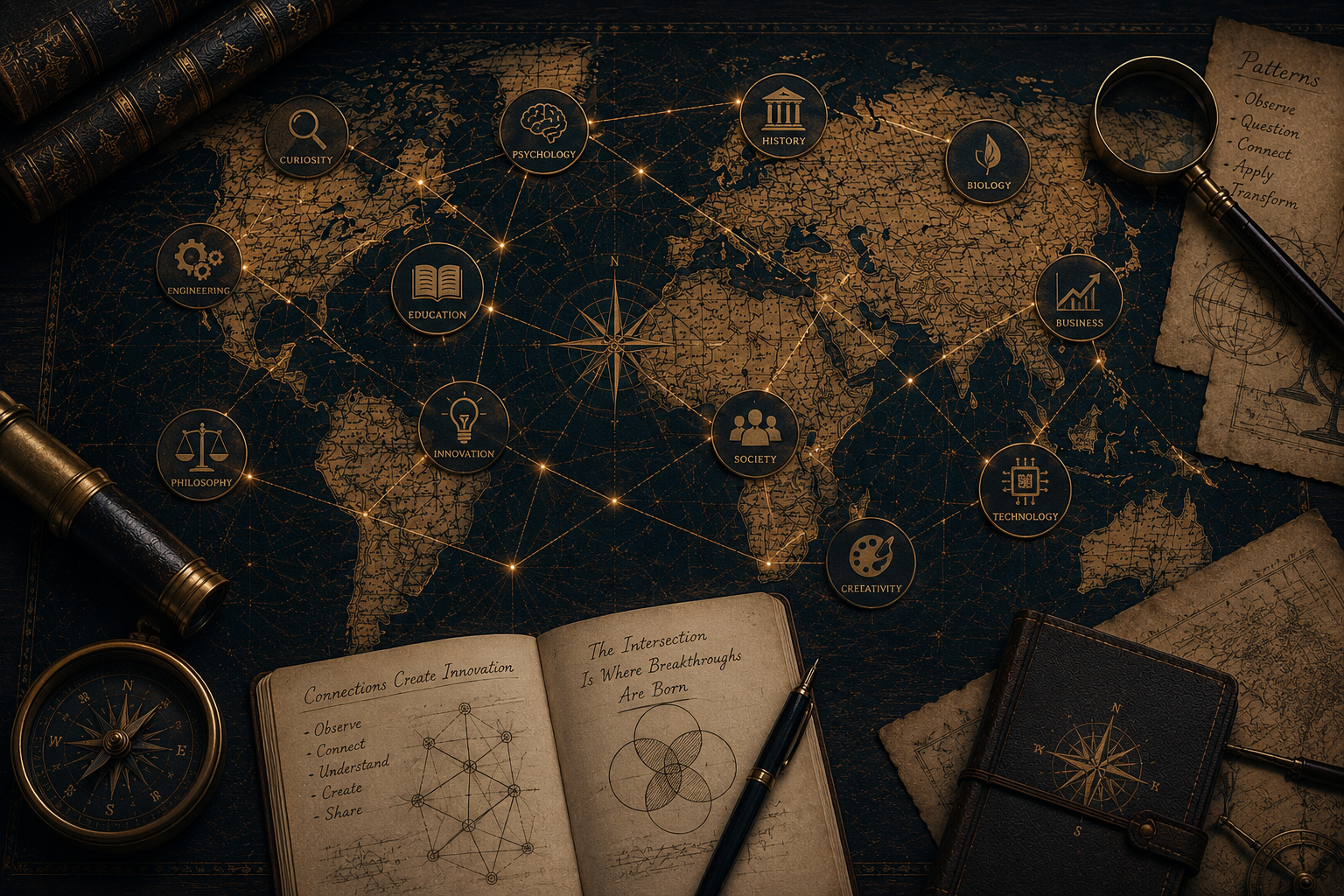

One of the greatest strengths of the polymath is not the ability to learn many things. At first glance, this may sound surprising because learning is often what polymaths are known for. They read widely, explore diverse subjects, develop multiple skills, and maintain an endless curiosity about the world around them. Yet knowledge alone is not what makes the polymath unique. Plenty of people accumulate information throughout their lives. What truly distinguishes the polymath is the ability to connect that information in meaningful ways.
This ability often goes unnoticed because it is difficult to measure. Society tends to value visible expertise. We can easily recognize someone who knows more about a specific topic than anyone else. We can identify the specialist who has dedicated decades to mastering a particular field. What is less obvious is the value of someone who sees relationships between different fields and discovers connections that others overlook.
And yet, throughout history, some of the most important breakthroughs have emerged not from going deeper into a single discipline, but from bringing different disciplines together.
Innovation rarely occurs in isolation. It often happens at the intersection of ideas.
When people think about innovation, they often imagine someone creating something entirely new. In reality, many innovations are not completely original. They are combinations. They occur when existing ideas are connected in a way that nobody has considered before. The breakthrough comes not from inventing something from nothing, but from seeing a relationship that was previously invisible.
Consider some of the greatest advances in history. Many emerged because someone applied knowledge from one field to a problem in another. Advances in medicine have been inspired by engineering. Developments in technology have borrowed principles from biology. Modern marketing incorporates insights from psychology. Entire industries have been transformed because someone recognized that two seemingly unrelated areas could be combined.
The reason these connections matter is that every field develops its own assumptions. Specialists become highly skilled within a particular domain, but they can also become limited by the frameworks of that domain. They learn to solve problems in familiar ways because those approaches have worked before. While this depth creates tremendous expertise, it can sometimes make it more difficult to see possibilities beyond established boundaries.
Polymaths approach the world differently.
Because they spend time in multiple disciplines, they are exposed to a wider variety of ideas, perspectives, and mental models. They become familiar with different ways of thinking. As a result, they are often able to transfer insights from one area into another. What appears obvious in one field may represent a breakthrough in another.
This process happens more frequently than most people realize.
A person studying psychology may discover insights that improve leadership. An entrepreneur who learns storytelling may become a more effective marketer. Someone interested in biology may develop a deeper understanding of business ecosystems. A musician may uncover principles of creativity that apply to innovation and problem-solving.
The value does not come from the individual pieces of knowledge alone. It comes from the relationships between them.
In many ways, the polymath acts as a bridge between worlds.
While specialists often explore deeper within a single territory, polymaths travel between territories. They carry ideas from one place to another. They notice similarities between systems that appear unrelated. They recognize patterns that remain hidden when disciplines are viewed separately.
This ability becomes increasingly important in a world that is growing more interconnected every year.
Many of today’s challenges do not fit neatly into a single category. Business problems are rarely just business problems. Health issues involve psychology, lifestyle, relationships, and environment. Social challenges are influenced by economics, culture, technology, education, and human behavior. Complex problems require complex thinking.
The more interconnected the world becomes, the more valuable broad thinking becomes.
Broad thinking is often misunderstood because it is sometimes mistaken for shallow thinking. People assume that anyone interested in many things cannot possibly understand any of them deeply. While this can occasionally be true, it is not an accurate description of most successful polymaths.
The strongest polymaths do not avoid depth. They simply pursue depth in multiple areas throughout their lives.
What makes broad thinking powerful is that it expands the range of possible solutions. When faced with a challenge, the polymath is not limited to a single framework. Their mind can draw from psychology, history, business, science, philosophy, creativity, and personal experience. Each discipline provides another lens through which to view the problem.
Imagine trying to solve a puzzle while looking through only one window. No matter how clear the view may be, your perspective remains limited. Now imagine being able to look through ten different windows. The broader your perspective becomes, the easier it is to understand the larger picture.
This is one reason polymaths often identify opportunities that others miss.
Opportunities frequently exist in the spaces between established categories. They emerge when ideas from one field are applied to another. They appear when someone questions assumptions that everyone else accepts. Because polymaths naturally move between disciplines, they spend more time exploring these intersections.
A specialist may see a problem through the lens of their expertise. A polymath may see the same problem through several lenses simultaneously.
Neither approach is inherently better. Both have value. The difference is that polymaths often uncover possibilities that would remain invisible from a narrower perspective.
This ability can also become a powerful source of creativity.
Creativity is commonly viewed as a mysterious talent possessed by a select group of people. In reality, creativity often involves connecting existing ideas in new ways. The more diverse your experiences and knowledge become, the more material your mind has available for making unexpected connections.
This helps explain why polymaths frequently generate unusual ideas. Their minds are constantly combining concepts from different domains. A lesson from history may influence a business strategy. An insight from philosophy may inspire a new product. A concept from nature may provide a solution to a technological challenge.
The greater the diversity of inputs, the greater the potential for unique outputs.
This is why curiosity and creativity are so closely connected. Every new subject a polymath explores adds another piece to an ever-growing network of knowledge. At first, these pieces may appear unrelated. Over time, however, connections begin to emerge. Ideas start reinforcing one another. Patterns become visible. Insights arise that could never have been discovered by staying within a single discipline.
Perhaps the most important result of this process is the creation of unique solutions.
In a world where information is increasingly accessible, knowledge alone is becoming less valuable. What matters more is the ability to synthesize information, connect ideas, and apply them creatively. The future belongs not only to those who know the most, but also to those who can combine knowledge in meaningful ways.
This is where the polymath possesses a remarkable advantage.
Because no two polymaths have exactly the same collection of interests, experiences, and perspectives, no two will create the same combinations. One person may blend psychology, leadership, and entrepreneurship. Another may combine technology, philosophy, and education. Someone else may draw from health, spirituality, creativity, and communication.
Their uniqueness does not come from mastering a single field better than everyone else. It comes from the distinctive way they bring multiple fields together.
The longer a polymath follows their curiosity, the more valuable these connections become. What initially appears to be a collection of unrelated interests gradually transforms into an integrated body of knowledge. The dots begin to connect. The patterns become clearer. The intersections reveal opportunities that were impossible to see before.
This is why the polymath should never underestimate the value of their broad interests. Every subject explored, every skill learned, and every idea encountered becomes part of a larger network. Even when the connections are not immediately obvious, they are quietly forming beneath the surface.
One day, often when least expected, those connections come together. A solution appears. An opportunity emerges. A new idea takes shape. What once seemed like a random collection of interests suddenly reveals itself as a powerful advantage.
That is the true power of connecting the dots. It is not merely about knowing many things. It is about seeing possibilities where others see separation and creating something new from ideas that were never meant to meet.
Member discussion