

This article is part of a free six-part course showing you how to build a business with scalable products in order to earn more while working less. Sign up for free and get all six lessons in your inbox.
In the previous lesson, you learned about the traditional way experts earn money: exchanging time for income. That model has one fundamental limitation. Your income grows only when your working hours grow. There is, however, a second system for creating income—one that forms the foundation of every scalable business. Instead of selling your time, you create assets that continue creating value long after you’ve built them. This principle is called leverage.
What Is Leverage?
Leverage means creating value once and delivering it many times. Instead of personally solving every client’s problem in a one-on-one conversation, you package your expertise into products, services, systems, or experiences that many people can benefit from.
Examples include:
- Digital courses
- Masterclasses
- Membership communities
- Books
- Templates
- Software
- Group coaching programs
The key difference is simple: Your effort no longer grows in direct proportion to the number of customers.
A Simple Example
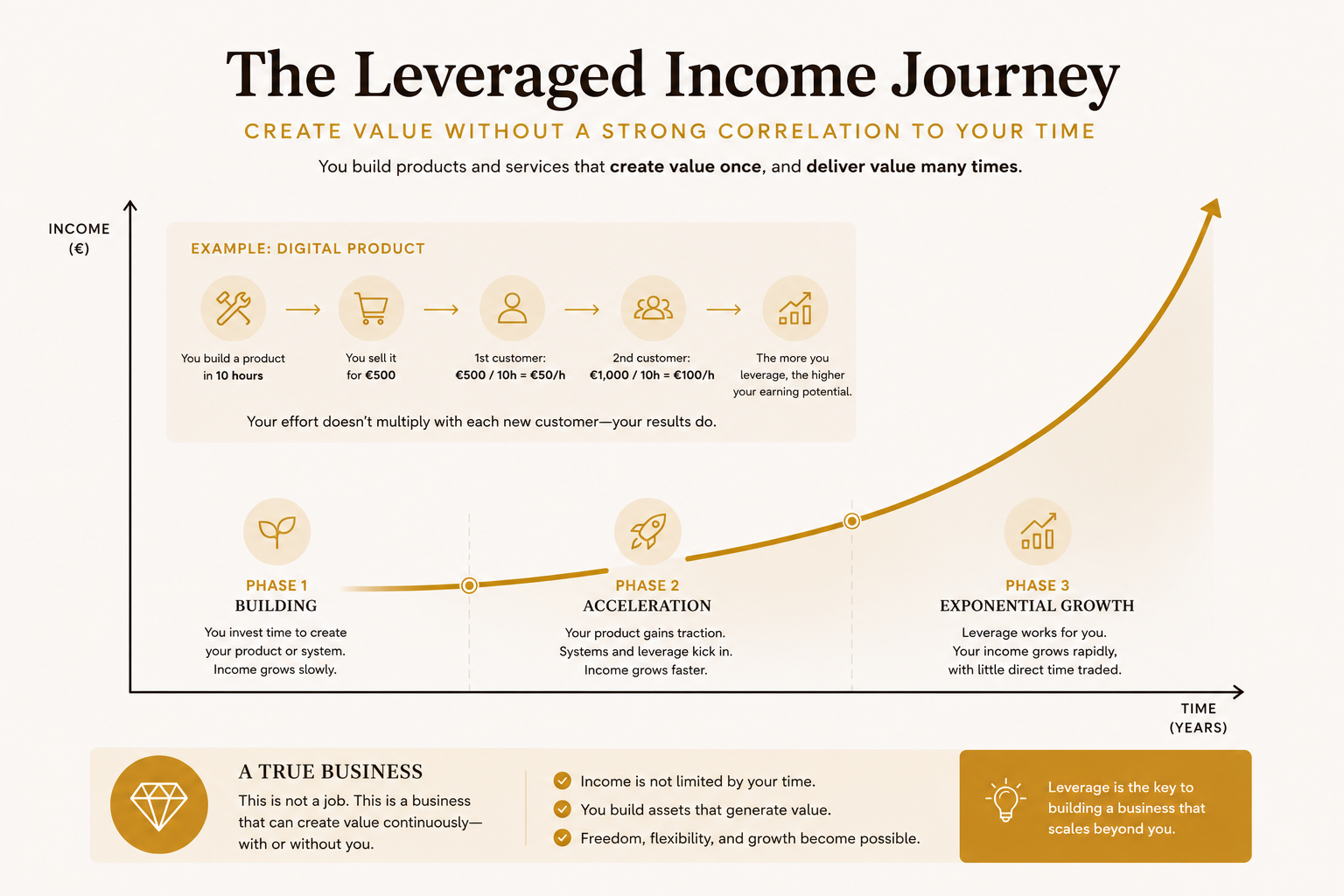
Imagine you create a masterclass. Developing the content takes you 10 hours. You decide to sell access for €500.
First customer: You invested 10 hours. Revenue: €500. Your effective hourly return is: €500 ÷ 10 hours = €50/hour
At this point, leverage doesn’t seem very impressive. In fact, you’re earning less than if you had simply charged a premium hourly rate. But then something changes.
Second customer: A second person purchases exactly the same masterclass. Your total revenue is now €1,000. But you didn’t invest another 10 hours. The original work remains the same. Your effective hourly return has now doubled.
Third customer: Revenue increases again. Time invested stays almost identical.
Fourth customer… Fifth… Tenth… Hundredth… Your income continues increasing while the initial creation time hardly changes. This is leverage.
Leverage Doesn’t Mean Zero Work
Many people believe scalable businesses are completely passive. They aren’t. You may still answer questions. Host live sessions. Update your material. Improve your products. Support your customers. But there is one crucial difference. Your effort doesn’t multiply with every additional client.
If twenty people buy your masterclass instead of one, you don’t suddenly need twenty times more working hours. That’s why leveraged businesses scale so efficiently.
Why the Income Curve Looks Different
The graph of a leveraged business looks completely different from the graph of a time-for-money business. In the beginning, growth is relatively slow. You invest time before you see significant returns. You’re building. Designing. Testing. Improving. It may even feel like you’re working harder than before.
But then something changes. The products already exist. Customers begin buying. Systems become more efficient. Marketing improves. Referrals increase. Every new customer benefits from work you’ve already completed. The result is an income curve that starts slowly but accelerates over time. Instead of growing in a straight line, it begins to grow exponentially. The more leverage you build into your business, the greater your earning potential becomes.
You’re No Longer Selling Hours
The goal isn’t simply to earn more money. The goal is to disconnect your income from your personal capacity. Instead of asking, “How many more hours can I work?” you begin asking, “How can this product create value for one hundred people instead of one?”
That single shift changes your entire business model.
This Is a Business—Not Just a Job
A job exists only while you work. A leveraged business creates value through assets you’ve built. Those assets continue serving customers whether you’re teaching live every day or not. Over time, your products become part of the value of your company itself.
Instead of only having expertise, you begin owning a portfolio of business assets that generate revenue, increase the value of your company, and give you far more freedom than selling your time ever could.
Key Takeaways
- There are two fundamentally different ways to earn income.
- Time-for-money businesses grow linearly because income depends on hours worked.
- Scalable businesses use leverage by creating value once and delivering it many times.
- In the beginning, leveraged businesses grow slowly while assets are being built.
- As products and systems gain traction, income accelerates and can grow exponentially.
- The objective is not to eliminate work—it’s to eliminate the one-to-one relationship between your time and your income.
Understanding leverage is only the first step. The next question is: How do you actually transform your expertise into something people can buy?
In the next lesson, you’ll discover the different types of scalable products and learn how to package your knowledge into business assets that continue creating value long after you’ve built them.
Member discussion