

This article is part of a free six-part course showing you how to build a business with scalable products in order to earn more while working less. Sign up for free and get all six lessons in your inbox.
Every expert starts their career in the same way: by exchanging their time for money. Whether you’re a coach, consultant, therapist, trainer, lawyer, accountant, or freelancer, the underlying business model is identical. You invest your time, and in return, you receive income.
The relationship is simple and linear.
If you charge €100 per hour, your income looks like this:
- Work 1 hour → Earn €100
- Work 2 hours → Earn €200
- Work 3 hours → Earn €300
Every additional hour creates one additional unit of income.
At first glance, this seems like a great system. Work more, earn more. But this business model follows a very predictable pattern that almost every expert experiences throughout their career.
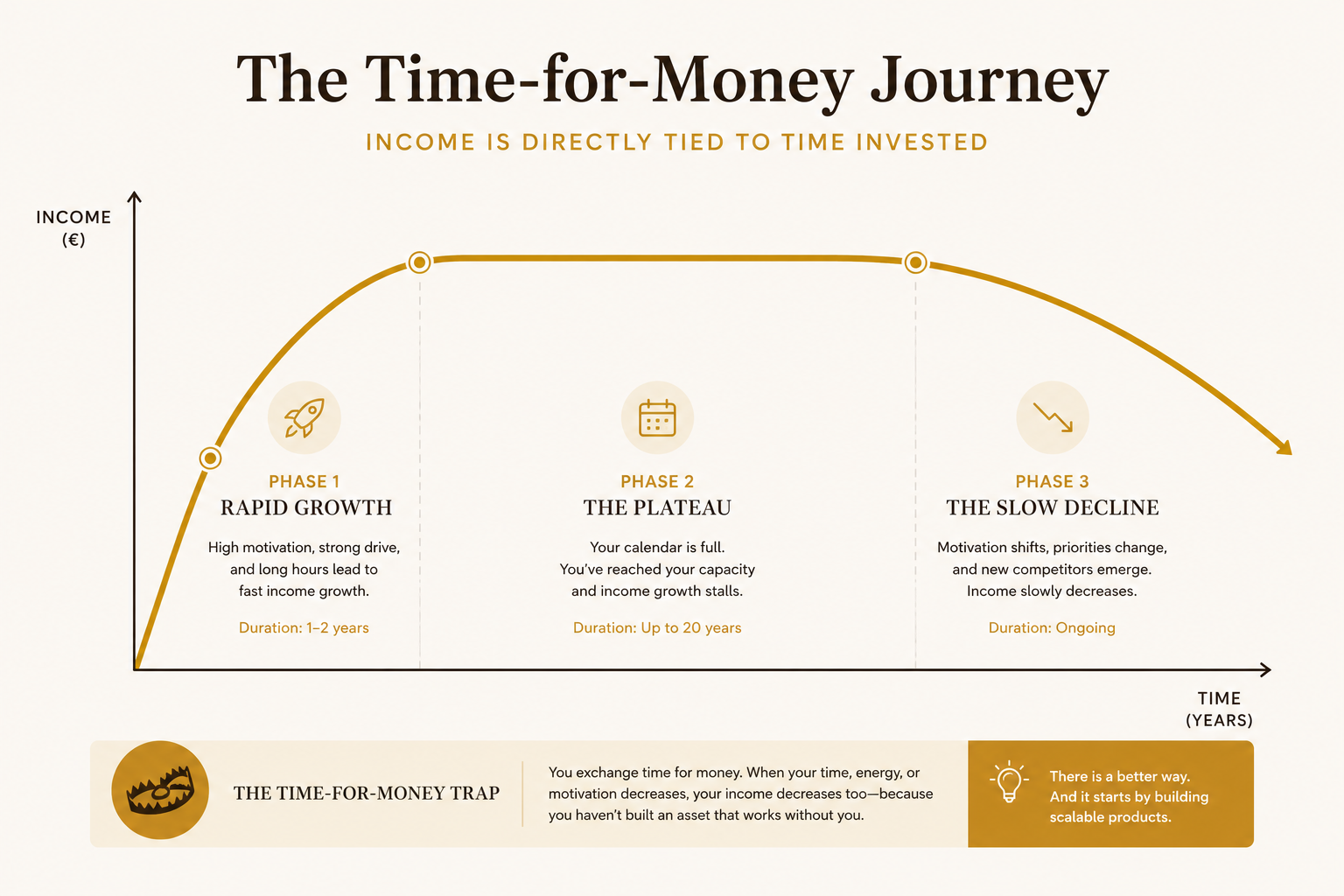
Phase 1: Rapid Growth
During the first years, your income grows quickly. You’re highly motivated. You want to establish yourself, build a reputation, and prove what you’re capable of. You actively look for clients, continuously improve your expertise, and willingly invest long hours into your work. Because every additional client directly increases your income, your revenue rises rapidly. For most experts, this phase lasts roughly one to two years.
Phase 2: The Plateau
Eventually, something changes. Your calendar becomes full. You now have as many clients as your available time allows. Every working day is booked, your schedule is packed, and you’re earning a good living. From the outside, this looks like success. But underneath the surface, growth has stopped. You cannot significantly increase your income anymore because there is no additional time available to sell. Every extra euro requires another hour of work—but there are simply no more hours left. Many experts remain in this stage for ten, fifteen, or even twenty years. They become highly skilled professionals, but their business reaches its natural capacity.
Phase 3: The Slow Decline
Much later in your career, another shift begins. Your priorities change. Perhaps you’ve already mastered everything that initially fascinated you about your field. The excitement of constantly proving yourself has faded. Family becomes more important. Maybe you want to spend more time with your children, support aging parents, travel more, or simply enjoy life outside of work. Your intrinsic motivation naturally decreases. At the same time, younger professionals enter the market. They have fresh energy, strong ambition, and the willingness to work longer hours—the same drive you once had yourself.
None of this is a problem by itself. The real problem is that your income still depends on your personal time. If you work less, you earn less. Your business has no mechanism to continue generating income independently of your own effort.
Why It’s Called the Time-for-Money Trap
This is where the trap becomes visible. For years—even decades—you’ve earned a good income. But during all those years, you haven’t necessarily built an asset that continues creating value without your direct involvement. You built an excellent career. You may not have built a scalable business. As your motivation, energy, or available time decreases, your income follows the same direction because the two remain permanently connected.
The result is a business that depends entirely on you.
And that’s exactly what we’ll solve in the next lesson, where you’ll discover the second system for creating income—one that allows your expertise to continue generating value without requiring you to exchange every hour of your time for every euro you earn.
Member discussion