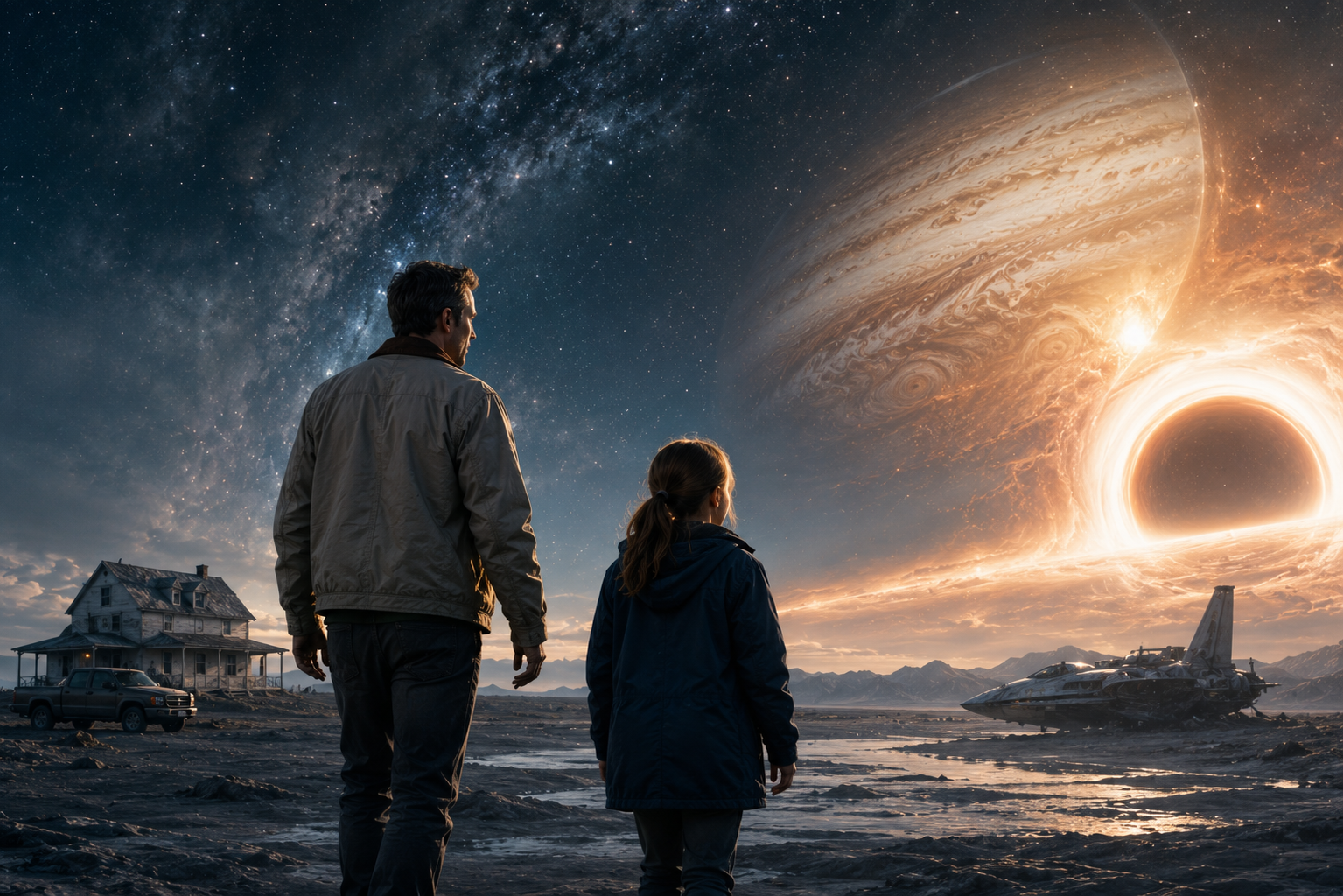

Christopher Nolan's Interstellar, released in 2014, is often described as one of the greatest science fiction films of the twenty-first century. While its breathtaking visuals, scientifically grounded depiction of black holes, and Hans Zimmer's unforgettable score have earned widespread acclaim, the film's lasting power lies elsewhere. Beneath the spectacle of interstellar travel is a profoundly human story about sacrifice, purpose, love, time, and the invisible connections that shape our lives. It is a film that becomes richer with every viewing because its deepest ideas are not hidden in scientific formulas but in the emotional relationships between its characters.
At first glance, Interstellar appears to be a story about humanity searching for a new home after Earth becomes increasingly uninhabitable. Crops fail one after another, dust storms devastate entire regions, and the future of civilization hangs by a thread. The mission seems straightforward: travel through a mysterious wormhole near Saturn, explore potentially habitable planets, and secure humanity's survival. Yet this mission quickly reveals itself as something much greater than an expedition across the galaxy. It becomes an exploration of what truly allows humanity to survive. The answer is not technology alone. It is not intelligence by itself. Instead, Nolan suggests that our greatest strength lies in the relationships that transcend time, distance, and even the known laws of physics.
A Hero Called to Leave Home
Every great myth begins with an ordinary world that is suddenly interrupted by a calling. Cooper lives a relatively simple life as a farmer, raising his children in a world that has abandoned dreams of exploration in favor of mere survival. Once an accomplished NASA pilot and engineer, he now watches humanity slowly retreat from ambition as society focuses solely on producing enough food to survive another season. His life is grounded, practical, and deeply connected to his family, especially his daughter Murph, whose curiosity and intelligence mirror his own.
When NASA secretly recruits Cooper for its mission, the central conflict of the film immediately emerges. He must choose between remaining the father his children desperately need or becoming the explorer humanity desperately requires. Neither choice is wrong, yet both carry immense consequences. This moral dilemma gives the film extraordinary emotional weight because Cooper is not abandoning his family out of selfishness. He leaves because he believes that staying would ultimately condemn them to extinction.

Murph cannot understand this decision. To her, the father she loves has chosen strangers over his own children. She experiences his departure as betrayal rather than sacrifice. This emotional wound shapes her entire life and becomes one of the film's driving forces. Rather than merely presenting an external adventure through space, Interstellar tells the story of two parallel journeys: a father traveling farther than any human has gone before and a daughter attempting to heal a broken relationship while carrying the burden of saving everyone left behind on Earth.
The Universe Is Vast, but Time Is Even Greater
One of the most fascinating aspects of Interstellar is how it transforms Einstein's theory of relativity into an emotional experience. Time is no longer simply measured by clocks. It becomes something that separates loved ones more cruelly than distance ever could.
This idea reaches its emotional peak during the expedition to Miller's planet. Situated dangerously close to the black hole Gargantua, time flows dramatically slower than it does elsewhere. Every hour spent on the planet equals seven years back on Earth. The crew expects only a brief mission, but unforeseen complications cause them to lose over two decades.

When Cooper finally returns to the Endurance and begins watching the accumulated video messages from his children, the scientific concept suddenly becomes heartbreakingly personal. His son grows from a teenager into a middle-aged man. Grandchildren are born. Loved ones die. Entire lifetimes unfold while Cooper has aged only a few hours.
Matthew McConaughey's performance during this sequence is extraordinary because he allows the audience to witness genuine grief unfolding in real time. This is not merely sadness over missing important moments. It is the realization that time itself has become his greatest enemy. Every second he spends pursuing humanity's future costs him an irreplaceable piece of his own past.
Among all the spectacular visual effects in Interstellar, this quiet sequence remains perhaps the most powerful. There are no explosions, no dramatic speeches, and no elaborate action scenes. There is only a father confronting the irreversible consequences of answering his calling.
Murph: The Soul Waiting at Home
Although Cooper is often viewed as the protagonist, the emotional center of Interstellar is arguably Murph. She begins as a brilliant, imaginative child who refuses to accept easy explanations. She senses patterns others overlook and instinctively believes there is meaning behind mysterious events occurring in her bedroom.
Throughout much of the film, Murph carries immense anger toward her father. Yet this anger never destroys her intelligence or her compassion. Instead, it becomes fuel for her determination. She dedicates her life to solving the gravitational equation that could save humanity, refusing to surrender even after discovering that those she trusted have deceived her.

One of the reasons Murph stands out as such a compelling character is that her strength never depends on becoming emotionally detached. Modern cinema often portrays strong female characters by emphasizing traditionally masculine traits. Murph is different. She remains deeply emotional, intuitive, compassionate, and vulnerable while simultaneously becoming one of the world's greatest scientists. Her intellect never diminishes her humanity. Instead, her emotional depth strengthens her scientific perseverance.
Seen symbolically, Murph represents something even greater than a daughter. She represents the soul itself.
The soul often feels abandoned when life's journey demands sacrifice. It questions why suffering exists and struggles to understand why those it loves sometimes disappear. Yet beneath this pain remains an unbreakable connection that cannot be destroyed by time or distance. Murph spends decades believing her father left her, only to discover that he had, in a profound sense, never truly left at all.
This interpretation transforms the entire narrative. Cooper becomes the archetypal hero who ventures into the unknown, while Murph becomes the soul that remains connected to him despite appearances. Their reunion is not simply a family reconciliation. It symbolizes the restoration of harmony between action and inner truth.
Love as a Force Beyond Physics
Perhaps no aspect of Interstellar generated more debate than its suggestion that love possesses a reality extending beyond ordinary scientific explanation. Some viewers dismissed this as sentimentality, believing the film abandoned hard science in favor of emotional convenience. Yet a closer examination reveals that Nolan never argues that love replaces science. Rather, he proposes that love directs science toward its highest purpose.
This idea first appears through Amelia Brand, who argues that love may function like a force connecting people across dimensions we do not yet understand. Cooper initially rejects this suggestion because it lacks empirical evidence. He trusts mathematics, engineering, and observable facts.
Ironically, it is Cooper himself who ultimately proves Brand's intuition correct.
After entering Gargantua, he discovers the tesseract, an extraordinary higher-dimensional structure that allows him to perceive every moment within Murph's childhood simultaneously. Here, love does not magically solve physics. Instead, love determines where the information needs to go. Cooper possesses the quantum data necessary to save humanity, but without his enduring connection to Murph, the data would remain meaningless.
His desperate attempts to communicate through gravity culminate in one heartbreaking realization. He repeatedly tries to tell his younger self not to leave. He wants to undo everything that caused such pain. Yet he slowly understands that leaving was never the mistake. The journey itself was necessary. The solution was never to avoid suffering. The solution was to remain connected despite it.
Dr. Mann and Professor Brand: Two Faces of Desperation
One of the reasons Interstellar remains so compelling is that its antagonists are not evil in the traditional sense. Christopher Nolan presents two characters who genuinely wish to save humanity, yet each loses sight of truth in a different way.
Professor Brand initially appears to be the wise mentor guiding humanity toward survival. He inspires hope, organizes the mission, and gives Cooper a purpose larger than himself. Only later does the audience discover that he has concealed the greatest truth of all: he never believed Plan A—the evacuation of Earth's population—could succeed. He knowingly allowed countless people to believe they would one day be rescued while secretly placing all his hope in Plan B, the continuation of humanity through frozen embryos on another world.
Brand's deception raises uncomfortable ethical questions. Can a lie be justified if it motivates humanity to keep fighting? Is false hope better than despair? Nolan offers no easy answers. Instead, he allows viewers to wrestle with the tension between practical necessity and moral integrity. Brand's intelligence is extraordinary, yet even genius cannot escape the consequences of abandoning truth.
If Brand represents the danger of sacrificing honesty for the greater good, Dr. Mann represents something even more personal. Introduced as humanity's greatest explorer, he is revealed to be deeply afraid. His planet is uninhabitable, his mission has failed, and isolation has slowly eroded his character. Faced with certain death, he chooses self-preservation over responsibility, endangering everyone who trusted him.
What makes Dr. Mann memorable is that his actions feel disturbingly human. He does not see himself as a villain. He continually justifies his decisions, convincing himself that survival excuses betrayal. His famous assertion that no one truly prepares for the instinct to survive becomes both an explanation and a warning. Intelligence, reputation, and achievement cannot compensate for a lack of character. Ultimately, as the saying goes, we are known by our fruits. Dr. Mann's choices reveal who he truly is, regardless of the image he once projected.
The Endurance: Humanity Held Together
The spacecraft Endurance serves a purpose beyond transportation. Symbolically, it represents humanity itself. Its circular design is significant. Every section depends upon every other section. Damage one part, and the entire structure is threatened. Cooperation, trust, and balance keep the mission alive. Throughout the film, the Endurance becomes a reminder that survival is never an individual achievement. Every person's decisions affect everyone else.
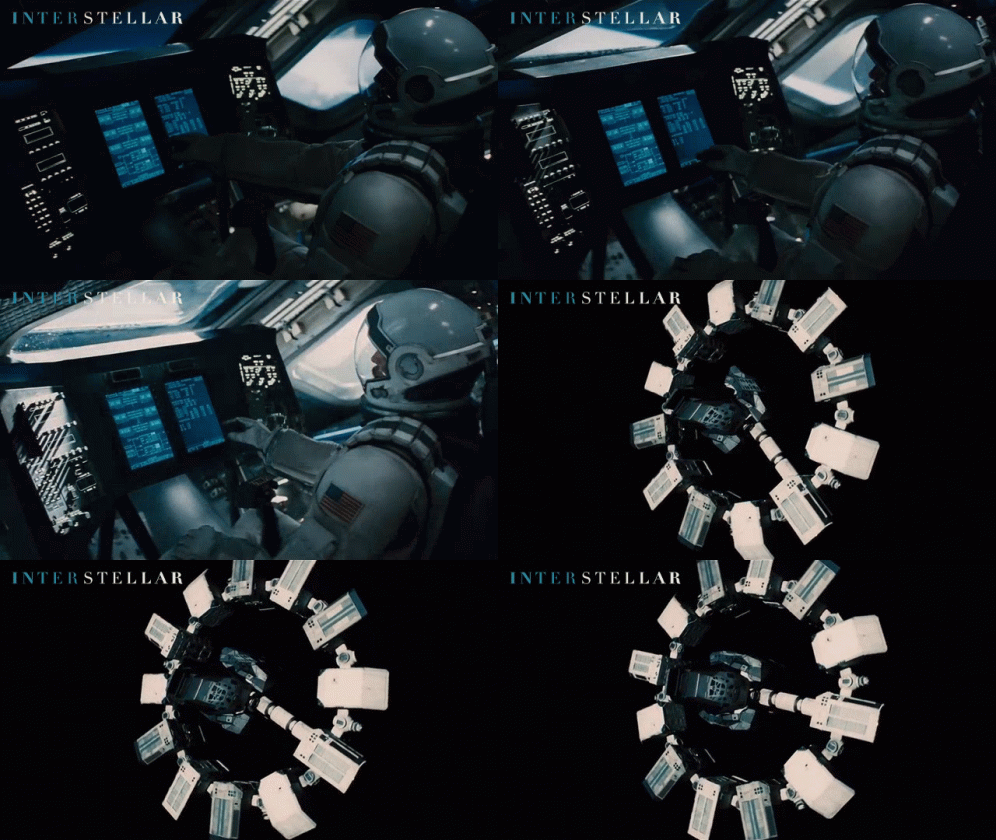
This symbolism reaches its peak after Dr. Mann's betrayal. His reckless attempt to dock with the spacecraft destroys part of the station and sends it spinning violently through space. What follows is one of the greatest sequences ever filmed in modern science fiction.
Cooper must match the station's impossible rotation while manually docking their shuttle. Failure means certain death. Success appears almost impossible.
Yet this scene is about far more than technical skill. It becomes a leap of faith.
There comes a moment in every meaningful life journey when preparation is no longer enough. Knowledge reaches its limits, certainty disappears, and action becomes necessary despite overwhelming risk. Cooper understands the danger completely, yet he commits himself fully. The docking sequence captures that moment when courage and competence meet. It is exhilarating because it reminds us that the greatest breakthroughs often require us to move forward before success is guaranteed.
Hans Zimmer's organ score transforms this already extraordinary scene into something almost spiritual. The music rises with immense emotional power, suggesting that the impossible sometimes becomes possible when determination, trust, and purpose align.
Gargantua and the Tesseract: Beyond Space and Time
Few films have attempted to visualize higher dimensions as boldly as Interstellar. Gargantua, the enormous rotating black hole, represents the ultimate frontier—not merely of space but of human understanding.
Throughout history, black holes have symbolized mystery, destruction, and the unknown. Nolan transforms this terrifying object into a gateway. Cooper's decision to detach from the Endurance and fall into Gargantua is the culmination of the hero's sacrifice. He believes he is giving his life so that Amelia Brand might continue humanity's mission.
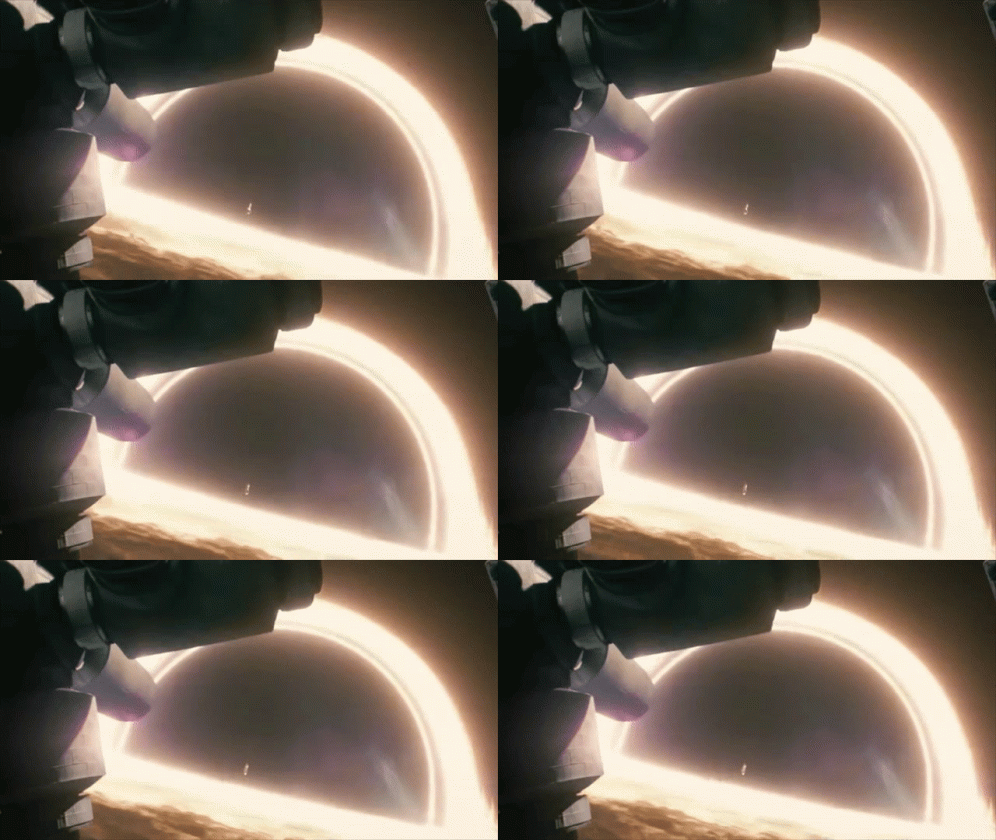
Instead, he discovers something beyond imagination.
The tesseract remains one of the most fascinating concepts ever presented in cinema. Rather than depicting higher dimensions through abstract mathematics, Nolan creates a visual representation that allows audiences to intuitively grasp the impossible. Cooper exists outside ordinary time while simultaneously observing every moment of Murph's childhood.
At first, he desperately tries to change history. He pounds on the bookshelves, begging his past self not to leave.
"Stay."
It is one of the film's most heartbreaking moments because every parent understands the desire to erase pain from their children's lives. Yet Cooper slowly realizes something profound. The journey was never the mistake.

Everything that happened—including the separation, the suffering, and the years apart—was necessary to bring humanity to this precise moment. The answer was not preventing the adventure. The answer was ensuring that love remained strong enough to bridge every distance the adventure created.
Only then can Cooper transmit the quantum data through the watch he once gave Murph. Time itself becomes the language through which love communicates.
The Hero and the Soul
Perhaps the most meaningful interpretation of Interstellar is to view Cooper and Murph as symbolic figures rather than merely father and daughter.
Cooper becomes the hero. Murph becomes the soul.
Every authentic hero eventually receives a calling. The familiar world no longer satisfies. Something larger demands attention, even when answering that call requires sacrifice. The hero leaves behind certainty, comfort, and sometimes even the people he loves most.
Yet a hero who loses connection with the soul eventually loses himself.
Murph represents that inner compass. Although wounded by abandonment, she never completely breaks the invisible bond between them. Her intuition allows her to recognize the truth when logic alone cannot explain it. She combines brilliant scientific reasoning with a deeply human heart, demonstrating that intellect and intuition are not enemies but partners.
This may be the film's greatest lesson. The mind calculates. The heart recognizes. Only when both work together can humanity solve its greatest problems.
In many ways, Cooper's physical journey across galaxies mirrors an inner journey toward this realization. He begins as a practical engineer who trusts only measurable facts. He ends as someone who understands that the deepest human connections cannot always be reduced to equations, even though they may ultimately guide us toward scientific discovery.
Why the Film Resonates So Deeply
Every person eventually reaches a point where life no longer feels like home. The familiar becomes too small, old identities no longer fit, and an uncertain future calls from beyond the horizon. This experience can feel strangely similar to drifting through space. The destination remains invisible. The old world can no longer sustain us. The new world has not yet appeared.
Interstellar captures this emotional landscape perfectly. It understands that pursuing one's calling almost always involves loss. Every meaningful "yes" requires many painful "no's." Cooper loses decades with his children. Murph loses the father she desperately needed. Amelia loses nearly everyone she has ever known. Yet none of these sacrifices are meaningless. They become the price of creating a future that otherwise could never exist.
This perspective offers comfort for anyone navigating major life transitions. Growth rarely feels comfortable while it is happening. Often it feels like drifting through darkness with nothing but faith to guide the next step.
Hans Zimmer's Timeless Score
It would be impossible to discuss Interstellar without acknowledging Hans Zimmer's extraordinary music. Rather than overwhelming scenes with constant orchestral spectacle, Zimmer builds an emotional vocabulary around a surprisingly simple musical theme. Like memory itself, the melody returns repeatedly, changing its character depending upon the emotional context.
Sometimes it feels hopeful. Sometimes mournful. Sometimes triumphant. Sometimes deeply spiritual.
The organ, an instrument traditionally associated with cathedrals, gives the soundtrack an almost sacred quality. It reminds us that while the film explores advanced science, it is equally interested in wonder, mystery, and humanity's search for meaning. The music never merely accompanies the images. It becomes another storyteller.
A Modern Masterpiece
Great science fiction has never been about predicting technology. It has always used imagined futures to explore timeless questions about human nature.
Interstellar succeeds because its greatest discoveries are not found on distant planets but within the human heart. Beneath the black holes, wormholes, equations, and spacecraft lies a story about love, sacrifice, forgiveness, and purpose. It reminds us that progress requires intelligence, but wisdom requires something more. It requires relationships worth fighting for.
For me, Interstellar is a five-star film in every sense. It combines breathtaking visuals with extraordinary performances, philosophical depth, scientific ambition, and genuine emotional power. More importantly, it leaves behind ideas that continue working long after the credits roll.
The greatest message I take from the film is beautifully simple: the hero must answer the call, even when doing so demands painful sacrifice. But that journey can only fulfill its true purpose if the hero remains deeply connected to the soul. Without that connection, achievement becomes empty. With it, even the greatest distances can be overcome.
Perhaps that is why Interstellar continues to inspire so many viewers years after its release. It reminds us that every meaningful journey begins with courage, is sustained by hope, and ultimately finds its way home through love. Whether we are crossing galaxies or simply navigating the uncertainties of everyday life, the invisible bond between purpose and the soul remains the force that guides us forward.
Member discussion