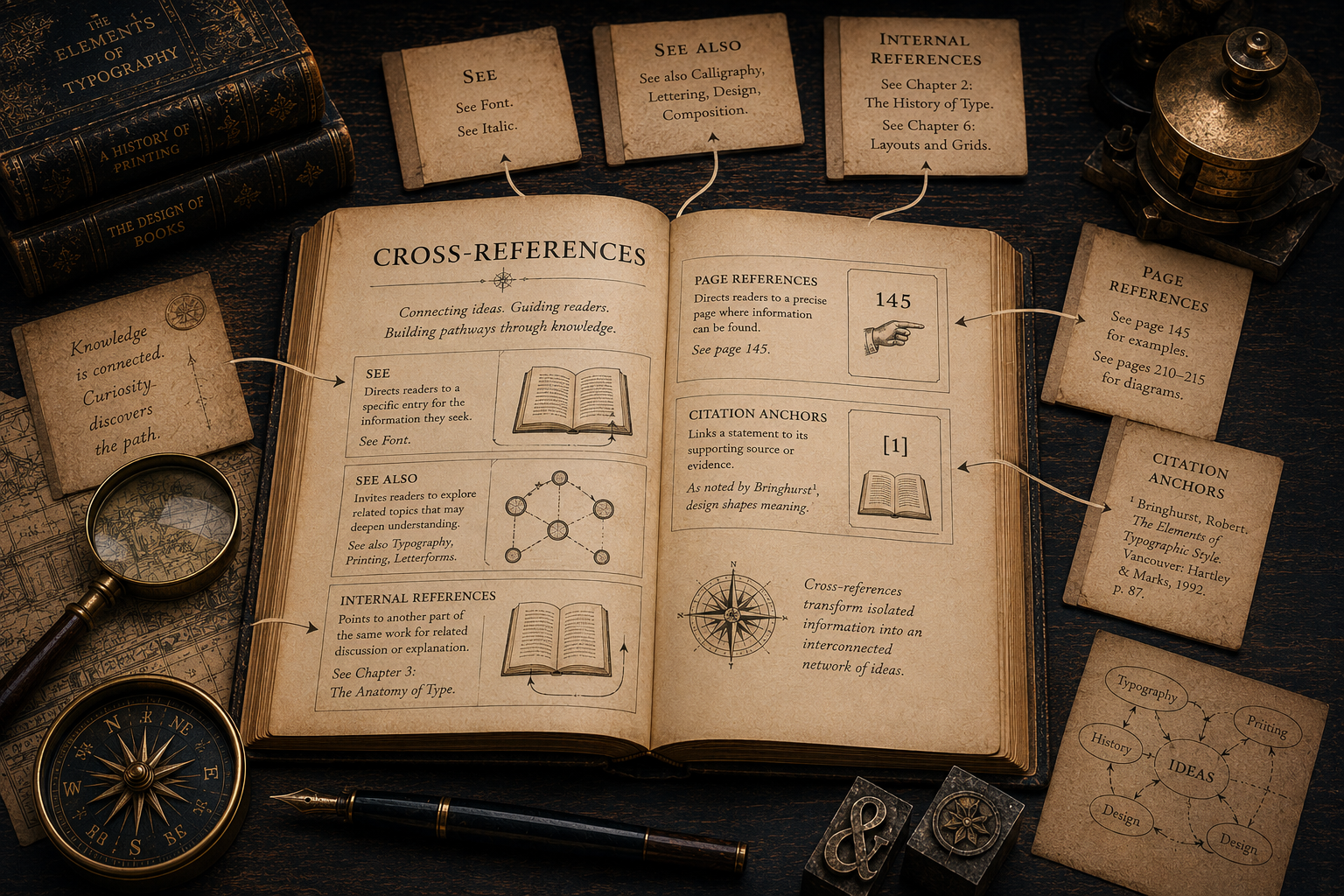

No book exists entirely within the boundaries of a single page. Ideas connect to other ideas, definitions depend upon earlier explanations, and concepts often reveal their full meaning only when viewed in relation to one another. For centuries, authors, editors, and printers have relied upon cross-references to guide readers through these connections. Long before search engines and hyperlinks transformed the way information is navigated, books developed their own sophisticated systems for linking related material.
Cross-references serve as the invisible pathways of a text. They encourage exploration, prevent unnecessary repetition, and help readers move efficiently through complex information. In a dictionary, an encyclopedia, a legal code, or a scholarly work, these references transform isolated entries into interconnected networks of knowledge.
Although they often consist of only a few words or numbers, cross-references perform one of the most important functions in publishing: they help readers find what they need.
See
Among the simplest and most direct forms of cross-reference is the instruction See. It is a modest word, yet one that carries considerable authority. When readers encounter it, they are being told that the information they seek exists elsewhere and that another entry or location provides a more complete explanation.
The use of See is particularly common in dictionaries, glossaries, indexes, and reference works. Rather than repeating information under multiple headings, editors can direct readers toward a single authoritative entry. A glossary, for example, might contain the instruction “Typeface. See Font,” thereby avoiding duplication while maintaining clarity.
The elegance of the See reference lies in its efficiency. It acknowledges that information is connected and that readers benefit from being guided toward the most appropriate source. Instead of creating unnecessary repetition, it encourages movement through the text.
In this way, a simple two-letter word becomes a navigational tool, quietly shaping the reader’s journey through a book.
See Also
If See points readers toward a specific destination, See Also invites exploration beyond that destination. Rather than directing attention to a single essential entry, it suggests related topics that may enrich understanding.
Reference works rely heavily on this device because knowledge rarely exists in isolation. A reader researching typography may benefit from exploring printing, calligraphy, or bookbinding. An entry on one historical figure may naturally connect to contemporaries, movements, or events that provide additional context.
The phrase See Also acknowledges the interconnected nature of learning. It assumes that curiosity does not end once a single question has been answered. Instead, it encourages readers to pursue broader connections and discover relationships that might otherwise remain hidden.
This form of cross-reference is particularly valuable because it mirrors the way human knowledge itself is organized. Ideas overlap, influence one another, and exist within larger frameworks. The See Also reference recognizes these relationships and transforms them into practical pathways for readers.
Internal References
An internal reference directs readers to another location within the same work. Unlike external citations that point to sources outside the book, internal references keep readers within the boundaries of the text itself.
Such references are especially common in nonfiction. An author discussing a topic in one chapter may remind readers that a related concept was introduced earlier or will be examined in greater detail later. Phrases such as “as discussed in Chapter 2” or “see the discussion in Chapter 8” serve as internal references, helping readers connect different parts of the work.
These references contribute significantly to the coherence of a book. Large works often contain recurring themes, complex arguments, and interconnected discussions. Without internal references, readers might struggle to recognize these relationships or remember where important information was previously presented.
Internal references also reveal the architecture of a book. They demonstrate that chapters are not isolated units but parts of a larger structure designed to support a central purpose. Through these references, the book begins to function as an integrated whole rather than a collection of separate sections.
Page References
Perhaps the most familiar form of cross-reference is the page reference. By directing readers to a specific page number, authors and editors provide an exact location where relevant information can be found.
Page references appear throughout the publishing world. Indexes rely upon them almost entirely. Scholarly works use them to connect discussions across chapters. Instruction manuals employ them to guide readers toward detailed explanations. Even casual nonfiction frequently includes references such as “see page 45 for additional information.”
The usefulness of page references lies in their precision. Rather than asking readers to search through an entire volume, they identify a single destination. This precision becomes particularly valuable in lengthy works where information may be scattered across hundreds of pages.
The history of page references is closely linked to the development of pagination itself. Once books began to feature consistent page numbering, entirely new possibilities for navigation emerged. Readers could locate information more quickly, scholars could cite sources more accurately, and publishers could create increasingly sophisticated systems of reference.
What now seems obvious was once a significant innovation in the history of the book.
Citation Anchors
In modern publishing, particularly within scholarly and technical writing, the concept of the citation anchor has become increasingly important. A citation anchor is the point within a text that connects a statement to supporting evidence, whether through a footnote, endnote, bibliography entry, or other form of documentation.
Traditionally, citation anchors appeared as superscript numbers or reference symbols placed immediately after the relevant passage. These markers established a direct relationship between a statement and its supporting source. Readers could follow the reference to verify information, examine evidence, or pursue additional research.
The concept is simple, yet its implications are profound. Citation anchors create transparency and accountability. They allow readers to trace the origins of claims and distinguish between established facts, interpretations, and opinions.
In the digital age, citation anchors have evolved into clickable links and interactive references, but their fundamental purpose remains unchanged. They serve as bridges between assertions and evidence, ensuring that knowledge can be examined rather than merely accepted.
For scholars, editors, and researchers, citation anchors are among the most essential tools of intellectual inquiry.
Building Pathways Through Knowledge
Cross-references may appear insignificant when viewed individually. A brief instruction, a page number, or a simple phrase rarely occupies much space on the page. Yet together they form one of the most sophisticated navigational systems ever developed for the printed word.
Without cross-references, readers would encounter information as isolated fragments. Books would become collections of disconnected passages rather than coherent networks of ideas. By creating pathways between concepts, chapters, entries, and sources, cross-references transform reading into an active process of discovery.
Whether expressed through a straightforward See reference, an exploratory See Also suggestion, a precise page reference, or a carefully placed citation anchor, each connection serves the same purpose. It helps readers move beyond a single point on the page and into the wider landscape of knowledge that surrounds it.
In this sense, cross-references are far more than editorial conveniences. They are the roads, bridges, and signposts of the written world, quietly guiding readers from one idea to the next and revealing the intricate connections that make books far richer than the sum of their pages.
Member discussion