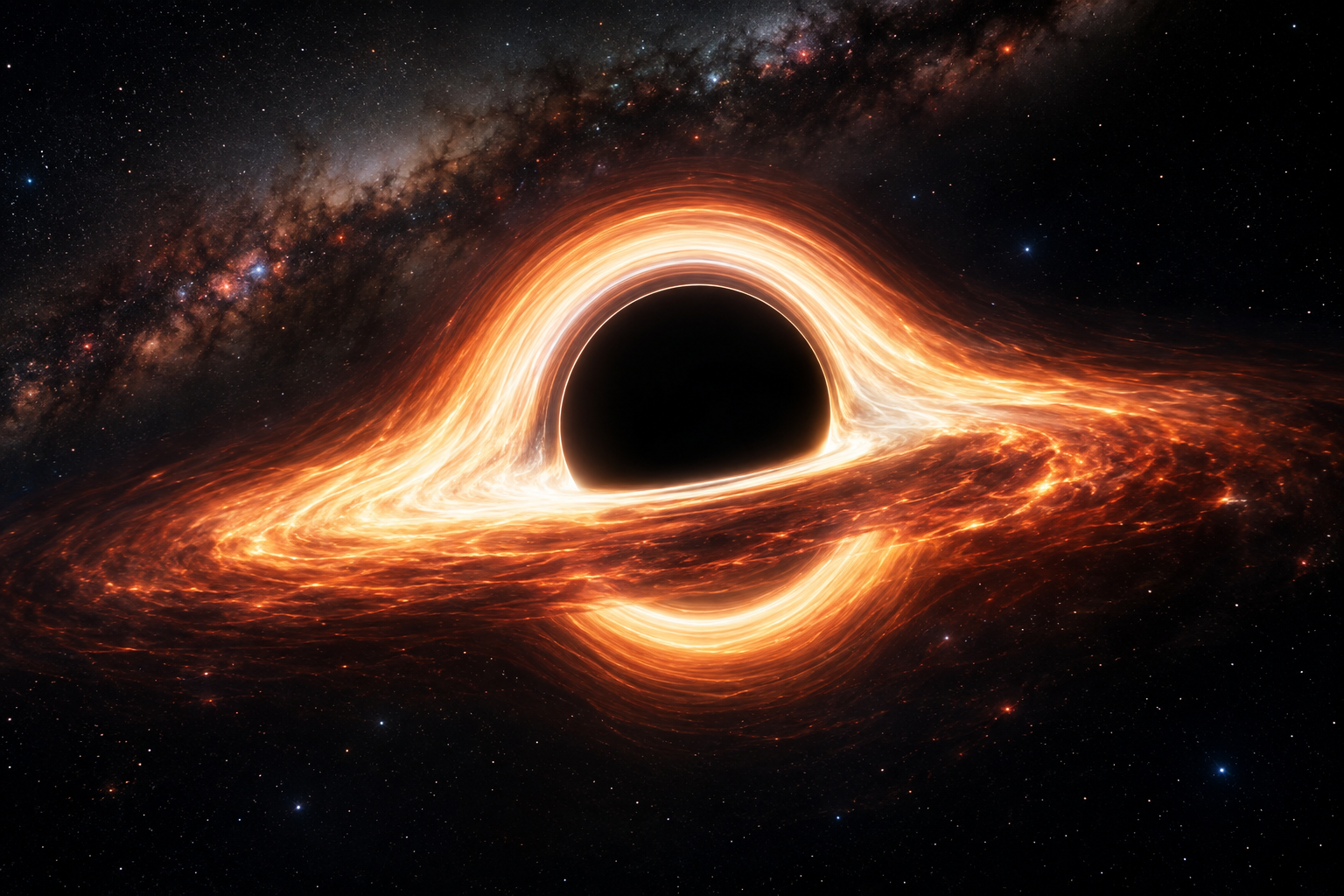

Black holes are among the most fascinating and mysterious objects in the universe. They challenge our understanding of space, time, matter, and even the fundamental laws of physics. Once considered little more than mathematical curiosities, black holes have become one of the most intensively studied subjects in modern astronomy. Over the past century, scientists have progressed from theoretical predictions to direct observations, transforming black holes from abstract concepts into observable cosmic phenomena. Their immense gravitational pull, their influence on nearby stars and galaxies, and their role in shaping the evolution of the universe have made them central to some of the greatest scientific discoveries of our time.
The journey toward understanding black holes is also a story of scientific perseverance. Many of the ideas that eventually led to their acceptance were initially controversial or misunderstood, and it took decades of advances in mathematics, physics, engineering, and observational astronomy before researchers could gather convincing evidence that these extraordinary objects truly exist. Today, black holes are not merely accepted by the scientific community—they have become essential laboratories for testing Einstein's theory of general relativity, studying extreme physics, and exploring some of the deepest unanswered questions about the nature of reality.
The Early Idea of an Invisible Star
The concept of an object so massive that even light could not escape predates modern physics by more than two centuries. During the late eighteenth century, English natural philosopher John Michell proposed the existence of what he called "dark stars." Working within the framework of Newtonian gravity, Michell reasoned that if a star were sufficiently massive and compact, its escape velocity could exceed the speed of light. Since light was then believed to consist of particles influenced by gravity, such an object would become invisible despite its enormous mass.
Around the same time, French mathematician Pierre-Simon Laplace independently reached a similar conclusion. Although these ideas were remarkably insightful, they remained largely speculative because scientists lacked both the theoretical framework and the observational technology necessary to investigate such exotic objects. As wave theories of light gained popularity during the nineteenth century, the notion of dark stars gradually faded from scientific discussion, only to be revived more than a century later by an entirely new understanding of gravity.
Einstein Revolutionizes Gravity
The true foundation of black hole physics emerged in 1915 when Albert Einstein introduced his General Theory of Relativity. Rather than describing gravity as an invisible force acting across space, Einstein demonstrated that massive objects curve the very fabric of spacetime itself. Planets orbit stars not because they are pulled by an invisible force but because they follow the natural curvature created by massive bodies.
This revolutionary idea fundamentally changed our understanding of the universe. Space and time were no longer separate entities but became interconnected into a four-dimensional continuum capable of stretching, bending, and warping under the influence of matter and energy. General relativity successfully explained numerous astronomical observations that Newtonian gravity could not fully account for, including the slight shift in Mercury's orbit and the bending of starlight around the Sun during a solar eclipse.
Einstein himself, however, remained skeptical that nature would actually produce the extreme conditions predicted by some of his equations. While his mathematics allowed for regions where gravity became effectively infinite, he believed that such singular solutions were unlikely to occur in the real universe.
The Schwarzschild Solution
Only months after Einstein published general relativity, German physicist Karl Schwarzschild discovered the first exact solution to Einstein's equations while serving on the front lines during World War I. His solution described the gravitational field surrounding a perfectly spherical, non-rotating mass.
Embedded within Schwarzschild's equations was a remarkable prediction: if enough mass were compressed within a certain critical radius, spacetime would become so severely distorted that nothing—not even light—could escape. This critical boundary eventually became known as the Schwarzschild radius.
For decades, physicists debated whether this strange mathematical result represented a genuine physical object or merely a limitation of the equations themselves. Many assumed that no natural process could compress matter to such extraordinary densities. Only later did advances in stellar physics demonstrate that nature is fully capable of creating these extreme conditions.
How Black Holes Form
Most stellar black holes originate from the deaths of massive stars. Throughout their lives, stars maintain a delicate balance between the inward pull of gravity and the outward pressure produced by nuclear fusion in their cores. Hydrogen atoms fuse into helium, releasing enormous amounts of energy that support the star against gravitational collapse.
Eventually, however, the star exhausts its nuclear fuel. Without sufficient outward pressure, gravity begins to dominate. Smaller stars like our Sun ultimately become white dwarfs, while somewhat larger stars may collapse into neutron stars. The most massive stars, however, experience a catastrophic core collapse that produces an enormous supernova explosion.
If the remaining core contains enough mass, no known force can halt its collapse. Matter is compressed beyond the point where atomic nuclei or even neutron degeneracy pressure can resist gravity. The collapsing core continues shrinking until it forms a black hole, where spacetime itself becomes so severely curved that escape becomes impossible.
The Event Horizon
The defining feature of a black hole is not the singularity at its center but the event horizon surrounding it. The event horizon represents the boundary beyond which no information can ever return to the outside universe.
Crossing the event horizon would not necessarily involve encountering a physical surface. An astronaut falling into a sufficiently massive black hole might notice nothing unusual at the exact moment of crossing. The event horizon is instead a point of no return, marking the region where every possible future path through spacetime leads inevitably toward the center.
To a distant observer, however, an object approaching the event horizon appears to slow dramatically. Light emitted from the falling object becomes increasingly redshifted, losing energy as it struggles against the immense gravitational field. Eventually, the object appears to freeze at the horizon and gradually fade from view, although from its own perspective it continues falling inward.
The Singularity
According to general relativity, the collapse continues until matter reaches an infinitely dense point known as the singularity. At this location, spacetime curvature becomes mathematically infinite, and the known laws of physics cease to provide meaningful predictions.
Most physicists believe that true singularities probably do not exist in nature as literally infinite points. Instead, they likely signal that general relativity is incomplete under such extreme conditions. A future theory combining quantum mechanics with gravity may eventually describe what actually happens inside black holes.
This unresolved conflict between Einstein's theory and quantum physics represents one of the greatest challenges in modern theoretical physics. Understanding the true nature of singularities could ultimately reveal entirely new principles governing the universe.
Rotating Black Holes
Real black holes are rarely perfectly stationary. Because the stars that produce them already rotate, most black holes inherit this angular momentum during collapse. Rotating black holes are described by the Kerr solution, discovered by Roy Kerr in 1963.
Rotation dramatically changes the surrounding spacetime. The black hole drags spacetime around with it in a phenomenon known as frame dragging. Outside the event horizon lies a region called the ergosphere, where spacetime itself is carried around the rotating black hole so strongly that nothing can remain stationary.
These rotating black holes are capable of powering some of the most energetic events in the universe, including enormous jets of particles that travel nearly at the speed of light and extend for thousands of light-years.
Supermassive Black Holes
While stellar black holes contain only a few to several dozen times the Sun's mass, supermassive black holes can contain millions or even billions of solar masses. Nearly every large galaxy appears to harbor one at its center.
Our own Milky Way contains Sagittarius A*, a supermassive black hole with a mass of approximately four million Suns. For decades, astronomers carefully tracked the motions of stars orbiting an apparently empty region at the galactic center. These stellar orbits revealed that an enormous amount of mass must be concentrated into an extraordinarily small volume, providing compelling evidence for a supermassive black hole.
The existence of these giants raises important questions about galaxy formation. Researchers now believe that galaxies and their central black holes likely evolved together, influencing each other's growth throughout cosmic history.
Feeding on Matter
Despite their reputation as cosmic vacuum cleaners, black holes do not actively pull in everything around them. Objects at safe distances can orbit black holes just as planets orbit the Sun. Only matter that ventures sufficiently close becomes trapped.
As gas and dust spiral inward, they form an accretion disk surrounding the black hole. Friction and magnetic forces within this rapidly rotating disk heat the material to millions of degrees, causing it to emit enormous amounts of radiation across the electromagnetic spectrum.
Ironically, while black holes themselves emit no light, the matter surrounding them often becomes some of the brightest objects in the universe. Quasars, powered by actively feeding supermassive black holes, can outshine entire galaxies containing hundreds of billions of stars.
Detecting the Invisible
Since black holes cannot be observed directly through emitted light, astronomers developed indirect methods to detect them. One approach involves observing stars orbiting unseen massive companions. If a visible star moves as though influenced by an invisible object with sufficient mass, a black hole becomes the most likely explanation.
Another method focuses on X-ray emissions from accretion disks. Binary systems containing one normal star and one black hole often produce intense X-rays as material from the companion star falls toward the invisible object.
Gravitational lensing also provides evidence. Massive black holes bend light passing nearby, magnifying and distorting distant galaxies located behind them. This phenomenon allows astronomers to measure the mass of otherwise invisible objects.
Gravitational Waves Open a New Window
A revolutionary breakthrough occurred in 2015 when the Laser Interferometer Gravitational-Wave Observatory (LIGO) detected gravitational waves produced by two merging black holes more than one billion light-years away.
Einstein had predicted gravitational waves a century earlier, but they remained undetected because their effects are incredibly small. LIGO measured distortions in spacetime smaller than the width of a proton, confirming one of general relativity's most remarkable predictions.
Since then, dozens of black hole mergers have been detected, inaugurating an entirely new branch of astronomy. Scientists can now study black holes not only through electromagnetic radiation but also by listening to the ripples they produce in spacetime itself.
The First Image of a Black Hole
Perhaps the most iconic milestone occurred in 2019, when the Event Horizon Telescope collaboration released humanity's first direct image of a black hole. Rather than photographing the black hole itself, astronomers captured the glowing ring of hot gas surrounding the event horizon of the supermassive black hole in the galaxy Messier 87.
The image closely matched predictions made by general relativity decades earlier, providing one of the strongest confirmations of Einstein's theory ever obtained. In 2022, the collaboration achieved another historic success by imaging Sagittarius A*, the supermassive black hole at the center of our own galaxy.
These accomplishments required synchronizing radio telescopes across the globe, effectively creating an Earth-sized virtual telescope capable of resolving extraordinarily fine detail.
Hawking Radiation and Black Hole Evaporation
One of the greatest theoretical breakthroughs came from Stephen Hawking in the 1970s. Combining quantum mechanics with general relativity, Hawking demonstrated that black holes are not entirely black.
Quantum fluctuations near the event horizon allow black holes to emit tiny amounts of thermal radiation, now known as Hawking radiation. Over unimaginably long periods, this process causes black holes to lose mass and eventually evaporate completely.
Although Hawking radiation has never been directly observed because it is extraordinarily weak for astrophysical black holes, the theory fundamentally changed scientific thinking by linking gravity, thermodynamics, and quantum mechanics in profound ways.
The Information Paradox
Hawking's work also created one of the greatest unsolved problems in theoretical physics. If black holes eventually evaporate completely, what happens to the information contained within everything that fell inside them?
Quantum mechanics insists that information cannot be destroyed, yet classical black hole theory appears to erase it permanently. This contradiction, known as the black hole information paradox, has inspired decades of research and remains one of the most important challenges in modern physics.
Proposed solutions involve holographic principles, quantum entanglement, spacetime geometry, and entirely new approaches to quantum gravity. Resolving this paradox may ultimately reveal a deeper understanding of the universe than either quantum mechanics or general relativity alone currently provides.
Black Holes as Laboratories of Extreme Physics
Far from being merely destructive cosmic monsters, black holes have become invaluable scientific tools. They allow researchers to study matter under conditions impossible to reproduce on Earth, test theories of gravity at their limits, investigate quantum phenomena, and better understand galaxy evolution.
Every new observation refines our understanding of these remarkable objects while simultaneously revealing new mysteries. Black holes have become the meeting point of astronomy, cosmology, particle physics, mathematics, and philosophy, demonstrating how interconnected scientific disciplines become when confronting nature's most extreme environments.
Conclusion
The history of black holes illustrates the extraordinary power of scientific inquiry. What began as a speculative idea in eighteenth-century thought experiments evolved into a rigorous prediction of Einstein's revolutionary theory of gravity before eventually becoming one of the most directly observed and intensely studied phenomena in modern astronomy. Advances in telescopes, computational modeling, radio interferometry, and gravitational-wave detection have transformed black holes from mathematical abstractions into observable cosmic realities, allowing scientists to investigate objects that were once thought to be forever beyond human reach.
Yet despite this remarkable progress, black holes continue to guard some of the universe's deepest secrets. Questions surrounding singularities, quantum gravity, Hawking radiation, and the information paradox remind us that our current understanding remains incomplete. Each discovery not only confirms decades of theoretical work but also opens new avenues of investigation, revealing that black holes are not merely the endpoints of collapsing stars but gateways to fundamental questions about space, time, matter, and the very structure of reality. As technology continues to advance and new observatories come online, black holes will undoubtedly remain at the forefront of scientific exploration, challenging our assumptions and expanding humanity's understanding of the cosmos for generations to come.
Member discussion