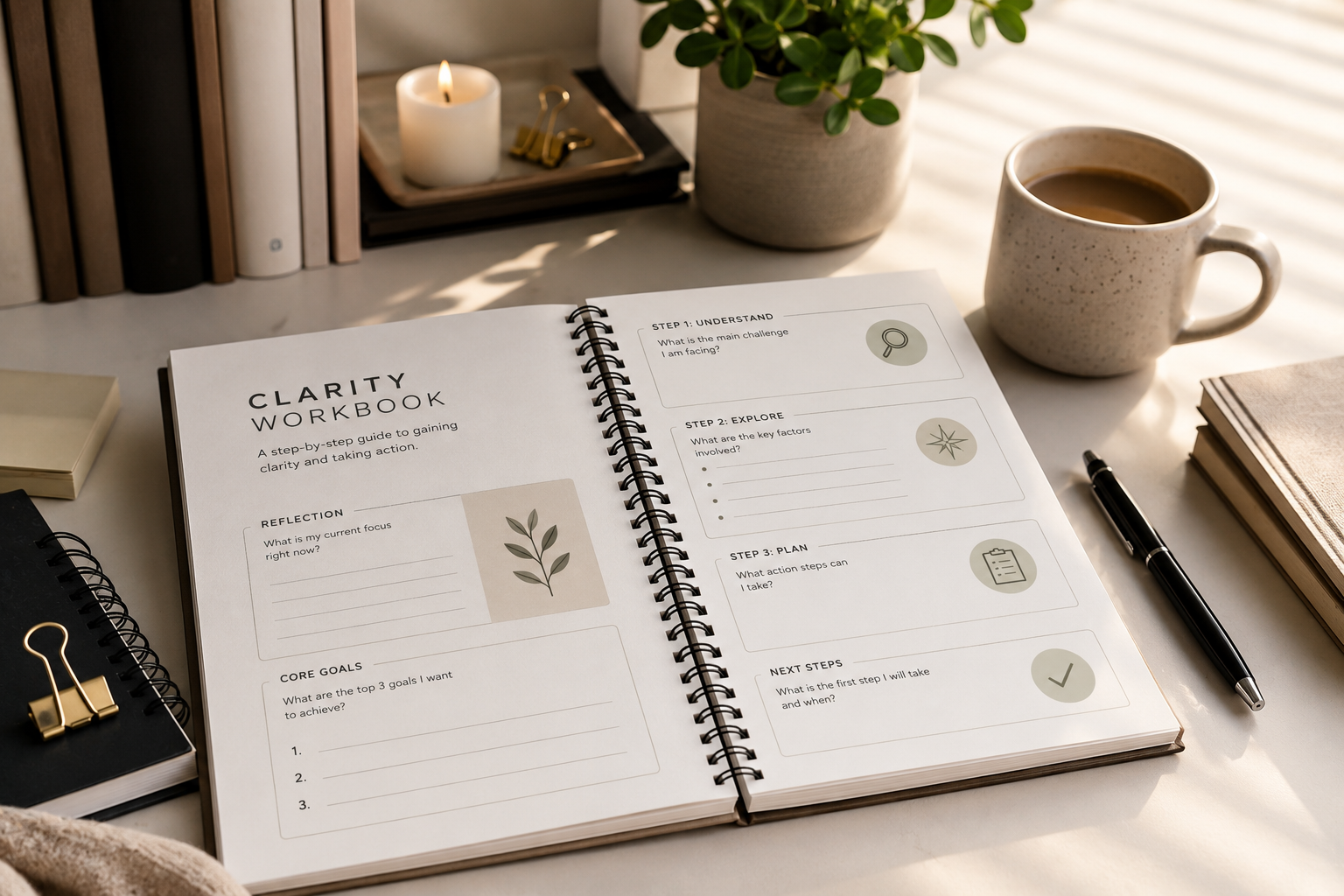

Most experts build their businesses by sharing knowledge. They coach, consult, teach, advise, mentor, and guide people through challenges using the expertise they’ve developed over years of experience. Their value lies not only in what they know but also in their ability to help others apply that knowledge to create meaningful results.
Yet much of that expertise exists only in conversations.
Every week, experts explain the same concepts, answer similar questions, recommend the same exercises, and guide clients through familiar processes. While every client is unique, many of the principles, frameworks, and steps remain remarkably consistent. This creates an opportunity that many experts overlook: transforming their knowledge into resources that continue delivering value long after the conversation has ended.
One of the most effective ways to begin that transformation is by creating a workbook.
A Workbook Turns Passive Learning into Active Progress
Reading can inspire people, but action creates change.
A workbook bridges the gap between understanding an idea and applying it. Instead of simply presenting information, it invites people to reflect, answer questions, make decisions, and work through exercises that move them closer to a specific outcome.
This active participation makes learning more personal. Rather than consuming your expertise, your clients begin using it. They develop insights about their own situation, identify obstacles, clarify their thinking, and create practical plans based on your guidance.
As a result, your knowledge becomes an experience rather than just information.
Your Clients Arrive Better Prepared
Many experts spend valuable session time gathering information that could have been collected beforehand.
Clients often arrive unsure of their goals, unable to articulate their challenges, or still trying to organise their thoughts. The first part of the meeting becomes an exploration rather than focused problem-solving.
A workbook changes that dynamic.
By working through carefully designed questions before the session, clients begin reflecting on their situation in advance. They identify patterns, recognise priorities, and organise information that allows your conversations to begin at a much deeper level.
Instead of spending time discovering the problem, you can spend more time solving it.
That creates a better experience for both you and your client.
You Stop Repeating Yourself
Every expert has explanations they have delivered dozens, if not hundreds, of times.
Perhaps it’s your methodology, your framework, your onboarding process, or a concept that every client needs to understand before moving forward. Repeating those explanations isn’t necessarily a problem, but it does consume time that could be invested elsewhere.
A workbook allows those foundational concepts to exist independently of your presence.
Clients can work through them at their own pace, revisit them whenever necessary, and return with more thoughtful questions. Rather than repeating the same information, you can focus your expertise where it creates the greatest value: interpretation, strategy, feedback, and accountability.
Your sessions become more meaningful because they move beyond the basics.
Your Expertise Becomes a Tangible Asset
One of the challenges of selling expertise is that much of its value is invisible.
A client pays for your knowledge, but they often leave with little more than notes from a conversation and a list of next steps. While the transformation may be significant, there isn’t always a physical reminder of the process.
A workbook changes that.
It becomes something clients can hold, revisit, annotate, and return to months or even years later. Every completed page represents progress. Every exercise becomes evidence of the work they’ve invested in themselves.
The workbook reinforces the value of your expertise long after the engagement has ended.
A Workbook Can Become Much More Than a Workbook
One of the greatest advantages of creating a workbook is that it rarely remains just a workbook.
The exercises inside can become downloadable worksheets. The frameworks can become blog articles. The questions can evolve into self-assessments. The calculations can become interactive calculators. The templates can become digital resources. The concepts can form the foundation of a course, a coaching programme, or an entire library of educational products.
Instead of creating something that serves only one purpose, you’re building intellectual property that can support multiple parts of your business.
Every page you create has the potential to create value in several different ways.
It Makes Your Business More Scalable
Perhaps the greatest benefit of a workbook is that it helps separate your expertise from your time.
Without resources, every client interaction depends entirely on you. Every explanation must be delivered personally, every exercise introduced individually, and every framework recreated during the session.
A workbook allows your knowledge to continue working even when you are not actively present.
It educates clients before meetings, guides them between sessions, and supports them after your work together has finished. Instead of replacing your expertise, it extends it.
That shift allows your business to grow without requiring every additional client to consume proportionally more of your time.
Start with the Knowledge You Already Have
Many experts delay creating a workbook because they believe they need entirely new content.
In reality, the material already exists.
It lives inside your coaching sessions, your client meetings, your presentations, your notebooks, and the countless conversations you’ve had over the years. The questions you ask repeatedly, the exercises you recommend, the frameworks you rely on, and the processes you follow are already the foundation of a workbook.
The task isn’t inventing new expertise.
It’s organising the expertise you already have into a structured journey that helps others move from where they are today to where they want to be.
When you do that, you’re creating more than a workbook.
You’re creating an asset that serves your clients, strengthens your brand, improves your services, and continues creating value long after you’ve finished writing it.
A well-designed workbook doesn’t simply document your knowledge. It multiplies the ways in which that knowledge can help others, allowing your expertise to reach further than your calendar ever could.
Subscribe for free and receive a six-part email course that walks you through the process of turning your expertise into a product, helping you move beyond selling your time for money.
Member discussion