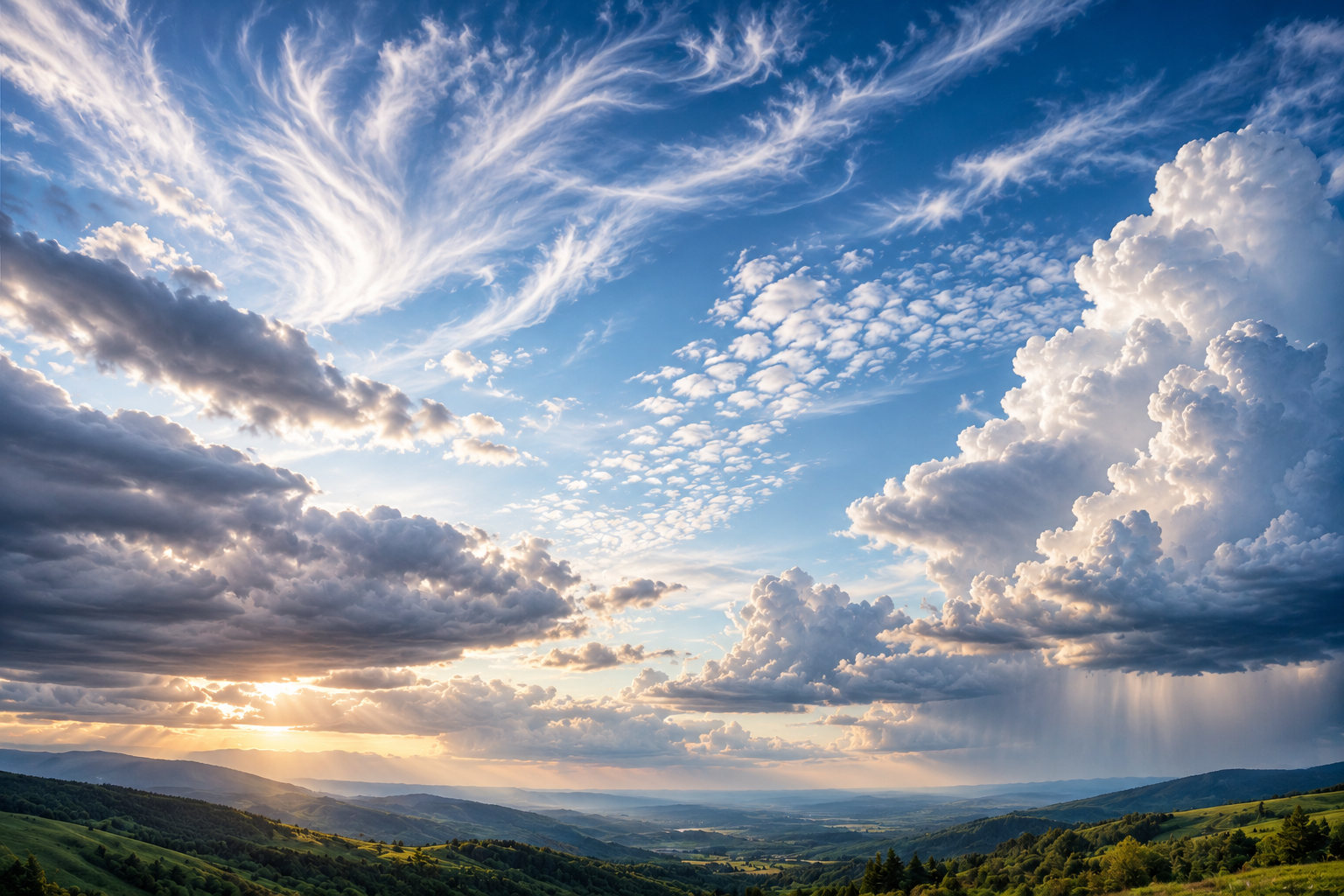

For as long as people have looked up at the sky, clouds have served as nature’s weather forecast. Long before satellites, radar, and smartphone apps, farmers, sailors, and travelers relied on the shapes, heights, and movements of clouds to predict changing conditions. While modern meteorology has become remarkably precise, the sky still tells an incredible story to anyone who knows how to read it.
Clouds form when warm, moisture-rich air rises and cools, causing water vapor to condense into countless tiny droplets or ice crystals. The altitude, temperature, humidity, and atmospheric stability determine what type of cloud develops. Each cloud family is associated with particular weather patterns, making cloud identification a surprisingly useful skill.
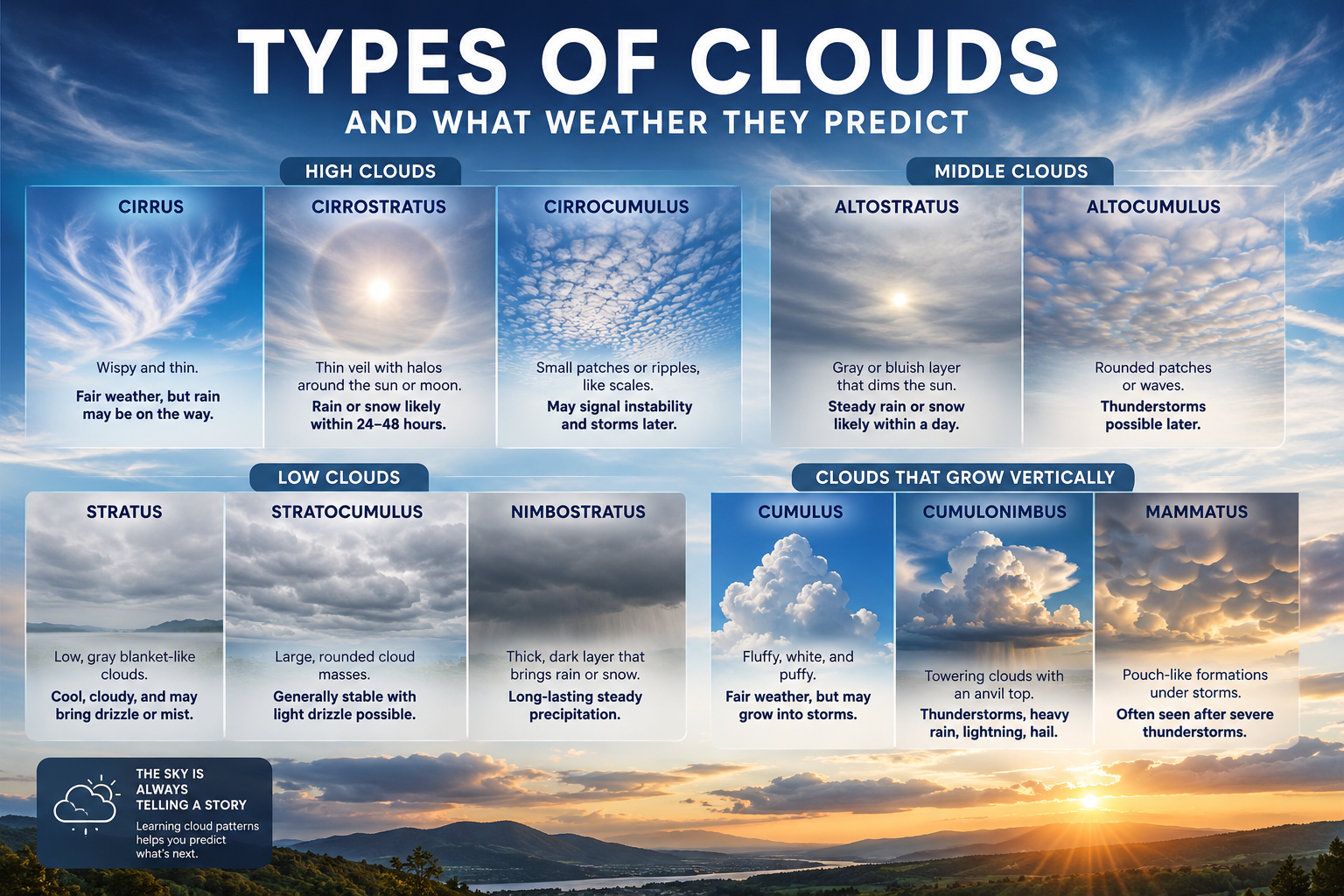
High-Level Clouds: The First Signs of Change
High clouds form between 6 and 13 kilometers (20,000–43,000 feet) above the Earth’s surface. At these altitudes, temperatures are well below freezing, so these clouds consist almost entirely of ice crystals. They rarely produce precipitation that reaches the ground but often announce changes in the weather.
Cirrus (Ci)
Cirrus clouds are the delicate, wispy strands that resemble feathers or horse tails stretching across a blue sky. They are among the highest clouds in the atmosphere and are often carried by strong upper-level winds.
Cirrus clouds usually indicate fair weather in the immediate moment. However, when they gradually increase in number and begin covering more of the sky, they often signal that a warm front is approaching. Rain or snow may arrive within the next 12 to 36 hours.
Cirrostratus (Cs)
These clouds appear as a thin, almost transparent white veil covering much or all of the sky. One of their most recognizable features is the halo they produce around the Sun or Moon, caused by sunlight passing through countless ice crystals.
A cirrostratus layer is one of the clearest indicators that widespread precipitation is approaching. Although the sky may still appear bright, rain or snow is often less than a day away.
Cirrocumulus (Cc)
Cirrocumulus clouds form small white patches or ripples arranged in rows, often resembling fish scales. This pattern is sometimes called a “mackerel sky.”
These clouds usually indicate atmospheric instability at high altitudes. While they do not produce rain themselves, they can precede unsettled weather or thunderstorms later in the day, especially during warmer months.
Middle-Level Clouds: The Atmosphere in Transition
Middle clouds develop between approximately 2 and 7 kilometers (6,500–23,000 feet). They often contain both water droplets and ice crystals and frequently accompany developing weather systems.
Altostratus (As)
Altostratus clouds create a smooth gray or bluish blanket that covers much of the sky. The Sun may still be visible but appears dim, as though viewed through frosted glass.
These clouds usually form ahead of warm fronts and signal prolonged periods of steady rain or snowfall. When an altostratus layer thickens over several hours, precipitation is becoming increasingly likely.
Altocumulus (Ac)
Altocumulus clouds appear as rounded white or gray patches arranged in layers or waves. On warm, humid mornings, towering altocumulus clouds can be an early warning sign of afternoon thunderstorms.
Meteorologists often pay close attention to altocumulus castellanus, which develop small vertical towers. These indicate instability higher in the atmosphere and frequently precede strong convection later in the day.
Low-Level Clouds: Close to the Ground
Low clouds form below about 2 kilometers (6,500 feet). They are composed primarily of water droplets and have the greatest direct influence on everyday weather.
Stratus (St)
Stratus clouds resemble a low, gray blanket that often obscures hills and mountaintops. They are essentially elevated fog.
These clouds produce cool, gloomy conditions and may bring light drizzle or mist. While they rarely generate heavy rain, they can persist for many hours, especially during autumn and winter.
Stratocumulus (Sc)
Stratocumulus clouds consist of large, rounded cloud masses that cover much of the sky while allowing occasional breaks of blue.
They generally indicate stable atmospheric conditions and produce little more than light drizzle. Many overcast days are dominated by stratocumulus, making them one of the world’s most common cloud types.
Nimbostratus (Ns)
The name says it all—“nimbo” means rain. Nimbostratus clouds are thick, dark gray layers that completely block the Sun and deliver widespread, continuous precipitation.
Unlike thunderstorms, nimbostratus clouds produce steady rain or snow that can last for many hours. They are typical of large low-pressure systems moving across continents.
Clouds That Grow Vertically
Some clouds don’t remain confined to a single altitude. Instead, they grow upward through multiple layers of the atmosphere, producing the most dramatic weather events.
Cumulus (Cu)
Cumulus clouds are the classic fluffy white clouds with flat bases and rounded tops that children often imagine as floating cotton balls.
Small fair-weather cumulus clouds typically indicate stable conditions and pleasant weather. However, if they continue growing taller throughout the day, they may be the first stage in thunderstorm development.
Cumulus Congestus
When cumulus clouds grow vertically into towering structures, they become cumulus congestus. Their cauliflower-shaped tops indicate vigorous upward air movement.
These clouds often produce brief showers and may rapidly evolve into full thunderstorms if atmospheric conditions remain unstable.
Cumulonimbus (Cb)
The king of all clouds is the cumulonimbus. Towering up to 18 kilometers (60,000 feet), these immense clouds are responsible for some of Earth’s most extreme weather.
A mature cumulonimbus cloud has a towering vertical column capped by a distinctive anvil-shaped top, where strong upper-level winds spread ice crystals outward.
These clouds produce thunderstorms, torrential rain, hail, lightning, damaging winds, flash floods, and, under the right conditions, tornadoes. When a cumulonimbus cloud approaches, rapidly changing weather should be expected.
Special Clouds Worth Recognizing
Not all clouds fit neatly into the main classifications. Some form under unique atmospheric conditions and provide fascinating clues about the environment.
Fog is simply a stratus cloud that forms at ground level. It develops when humid air cools to its dew point, reducing visibility and often creating hazardous driving conditions.
Lenticular clouds are smooth, lens-shaped formations that develop over mountains as air flows across elevated terrain. Although they look unusual—sometimes even resembling flying saucers—they simply indicate strong winds at higher altitudes.
Mammatus clouds hang like rounded pouches beneath the base of large thunderstorms. They are among the most striking cloud formations and often appear after severe storms rather than before them.
Reading the Sky Like a Meteorologist
Individual clouds provide valuable information, but observing how they change over time reveals even more. A progression from wispy cirrus to cirrostratus, followed by altostratus and finally nimbostratus, typically marks the approach of a warm front and prolonged rainfall.
In contrast, a sunny morning with rapidly growing cumulus clouds that evolve into towering cumulonimbus often indicates localized thunderstorms developing from daytime heating.
Wind direction, cloud movement, humidity, temperature, and atmospheric pressure all work together with cloud observations to create the complete weather picture. Experienced meteorologists combine these clues with sophisticated forecasting models, but even casual observers can make surprisingly accurate predictions by learning the language of clouds.
The Sky Never Stops Speaking
Clouds are far more than beautiful features drifting overhead. They are visible expressions of the invisible movements occurring throughout Earth’s atmosphere. Every cloud tells a story about moisture, temperature, air pressure, and wind, offering clues about what has happened, what is happening now, and what is likely to happen next.
Learning to recognize cloud types transforms an ordinary glance at the sky into an understanding of the atmosphere in motion. Whether you are planning a hike, photographing landscapes, gardening, sailing, or simply appreciating nature, the ability to read the clouds connects you with one of humanity’s oldest and most reliable forms of weather forecasting.
Member discussion