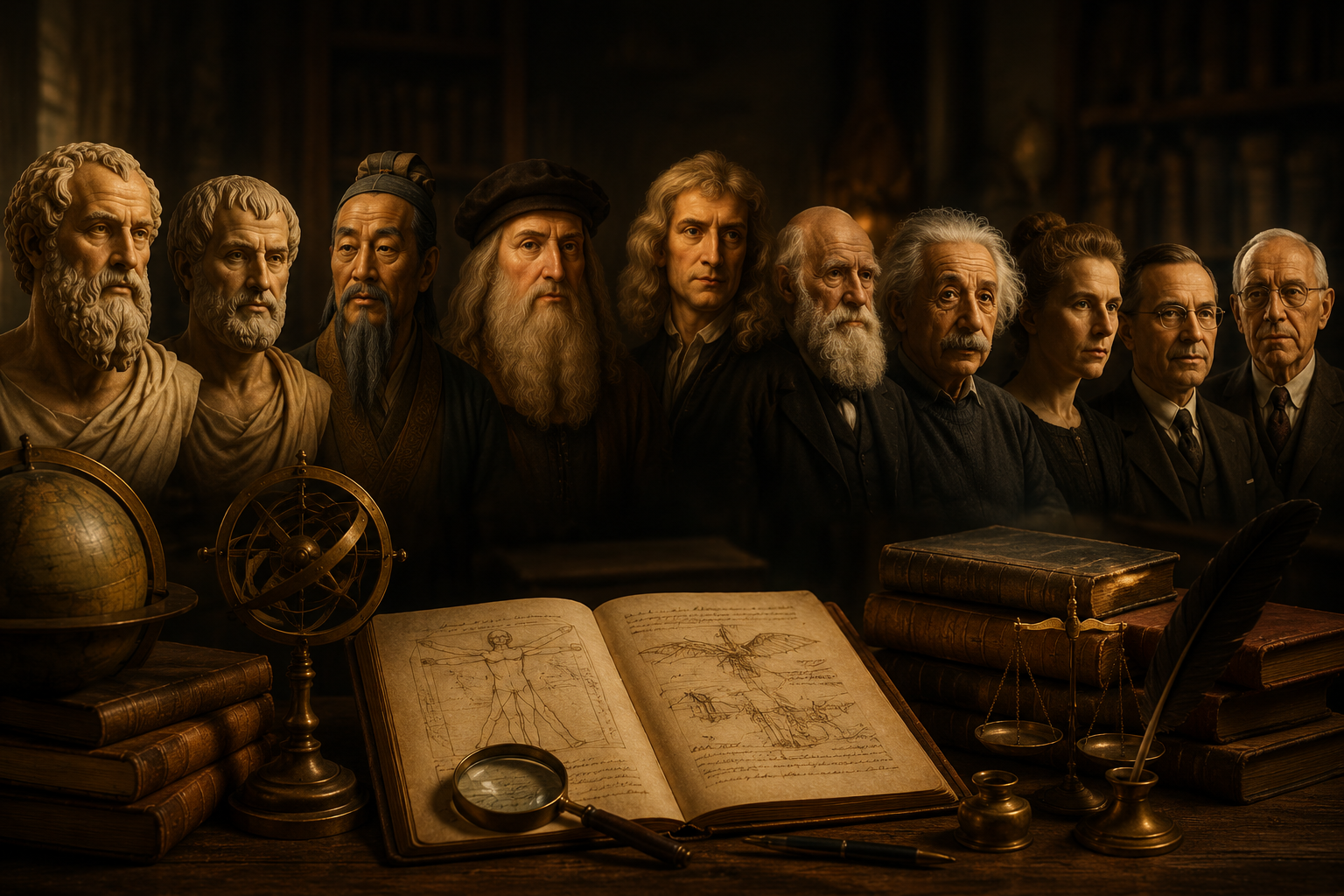

Civilizations are not only built by kings, inventors, and conquerors. They are built first by thinkers. Every scientific breakthrough, political revolution, technological innovation, philosophical movement, and artistic renaissance began as an idea inside the mind of someone who dared to question the accepted view of reality. Long before bridges are constructed or constitutions are written, someone must first imagine a better possibility. Thought precedes action, and for this reason the greatest thinkers have often had a more enduring influence than the greatest rulers.
The remarkable characteristic shared by history's greatest minds is not extraordinary intelligence alone. Rather, it is their willingness to examine assumptions that everyone else accepted without question. They developed methods for thinking rather than merely collecting information. Instead of asking what people believed, they asked why those beliefs existed. Instead of memorizing answers, they learned how to formulate better questions. Their legacy therefore extends far beyond the specific ideas they produced. They transformed the way humanity approaches knowledge itself.
Many of these thinkers lived centuries apart and addressed entirely different subjects, yet their work shares a common thread. Each attempted to uncover fundamental principles that explain the world more accurately than inherited traditions. Some searched for truth through logic, others through observation, experimentation, mathematics, or introspection. Collectively they laid the intellectual foundations upon which modern civilization rests.
Socrates – The Father of Critical Thinking
Few individuals have influenced Western thought as profoundly as Socrates. Although he left behind no writings of his own, his teachings survived through the works of Plato and later philosophers. His greatest contribution was not a doctrine but a method. Socrates believed that wisdom begins with recognizing the limits of one's own knowledge, a principle captured in the famous statement often attributed to him: "I know that I know nothing."
Rather than delivering lectures, Socrates questioned people relentlessly. Through careful dialogue he exposed contradictions in their beliefs, forcing them to examine assumptions they had never consciously considered. This approach, now known as the Socratic Method, remains one of the most powerful educational techniques ever developed. It teaches that genuine understanding emerges not from accepting authority but from disciplined questioning.
The influence of Socrates reaches far beyond philosophy. Modern law schools, scientific inquiry, psychotherapy, and critical education all rely upon forms of structured questioning that trace their origins back to his conversations in the streets of Athens. His commitment to intellectual honesty established a standard that continues to define rigorous thinking more than two thousand years later.
Aristotle – The Architect of Knowledge
If Socrates taught humanity how to ask questions, Aristotle attempted to organize all existing knowledge into coherent systems. Student of Plato and teacher of Alexander the Great, Aristotle explored virtually every field available in his time, including biology, ethics, politics, metaphysics, logic, rhetoric, literature, and natural science. Few individuals have ever demonstrated such extraordinary intellectual breadth.
Perhaps Aristotle's greatest achievement was developing formal logic. He recognized that reasoning follows identifiable structures and created systematic methods for distinguishing valid arguments from invalid ones. His work became the foundation of logical reasoning for nearly two millennia and continues to influence mathematics, computer science, and philosophy today.
Equally significant was Aristotle's insistence on observing nature directly rather than relying solely on speculation. Although many of his scientific conclusions were later corrected, his commitment to empirical observation represented a decisive step toward the scientific method. His work illustrates that progress depends not merely on intelligence but on disciplined investigation.
Confucius – The Philosopher of Harmony
While Greek philosophers explored logic and metaphysics, Confucius transformed the moral and political landscape of East Asia. Living during a period of political instability in ancient China, he sought principles capable of restoring order, justice, and social harmony. Rather than focusing on abstract theories about the universe, Confucius concentrated on the relationships between individuals, families, communities, and governments.
His philosophy emphasized character over power. According to Confucius, a stable society cannot emerge from strict laws alone but requires virtuous individuals who cultivate integrity, humility, responsibility, and respect. Leadership, in his view, is earned through moral example rather than coercion. This emphasis on ethical self-improvement profoundly shaped Chinese civilization for more than two thousand years.
Confucian ideas continue to influence education, family structures, public administration, and cultural values throughout East Asia. His enduring legacy demonstrates that civilizations are sustained not only by institutions but also by the moral character of the people who inhabit them.
Leonardo da Vinci – The Universal Mind
Few historical figures embody intellectual curiosity more completely than Leonardo da Vinci. Painter, engineer, anatomist, inventor, architect, musician, and scientist, Leonardo refused to recognize boundaries between disciplines. He approached every subject with the same relentless desire to understand how things worked.
His notebooks reveal thousands of observations on anatomy, flight, water movement, engineering, geology, and optics. Many of his ideas anticipated technologies that would not become practical until centuries later. Although many of his inventions remained unfinished, his method of combining artistic observation with scientific investigation represents one of history's greatest demonstrations of interdisciplinary thinking.
Leonardo believed that careful observation reveals hidden patterns governing nature. Rather than separating art from science, he viewed both as complementary methods of understanding reality. His intellectual versatility remains a powerful reminder that creativity often emerges where different fields intersect.
Isaac Newton – The Mathematician of the Universe
Isaac Newton fundamentally changed humanity's understanding of the physical world. Before Newton, celestial motions and earthly phenomena appeared governed by different principles. Newton demonstrated that the same universal laws explain both the falling of an apple and the movement of planets across the heavens.
His formulation of the laws of motion and universal gravitation unified physics into a coherent mathematical framework. Equally revolutionary was his independent development of calculus, a mathematical language capable of describing continuous change. These achievements transformed science from qualitative description into quantitative prediction.
Newton exemplified extraordinary concentration. He often devoted years to solving a single problem, convinced that nature possessed underlying order waiting to be discovered. His work illustrates how patience, mathematical precision, and relentless curiosity can reshape humanity's understanding of reality.
Charles Darwin – The Thinker Who Changed Biology
Charles Darwin forever altered humanity's understanding of life by proposing the theory of evolution through natural selection. Rather than viewing species as fixed and unchanging, Darwin demonstrated that life evolves gradually through variation, inheritance, and environmental selection.
His theory united countless biological observations under a single explanatory framework. Evolution provided answers to questions concerning adaptation, biodiversity, extinction, and the relationships among living organisms. More importantly, Darwin exemplified scientific patience. He spent more than twenty years collecting evidence before publishing On the Origin of Species, ensuring that his arguments rested upon overwhelming empirical support.
Darwin's influence extends beyond biology. His approach demonstrates the importance of allowing evidence—not intuition or tradition—to determine conclusions. His work remains a model of careful observation, intellectual humility, and scientific reasoning.
Albert Einstein – Rethinking Reality
Albert Einstein challenged humanity's deepest assumptions about space, time, gravity, and the nature of the universe. His theories of special and general relativity revealed that concepts previously considered absolute are instead relative to motion and gravity. These discoveries fundamentally transformed modern physics.
Einstein possessed an unusual ability to conduct thought experiments. Rather than relying solely upon laboratory equipment, he imagined hypothetical situations that exposed hidden contradictions within existing theories. By asking simple yet profound questions such as what it would be like to ride alongside a beam of light, he uncovered principles that reshaped twentieth-century science.
Despite his extraordinary mathematical achievements, Einstein consistently emphasized imagination. Knowledge, he argued, is limited by existing information, whereas imagination explores possibilities beyond current understanding. His legacy reminds us that innovation often begins by questioning assumptions so fundamental that few people even recognize them.
Marie Curie – The Persistence of Discovery
Marie Curie demonstrated that intellectual greatness requires not only brilliance but extraordinary perseverance. Working under difficult conditions, she discovered the elements polonium and radium while pioneering research into radioactivity, a term she herself introduced.
Curie became the first person ever awarded two Nobel Prizes in different scientific disciplines. Her work laid foundations for nuclear physics, medical imaging, and modern cancer treatments. Yet perhaps her greatest contribution was her unwavering commitment to scientific inquiry despite social barriers that severely limited opportunities for women during her lifetime.
Her career illustrates that discovery depends as much upon discipline, resilience, and dedication as it does upon talent. Curie's example continues to inspire scientists across every discipline.
Carl Jung – Exploring the Human Mind
Swiss psychiatrist Carl Jung expanded humanity's understanding of psychology by investigating the unconscious dimensions of the human mind. While many psychologists concentrated on observable behavior, Jung explored dreams, myths, symbols, religion, and cultural archetypes as windows into universal psychological patterns.
His concept of the collective unconscious proposed that human beings inherit symbolic structures shared across cultures. Jung believed that personal growth requires integrating unconscious aspects of personality rather than suppressing them. Ideas such as archetypes, individuation, and the shadow continue to influence psychology, literature, leadership, and personal development.
Jung's significance lies less in providing definitive answers than in encouraging deeper exploration of human consciousness. He demonstrated that understanding oneself requires examining hidden motivations as carefully as external behavior.
Charlie Munger – The Modern Master of Mental Models
Among contemporary thinkers, few have influenced practical decision-making more than Charlie Munger. Vice Chairman of Berkshire Hathaway alongside Warren Buffett, Munger became famous for advocating a multidisciplinary approach to thinking based on what he called a "latticework of mental models."
Rather than specializing exclusively in finance, Munger argued that sound judgment emerges from combining insights drawn from psychology, economics, biology, mathematics, engineering, history, and physics. According to Munger, relying upon a single perspective inevitably produces distorted conclusions. Reality is too complex to be understood through one discipline alone.
His philosophy has transformed modern approaches to investing, business strategy, and decision-making. Mental models such as inversion, margin of safety, compounding, incentives, and opportunity cost have become essential tools for individuals seeking clearer thinking in uncertain environments. Munger demonstrated that wisdom is less about possessing more information than about organizing knowledge into useful frameworks that improve judgment.
What Unites the Greatest Thinkers?
Although these remarkable individuals lived in different cultures and pursued different disciplines, they share striking characteristics. Each questioned accepted beliefs rather than accepting tradition as final authority. Each cultivated deep curiosity, remained willing to revise opinions when confronted with new evidence, and devoted years—even decades—to understanding difficult problems. Most importantly, they developed methods for thinking that outlived the specific conclusions they reached.
Their greatest legacy is therefore not a collection of isolated discoveries but an invitation to think more carefully ourselves. Logic, observation, experimentation, first principles, interdisciplinary learning, critical questioning, and intellectual humility are tools available to anyone willing to practice them. Great thinkers are not remembered simply because they knew more than others. They are remembered because they taught humanity better ways of searching for truth.
The study of great thinkers ultimately serves a practical purpose. By learning how Socrates questioned assumptions, Aristotle organized knowledge, Confucius cultivated virtue, Leonardo connected disciplines, Newton searched for universal laws, Darwin followed evidence, Einstein reimagined reality, Curie persevered through adversity, Jung explored the mind, and Charlie Munger assembled mental models, we gradually improve our own capacity for judgment. Knowledge informs us, but the disciplined habits of great thinking transform knowledge into wisdom.
Member discussion