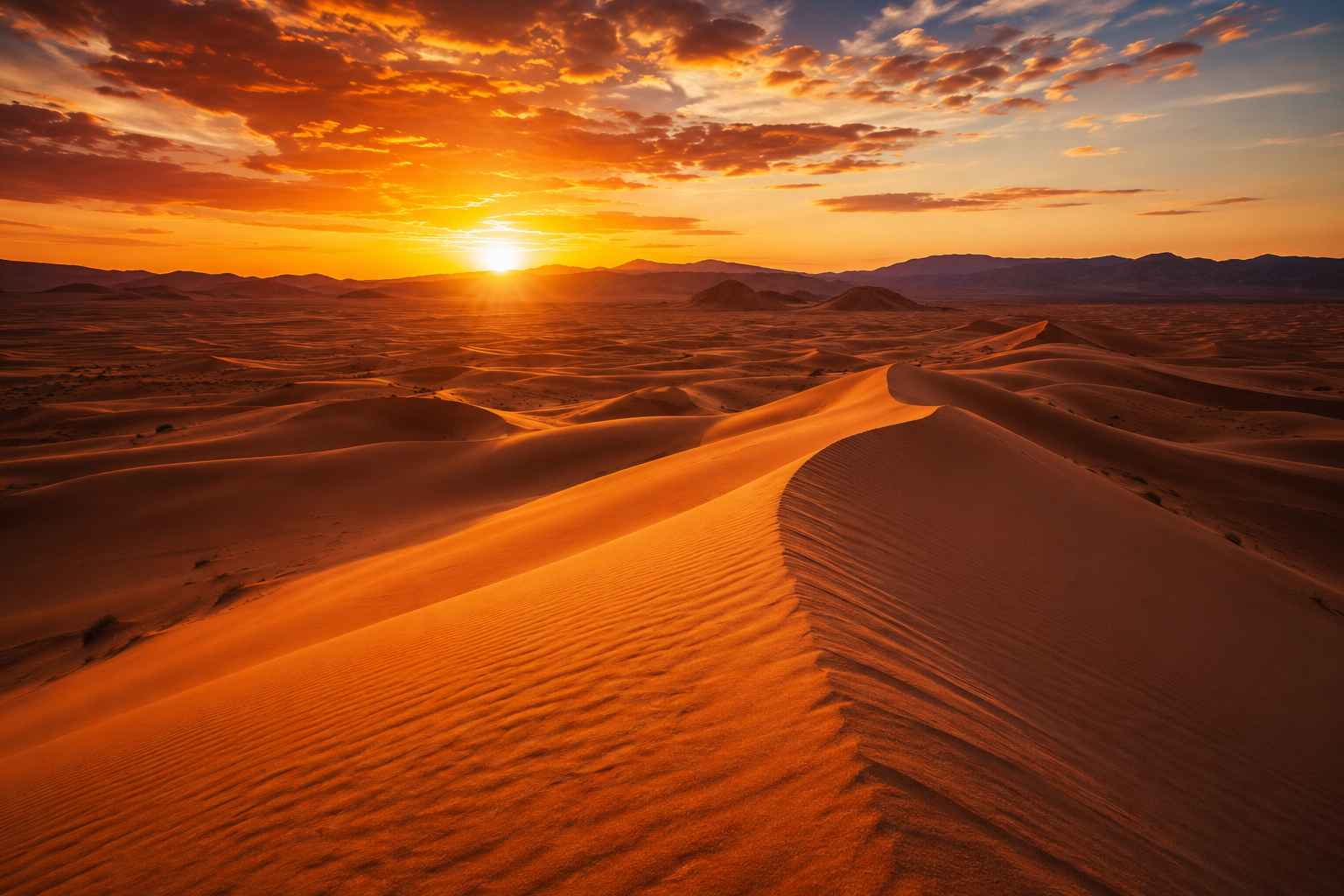

Deserts are often imagined as endless seas of golden sand beneath a scorching sun, but the reality is far more diverse and fascinating. A desert is defined not by its temperature or the presence of sand, but by its lack of precipitation. Any region that receives very little rainfall—typically less than 250 millimeters (10 inches) annually—is considered a desert. This means deserts can be blisteringly hot, bitterly cold, rocky, mountainous, or even covered in ice.
Despite their harsh conditions, deserts are home to uniquely adapted plants, animals, and human cultures that have learned to survive where life might seem impossible. They also play an essential role in Earth’s climate, geology, and biodiversity. From the immense ice sheets of Antarctica to the towering dunes of the Sahara, the world’s deserts are among the planet’s most extraordinary natural environments.
Antarctica: The World’s Largest Desert
Many people are surprised to learn that the largest desert on Earth is not hot at all. Antarctica is, in fact, the world’s largest desert, covering approximately 14 million square kilometers (5.4 million square miles).
Although the continent is almost entirely covered by ice, it receives very little precipitation, making it technically a polar desert. Some parts of Antarctica receive less annual precipitation than the Sahara Desert. Most of its moisture remains permanently frozen, while fierce katabatic winds regularly sweep across the landscape at extraordinary speeds.
Despite its seemingly lifeless appearance, Antarctica supports penguins, seals, whales, and microscopic organisms specially adapted to survive in one of the harshest environments on Earth.
The Arctic Desert
The Arctic is the second-largest desert on the planet, stretching across northern Canada, Greenland, Russia, Alaska, Norway, and other polar regions.
Like Antarctica, the Arctic receives minimal precipitation. Instead of sand dunes, the landscape consists of ice, snow, frozen tundra, and rocky terrain. During winter, darkness can last for months, while summer brings nearly continuous daylight.
Wildlife such as polar bears, Arctic foxes, musk oxen, snowy owls, and seals have evolved remarkable adaptations that allow them to thrive despite freezing temperatures and limited food supplies.
The Sahara Desert
When most people picture a desert, they are imagining the Sahara. Covering roughly 9.2 million square kilometers (3.6 million square miles), it is the largest hot desert in the world and spans eleven countries across North Africa.
Contrary to popular belief, only about a quarter of the Sahara consists of sand dunes. Much of the landscape is rocky plateaus, gravel plains, mountains, and dry valleys. Towering dunes, some exceeding 180 meters (600 feet), are found primarily in specific regions known as ergs.
Daytime temperatures can exceed 50°C (122°F), while nighttime temperatures may drop close to freezing due to the extremely dry air. Yet life persists through resilient species such as fennec foxes, camels, desert reptiles, scorpions, and hardy vegetation clustered around precious oases.
The Sahara has not always been dry. Thousands of years ago, much of the region was covered with grasslands, rivers, lakes, and abundant wildlife. Ancient rock paintings still depict giraffes, elephants, and hippopotamuses that once lived there during a much wetter climate.
The Arabian Desert
Stretching across much of the Arabian Peninsula, the Arabian Desert covers around 2.3 million square kilometers (890,000 square miles). It encompasses Saudi Arabia, Oman, the United Arab Emirates, Yemen, Jordan, Iraq, and neighboring countries.
One of its most famous regions is the Rub’ al Khali, or the Empty Quarter, which contains one of the world’s largest continuous sand deserts. Massive dunes rise hundreds of feet high, creating an almost endless landscape of shifting golden waves.
Despite its harsh environment, the Arabian Desert has supported Bedouin communities for centuries. Today, modern cities coexist alongside ancient caravan routes that once connected Asia, Africa, and Europe.
The Gobi Desert
Unlike the Sahara, the Gobi Desert is a cold desert. Spanning northern China and southern Mongolia, it covers approximately 1.3 million square kilometers (500,000 square miles).
The Gobi experiences dramatic seasonal extremes. Summers can exceed 40°C (104°F), while winter temperatures frequently plunge below –40°C (–40°F). Snowfall occasionally blankets parts of the desert, demonstrating that deserts are not always hot.
The Gobi is famous for its dinosaur fossils, many of which have transformed our understanding of prehistoric life. Today, it remains home to wild Bactrian camels, snow leopards, gazelles, wolves, and numerous bird species.
The Kalahari Desert
The Kalahari stretches across Botswana, Namibia, and South Africa, covering roughly 900,000 square kilometers (350,000 square miles). Unlike many deserts, the Kalahari receives enough seasonal rainfall to support grasses, shrubs, and scattered trees.
Its wildlife is exceptionally rich, including lions, cheetahs, meerkats, elephants, giraffes, antelope, and countless bird species. The indigenous San people have lived in the Kalahari for thousands of years, developing extraordinary knowledge of water sources, edible plants, and animal behavior.
Rather than appearing barren, much of the Kalahari comes alive after seasonal rains, transforming into a surprisingly vibrant landscape.
The Patagonian Desert
Occupying much of southern Argentina, the Patagonian Desert is the largest desert in South America. Covering approximately 670,000 square kilometers (260,000 square miles), it lies in the rain shadow of the Andes Mountains.
Strong winds constantly shape its rocky plains and sparse vegetation. Although relatively cool compared to tropical deserts, rainfall remains extremely limited.
The region supports guanacos, rheas, foxes, armadillos, and even the elusive puma. Its dramatic scenery attracts hikers, photographers, and nature enthusiasts from around the world.
The Great Victoria Desert
Australia is home to several major deserts, the largest of which is the Great Victoria Desert. Covering approximately 348,000 square kilometers (134,000 square miles), it stretches across Western Australia and South Australia.
The landscape combines red sand dunes, grasslands, salt lakes, and low shrublands. Despite its remote appearance, the desert supports a surprising diversity of reptiles, marsupials, birds, and flowering plants.
Indigenous Aboriginal Australians have lived throughout this region for tens of thousands of years, maintaining a profound cultural and spiritual connection with the land.
The Atacama Desert
Located primarily in northern Chile, the Atacama Desert is widely regarded as the driest non-polar desert on Earth.
Some weather stations in the Atacama have recorded decades without measurable rainfall. The combination of cold ocean currents and surrounding mountain ranges creates conditions that prevent clouds from forming.
Its barren landscape resembles the surface of Mars so closely that NASA has tested robotic equipment there before sending missions into space. Yet even here, specialized plants, microorganisms, flamingos, and hardy mammals survive in isolated pockets where water exists.
Life Finds a Way
Although deserts appear hostile, they are remarkable examples of nature’s ability to adapt. Desert plants conserve water through thick stems, waxy coatings, deep roots, or tiny leaves. Many animals avoid the intense daytime heat by becoming nocturnal, while others obtain nearly all the moisture they need from their food.
Human civilizations have also adapted to desert environments for thousands of years through ingenious irrigation systems, architecture designed to stay cool, and deep knowledge of seasonal weather patterns.
Far from being empty wastelands, deserts support unique ecosystems found nowhere else on Earth.
Why Deserts Matter
Deserts influence global weather patterns, store valuable mineral resources, preserve ancient fossils, and provide important habitats for countless species. They are also increasingly valuable for renewable energy, as many receive abundant sunshine suitable for large-scale solar power generation.
However, deserts remain fragile environments. Climate change, overgrazing, groundwater depletion, and expanding human development threaten many desert ecosystems. Protecting these landscapes helps preserve biodiversity, scientific knowledge, and cultural heritage that has evolved over millennia.
A World of Extraordinary Extremes
The world’s great deserts reveal that beauty can exist in the harshest places. Whether it is the icy silence of Antarctica, the endless dunes of the Sahara, the fossil-rich plains of the Gobi, or the seemingly lifeless expanses of the Atacama, each desert tells a story of resilience, adaptation, and the remarkable diversity of our planet.
Though often viewed as empty spaces, deserts are anything but barren. They are living landscapes shaped by wind, time, and survival, reminding us that life has an extraordinary ability to flourish even under the most challenging conditions.
Member discussion