

Have you ever met someone who spoke with absolute confidence despite clearly lacking knowledge on the subject? Perhaps you have also experienced the opposite—becoming more knowledgeable about a topic only to realize how much there is still to learn. This paradox is explained by the Dunning–Kruger effect, a cognitive bias in which people with limited knowledge or skill in a particular domain tend to overestimate their competence, while those with greater expertise often assess themselves more cautiously. Understanding this phenomenon is essential because it influences learning, decision-making, leadership, and personal growth.
The Dunning–Kruger effect is not simply about arrogance or intelligence. Instead, it highlights a fundamental limitation of human cognition: the skills required to perform a task well are often the same skills needed to evaluate one's own performance accurately. Without sufficient knowledge, individuals lack the ability to recognize their mistakes, making overconfidence a predictable outcome rather than a personal flaw.
The Origins of the Dunning–Kruger Effect
The concept was introduced in 1999 by psychologists David Dunning and Justin Kruger following a series of experiments that examined how people assessed their own abilities. Participants completed tests involving humor, logical reasoning, and grammar before estimating how well they had performed compared to others. The researchers consistently found that participants who performed the worst tended to rate themselves far above their actual level of competence, while high-performing individuals often underestimated their relative performance.
These findings demonstrated that poor performers were disadvantaged twice. Not only did they make more mistakes, but they also lacked the knowledge necessary to recognize those mistakes. As a result, they remained confident even when their judgments were objectively incorrect. This insight has since been replicated across numerous disciplines and has become one of the most widely recognized cognitive biases in psychology.
Why Overconfidence Happens
The primary cause of the Dunning–Kruger effect is a lack of metacognitive ability—the capacity to evaluate one's own thinking and performance accurately. When people possess only a superficial understanding of a subject, they often mistake familiarity for mastery. Because they know just enough to feel confident but not enough to recognize complexity, they develop an inflated perception of their competence.
As individuals gain more experience, they begin to encounter exceptions, competing viewpoints, and deeper layers of complexity. This growing awareness often reduces confidence because they realize that the subject is more nuanced than they initially believed. Eventually, genuine expertise develops alongside a more balanced and realistic assessment of personal ability, producing confidence that is grounded in evidence rather than assumption.
The Confidence Curve
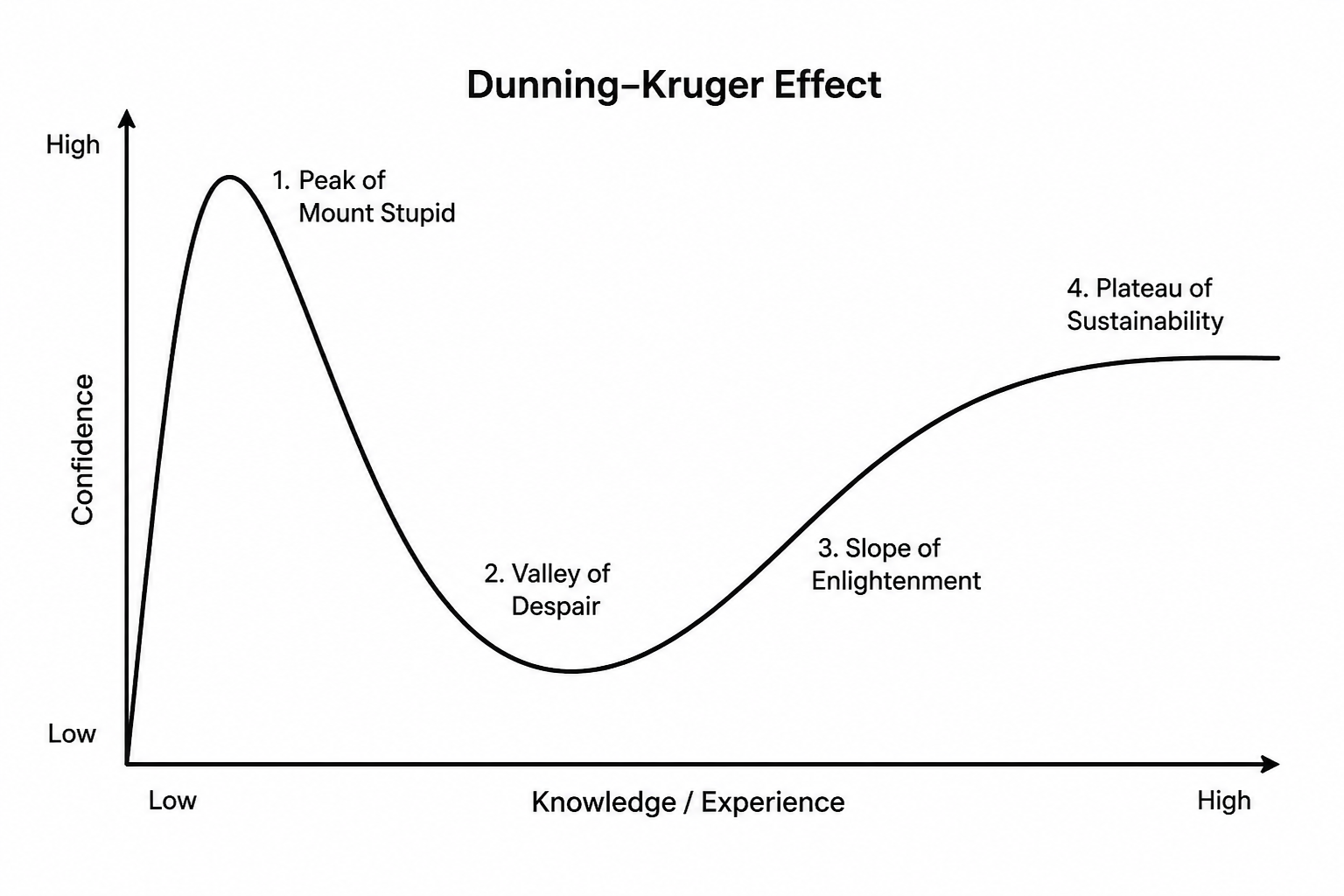
The Dunning–Kruger effect is frequently illustrated as a confidence curve that changes as knowledge increases. At the beginning of the learning process, confidence rises rapidly because early progress creates the impression that the subject is relatively simple. This initial enthusiasm can produce a false sense of mastery, leading individuals to overestimate both their understanding and their abilities.
As learning continues, confidence often declines because new information reveals previously unseen complexities. This period can be uncomfortable, but it represents genuine intellectual growth rather than failure. With sustained practice and experience, confidence gradually returns, this time supported by competence, evidence, and a realistic understanding of both strengths and limitations.
Real-World Examples
The Dunning–Kruger effect appears in nearly every area of life. New investors may believe they have discovered foolproof strategies after a few successful trades, only to underestimate the complexity of financial markets. Beginning entrepreneurs may assume that launching a business is straightforward before encountering challenges related to marketing, operations, finance, and leadership. Similarly, individuals who read a handful of articles about nutrition, psychology, or economics may become convinced they fully understand subjects that experts spend decades studying.
The bias is also common in professional environments. Employees may overestimate their abilities while resisting feedback, managers may make decisions outside their expertise with excessive confidence, and leaders may ignore valuable advice because they fail to recognize the limits of their own knowledge. In each case, overconfidence increases the likelihood of poor decisions and missed opportunities for learning.
The Hidden Cost of Overconfidence
Overconfidence can have serious consequences because it discourages further learning. People who believe they already possess sufficient knowledge are less likely to seek feedback, question their assumptions, or invest time in developing new skills. This creates a cycle in which confidence remains high while competence improves only slowly, if at all.
The Dunning–Kruger effect also affects communication and collaboration. Individuals who overestimate their expertise may dismiss opposing viewpoints, dominate discussions, or make decisions without considering alternative perspectives. This behavior can reduce trust, hinder teamwork, and create unnecessary conflict, particularly in environments where thoughtful analysis is essential.
Recognizing the Bias in Yourself
Although it is easy to recognize overconfidence in others, identifying it within ourselves is considerably more difficult. The most effective defense is intellectual humility—the willingness to acknowledge uncertainty and remain open to new evidence. Rather than assuming that confidence reflects competence, thoughtful individuals regularly ask whether they possess enough knowledge to justify their conclusions.
Seeking constructive feedback is another powerful strategy. Other people often notice weaknesses and blind spots that are invisible to us. Reading opposing viewpoints, consulting experts, and actively testing personal assumptions all improve self-awareness and reduce the likelihood of overestimating one's abilities. The goal is not to eliminate confidence but to ensure that confidence reflects reality.
Developing Accurate Self-Assessment
Improving self-assessment requires continuous learning and reflection. Keeping a decision journal, reviewing past predictions, and analyzing mistakes can reveal patterns that would otherwise remain hidden. Over time, this practice strengthens metacognitive skills and produces a more accurate understanding of personal strengths and weaknesses.
Deliberate practice also plays an important role because it provides objective feedback about performance. Instead of relying on feelings of confidence, deliberate practice emphasizes measurable improvement through repetition, coaching, and consistent evaluation. This evidence-based approach helps replace false confidence with genuine competence.
Conclusion
The Dunning–Kruger effect reminds us that confidence and competence are not always aligned. Limited knowledge often creates the illusion of expertise, while deeper understanding reveals complexity and encourages humility. Recognizing this bias is an important step toward becoming a better learner, decision-maker, and thinker because it encourages curiosity instead of certainty and reflection instead of assumption.
The most effective thinkers are not those who believe they know everything but those who continually question their own understanding. By embracing intellectual humility, seeking honest feedback, and remaining committed to lifelong learning, we can reduce the influence of the Dunning–Kruger effect and develop confidence that is supported by genuine knowledge and experience.
Member discussion