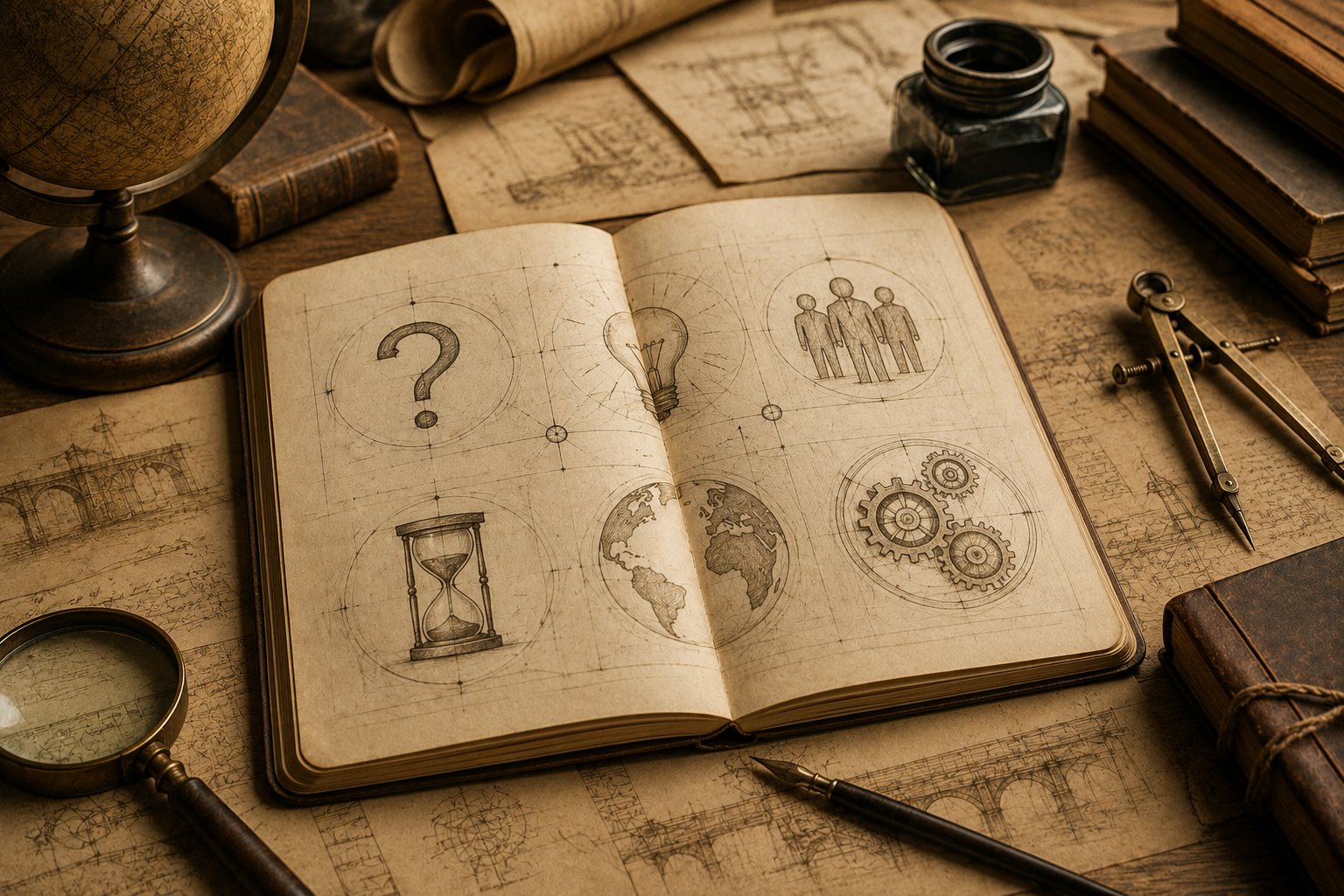

Exploring a topic effectively requires more than collecting information. It requires a structure that helps us understand what something is, why it matters, who is involved, when and where it occurs, and how it works. The 5W1H method provides a simple but powerful framework for doing exactly this. By asking six fundamental questions — What, Why, Who, When, Where, and How — we can move from a surface-level awareness of a subject toward a more complete and connected understanding.
What Is the 5W1H Method?
The 5W1H method is an investigative framework built around six questions: What is it? Why does it matter? Who is involved? When does it happen? Where does it occur? How does it work? These questions can be applied to almost any subject, from a scientific concept or historical event to a business model, artistic movement, technology, or personal skill.
The strength of the method comes from its simplicity. Instead of approaching a topic as an undifferentiated mass of information, the learner divides it into distinct dimensions. Each question opens a different path of inquiry, while the answers begin to connect with one another and form a coherent mental model.
What: Establishing the Subject
The first question is What? It establishes the basic identity and boundaries of the topic. Before attempting to understand something deeply, we need to know what we are actually studying. This involves defining the subject, identifying its essential characteristics, understanding its terminology, and distinguishing it from related concepts.
For example, if the topic is deliberate practice, the “What?” question might explore what deliberate practice means, how it differs from ordinary repetition, what its defining characteristics are, and what activities qualify as deliberate practice. This creates a conceptual foundation on which the rest of the investigation can build.
Why: Understanding Significance
Once we know what something is, the next question is Why? This moves the investigation from description toward significance. Why does the topic exist? Why does it matter? Why did it develop? Why should we care about it? What problem does it solve, or what consequences does it produce?
The “Why?” question is particularly important because information without significance is difficult to retain and apply. Understanding why a phenomenon matters allows us to connect facts to causes, consequences, purposes, and broader ideas. It transforms knowledge from a collection of statements into an explanation.
Who: Identifying the People and Perspectives
The question Who? introduces the human dimension of a topic. Depending on the subject, this might involve identifying its creators, researchers, practitioners, institutions, users, critics, beneficiaries, or people affected by it. It can also reveal competing perspectives and disagreements.
When exploring a historical event, for example, “Who?” might involve the leaders who shaped it, the communities affected by it, and the historians who later interpreted it. When exploring a scientific theory, it could involve the researchers who developed it, the scientists who tested it, and the communities that use it today. This prevents us from treating knowledge as something detached from the people and systems that produce it.
When: Adding Time and Development
The question When? places the topic within a temporal context. It asks when something began, when important developments occurred, how it changed over time, and whether its significance has evolved.
Time can fundamentally change our understanding of a subject. An idea that was revolutionary when introduced may later become conventional, while a technology that was once experimental may eventually become widespread. Looking at a topic chronologically allows us to distinguish origins from later developments and understand how one stage led to another.
Where: Exploring Context
The question Where? examines the geographical, cultural, institutional, or environmental context surrounding a topic. Some ideas develop differently depending on where they emerge and who encounters them.
Exploring where something happens can reveal patterns that are invisible when the topic is considered in isolation. A political movement, artistic style, scientific discovery, or business practice may be strongly influenced by its geographical location, cultural environment, available resources, institutions, or surrounding communities. Context therefore becomes part of the explanation rather than merely background information.
How: Understanding Mechanisms
The final question is How? This is often the most analytical part of the investigation because it asks how something actually works. It moves beyond definitions and descriptions toward mechanisms, processes, methods, relationships, and applications.
For example, if we are studying deliberate practice, “How?” would examine how a person identifies weaknesses, designs targeted exercises, receives feedback, corrects errors, and gradually increases the difficulty of the task. Understanding the mechanism makes the knowledge actionable because we can begin to reproduce or apply the process ourselves.
Moving Beyond Six Separate Questions
The real value of 5W1H appears when the six questions are connected rather than treated as an isolated checklist. What establishes the subject, why establishes its significance, who identifies the people and perspectives involved, when provides historical development, where provides context, and how reveals the underlying process.
The answers should therefore lead naturally into further questions. Understanding what something is may raise questions about why it developed. Understanding why it developed may lead us to investigate who influenced it. Discovering who was involved may require us to examine when and where their contributions occurred. Understanding all of these elements eventually allows us to ask how the system works as a whole.
Using 5W1H to Explore a New Topic
When encountering an unfamiliar subject, the method can be used as a first-pass investigation. Begin by writing the six questions and answering each one using reliable sources. At this stage, the objective is not to become an expert but to construct an initial map of the subject.
Once the basic answers are established, identify the questions that remain incomplete or particularly interesting. These become the next areas of investigation. The process can then become iterative: each answer generates new questions, and each new question expands the mental model. In this sense, 5W1H is not simply a way of organizing information; it is a mechanism for generating inquiry.
Using 5W1H for Deeper Learning
The framework becomes even more powerful when combined with comparison, evidence, and application. After establishing what something is and why it matters, we can compare it with related concepts. After identifying how it works, we can examine evidence for whether it actually works. After understanding its historical development, we can consider whether the same principles apply today.
This turns the method into a progression from orientation to understanding, and from understanding to evaluation. The learner begins by mapping the territory, then investigates relationships and mechanisms, and finally tests whether the resulting understanding is accurate and useful.
Applying the Method to Any Subject
Imagine that you want to explore the topic of artificial intelligence. What would establish what AI is and distinguish it from related technologies. Why would examine why AI has become significant and what problems it is intended to solve. Who would investigate researchers, companies, users, regulators, and people affected by the technology. When would trace its development from early computing research to contemporary systems. Where would examine the countries, industries, institutions, and environments in which AI is being developed and deployed. How would finally investigate how AI systems are trained, how they generate outputs, and how those outputs are used.
By answering all six questions, the learner develops a much richer understanding than they would by simply reading a definition of artificial intelligence. The topic becomes a network of relationships rather than a single piece of information.
From Information to Understanding
The fundamental purpose of 5W1H is to transform information into structure. Facts become more meaningful when we understand their causes, context, participants, chronology, and mechanisms. The framework encourages curiosity while preventing investigation from becoming directionless.
It is particularly useful for independent learning because it provides a starting point whenever we encounter something unfamiliar. Instead of asking only, “What should I read about this?”, we can ask a sequence of more precise questions that determines what information we actually need.
Conclusion
The 5W1H method is a simple framework for turning an unfamiliar topic into an organized investigation. By asking What, Why, Who, When, Where, and How, we examine a subject from multiple perspectives and begin to understand not only what something is, but also why it matters, who shaped it, how it developed, where it exists, and how it functions.
Used properly, 5W1H is more than a note-taking technique. It is a thinking tool for exploration. It provides the initial structure for inquiry, exposes gaps in knowledge, generates better questions, and helps learners build connected mental models. Most importantly, it creates a repeatable method for approaching almost any subject with curiosity, structure, and intellectual depth.
Member discussion