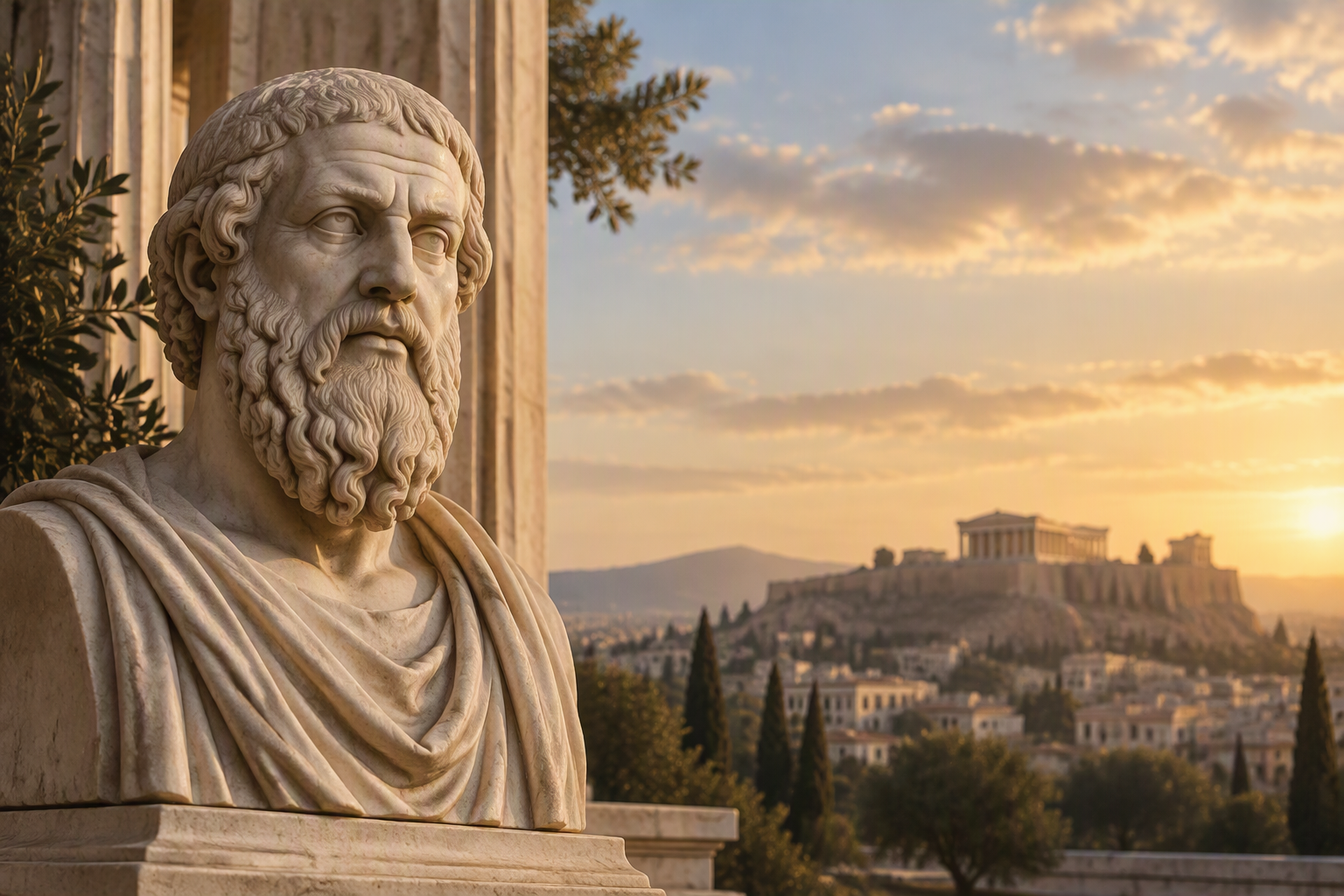

More than 2,400 years after his death, Socrates remains one of the most influential thinkers in human history. Although he never wrote a single book, his ideas helped shape Western philosophy, education, ethics, and critical thinking. His commitment to asking difficult questions and seeking truth continues to inspire students, scholars, and ordinary people around the world. Socrates believed that wisdom begins with recognizing how little we truly know. In an age filled with information, his message may be more relevant than ever.
Who Was Socrates?
Socrates was born around 470 BCE in Athens, Greece, during a period often considered the height of Greek civilization. Little is known about his early life, but historical accounts suggest that he served as a soldier before becoming a philosopher. Unlike many teachers of his time, Socrates did not charge money for his lessons. Instead, he spent his days in public spaces, engaging citizens in conversations about justice, virtue, courage, wisdom, and the good life. His unusual teaching method involved asking a series of questions that challenged people to examine their beliefs. Most of what we know about Socrates comes from the writings of his students, especially Plato, who portrayed him as a passionate seeker of truth and a relentless critic of shallow thinking.
The Socratic Method
Perhaps Socrates’ most enduring contribution is the Socratic Method. Rather than lecturing, he guided discussions by asking questions. His goal was not to provide easy answers but to help others discover weaknesses and contradictions in their own reasoning. A typical conversation might begin with a simple question: "What is justice?" As the other person responded, Socrates would ask follow-up questions, carefully examining each assumption. Often, the discussion revealed that ideas people considered obvious were actually far more complicated. Today, the Socratic Method is widely used in education, law schools, and professional training because it encourages critical thinking, self-reflection, and intellectual honesty.
"I Know That I Know Nothing"
One of the statements most closely associated with Socrates is the idea that true wisdom comes from recognizing one's ignorance. According to ancient accounts, an oracle once declared that no one was wiser than Socrates. Confused by this claim, Socrates sought out politicians, poets, and craftsmen to test their wisdom. He concluded that while many people believed they knew a great deal, they often lacked genuine understanding. Socrates considered himself wiser only because he was aware of his own limitations. This intellectual humility became a cornerstone of his philosophy and remains an important lesson in a world where confidence is often mistaken for knowledge.
Ethics and the Good Life
For Socrates, philosophy was not merely an academic exercise. It was a way of living. He argued that a good life depends on developing virtue rather than pursuing wealth, fame, or power. In his view, people do wrong not because they are evil, but because they lack understanding. If individuals truly knew what was good, they would naturally choose to act morally. Socrates emphasized self-examination and personal responsibility. His famous statement, "The unexamined life is not worth living," reflects his belief that meaningful living requires continuous reflection on our actions, values, and goals.
Trial and Death
Despite his influence, Socrates became a controversial figure in Athens. Some citizens viewed his questioning as disruptive and believed that he was undermining traditional values. In 399 BCE, he was put on trial on charges of corrupting the youth and disrespecting the city's gods. During the trial, Socrates refused to abandon his principles or stop practicing philosophy. He was found guilty and sentenced to death. Rather than fleeing Athens when given the opportunity, he accepted the court's decision. He spent his final hours discussing philosophy with friends before drinking a cup of poison hemlock, the traditional method of execution at the time. His calm acceptance of death became a powerful symbol of integrity and commitment to one's beliefs.
Socrates' Lasting Legacy
The influence of Socrates extends far beyond ancient Greece. Through his students, particularly Plato, his ideas shaped the development of Western philosophy and indirectly influenced thinkers such as Aristotle, Augustine, Descartes, and many others. His emphasis on critical inquiry laid the foundation for scientific investigation, philosophical debate, and modern education. Whenever people challenge assumptions, seek evidence, or engage in thoughtful dialogue, they are continuing a tradition that Socrates helped establish more than two millennia ago.
Conclusion
Socrates left no books, founded no formal school, and held no political office. Yet few individuals have had a greater impact on human thought. His legacy is not a collection of written works but a way of thinking: questioning assumptions, pursuing truth, and remaining humble in the face of uncertainty. In a world that often rewards quick answers, Socrates reminds us that asking the right questions may be even more important. His life demonstrates that wisdom is not about knowing everything, but about having the courage to examine what we think we know.
Member discussion