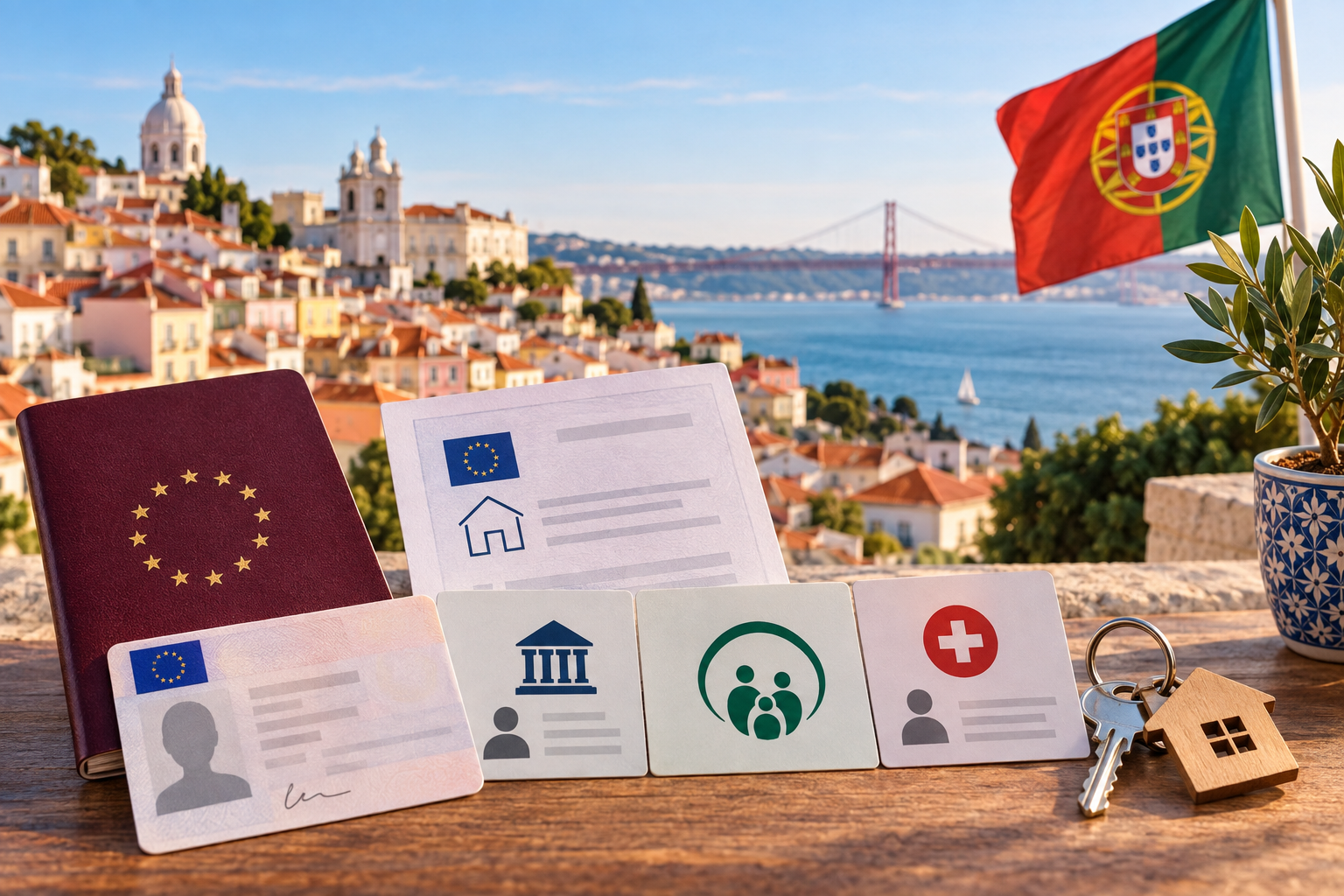

Moving to Portugal as an EU citizen is considerably simpler than moving from outside the European Union, but there is still a fair amount of Portuguese administration to navigate. Once you decide to make Portugal your home, you will encounter several different documents and identification numbers, each connected to a different part of your life: residency, taxes, Social Security, and healthcare.
The good news is that these systems are increasingly connected. As of September 2026, foreign citizens with a Portuguese address—including EU citizens—can, in certain locations, request their NIF, NISS, and SNS user number together in a single application.
Here is a practical overview of the main documents and numbers you are likely to need.
1. Your European ID Card or Passport
The starting point is, of course, your valid national identity card or passport. As an EU citizen, you can enter Portugal with a valid identity document or passport and do not need a visa simply to enter or stay for up to three months. If you intend to remain in Portugal for longer than three months, however, you need to formalize your residence.
It is worth keeping your identity document accessible because it will be used repeatedly when dealing with Portuguese public authorities, banks, healthcare services, and other institutions.
2. The EU Citizen Registration Certificate
If you are an EU citizen and plan to live in Portugal for more than three months, one of the most important documents to obtain is the Certificado de Registo de Cidadão da União Europeia, commonly referred to as the EU Citizen Registration Certificate.
This certificate formalizes your right of residence in Portugal. It should be requested at the Câmara Municipal (Town Hall) in the area where you live, within 30 days after the first three months of your stay.
The requirements depend on your situation. For example, you may declare that you are working in Portugal, that you have sufficient financial resources and appropriate health insurance, or that you are studying and have sufficient resources and, where required, health insurance.
This is an important distinction: EU citizenship gives you the right to move to Portugal, but if you are staying longer than three months, you still need to register your residence.
3. NIF — Your Portuguese Tax Identification Number
The NIF (Número de Identificação Fiscal) is your Portuguese tax identification number. Think of it as one of the fundamental identification numbers you will use for everyday life in Portugal.
You will encounter the NIF when dealing with things such as employment, contracts, banking, and tax matters. The Portuguese Tax Authority also states that the NIF is required for many everyday activities, including opening a bank account and entering into contracts.
For an EU citizen who wants to be registered as a Portuguese tax resident, the Tax Authority lists a valid identity document or passport together with the EU Citizen Registration Certificate as the relevant documentation.
One useful point to understand is that having a NIF does not automatically make you a Portuguese tax resident. Your tax status is a separate matter. If you meet the conditions for Portuguese tax residence, you need to update your status with the Tax Authority.
4. NISS — Your Social Security Number
The NISS (Número de Identificação da Segurança Social) is your Social Security identification number. It connects you to Portugal's Social Security system and is used for your Social Security rights and obligations.
If you work in Portugal, the NISS becomes particularly important because it is connected to your Social Security contributions and access to relevant benefits and support. The Portuguese government states that foreign citizens can apply for a NISS online, and an employer can also request it on behalf of a foreign worker in certain circumstances.
For EU/EEA/Swiss citizens, the documentation accepted for a NISS application includes a valid national identity document, passport, or residence card, together with documentation relating to the person's work situation where required.
The NISS application itself is free.
5. SNS User Number — Your Portuguese Healthcare Number
The Número Nacional de Utente do SNS, commonly called the SNS user number, identifies you within Portugal's public healthcare system, the Serviço Nacional de Saúde (SNS).
For foreign citizens, the number can be assigned when you first go to a public healthcare facility such as a health centre or hospital. You can also request it at a public health facility even if you do not currently need medical treatment.
There is an important distinction here: having an SNS user number does not, by itself, guarantee that the SNS will cover your healthcare costs. For the SNS to cover expenses, the relevant registration generally needs to be associated with information such as your identification document, Portuguese NIF, full Portuguese address, and valid residence authorization, subject to exceptions established by law.
For someone settling in Portugal, it is therefore useful to think of the SNS number as your identification within the healthcare system, rather than as proof by itself that all healthcare is automatically covered.
6. Registering With Your Local Health Centre
Once you have your healthcare number and the relevant documentation, you can register with a Centro de Saúde, preferably the one serving your area of residence.
The Portuguese government states that foreign citizens with residence authorization can register with a health centre and that, for registration, foreign citizens may need to provide their residence documentation, proof of healthcare benefits where applicable, permanent Portuguese address, civil identification number, and NIF.
For EU citizens, your exact healthcare situation can also depend on where you are insured and whether you are working, retired, or otherwise covered by another EU country's social security system. For example, EU citizens who are residents in Portugal and require planned healthcare may need an S1 certificate from their country of origin in certain circumstances.
The Three Numbers You Will Hear About Constantly
Once you start dealing with Portuguese administration, you will probably hear three abbreviations over and over again:
These numbers serve different purposes, but they are increasingly easier to obtain together. As of September 2026, foreign citizens with a Portuguese address who meet the eligibility conditions can request the NIF, NISS and SNS user number in a single application at participating Espaços Cidadão. EU nationality is specifically included among the eligibility conditions.
A Simple Way to Think About the Process
Rather than seeing Portuguese bureaucracy as one giant process, it helps to divide it into four areas.
Residence: If you are staying for more than three months, obtain your EU Citizen Registration Certificate from your local Câmara Municipal.
Taxes and everyday administration: Obtain your NIF and make sure your tax-residency status is correctly registered with the Tax Authority when applicable.
Work and Social Security: If you work or otherwise fall within the Portuguese Social Security system, obtain your NISS and make sure your employment or self-employment situation is correctly registered.
Healthcare: Obtain your SNS user number, establish the basis on which your healthcare is covered, and register with your local health centre when appropriate.
Your Portugal Moving Checklist
For an EU citizen planning to settle in Portugal, your basic checklist will therefore look something like this:
- Valid EU identity card or passport
- EU Citizen Registration Certificate if staying longer than three months
- NIF — Tax Identification Number
- NISS — Social Security Identification Number, where applicable
- SNS User Number — Portuguese healthcare identification
- Registration with your local health centre, where applicable
- Correct Portuguese tax-residency status, if you become tax resident
- S1 or other healthcare documentation, where your particular circumstances require it
The exact documents you need can vary depending on whether you are employed, self-employed, retired, studying, financially independent, or moving to Portugal with family members. The Portuguese authorities also update administrative procedures from time to time, so it is worth checking the official requirements before making an appointment.
Member discussion