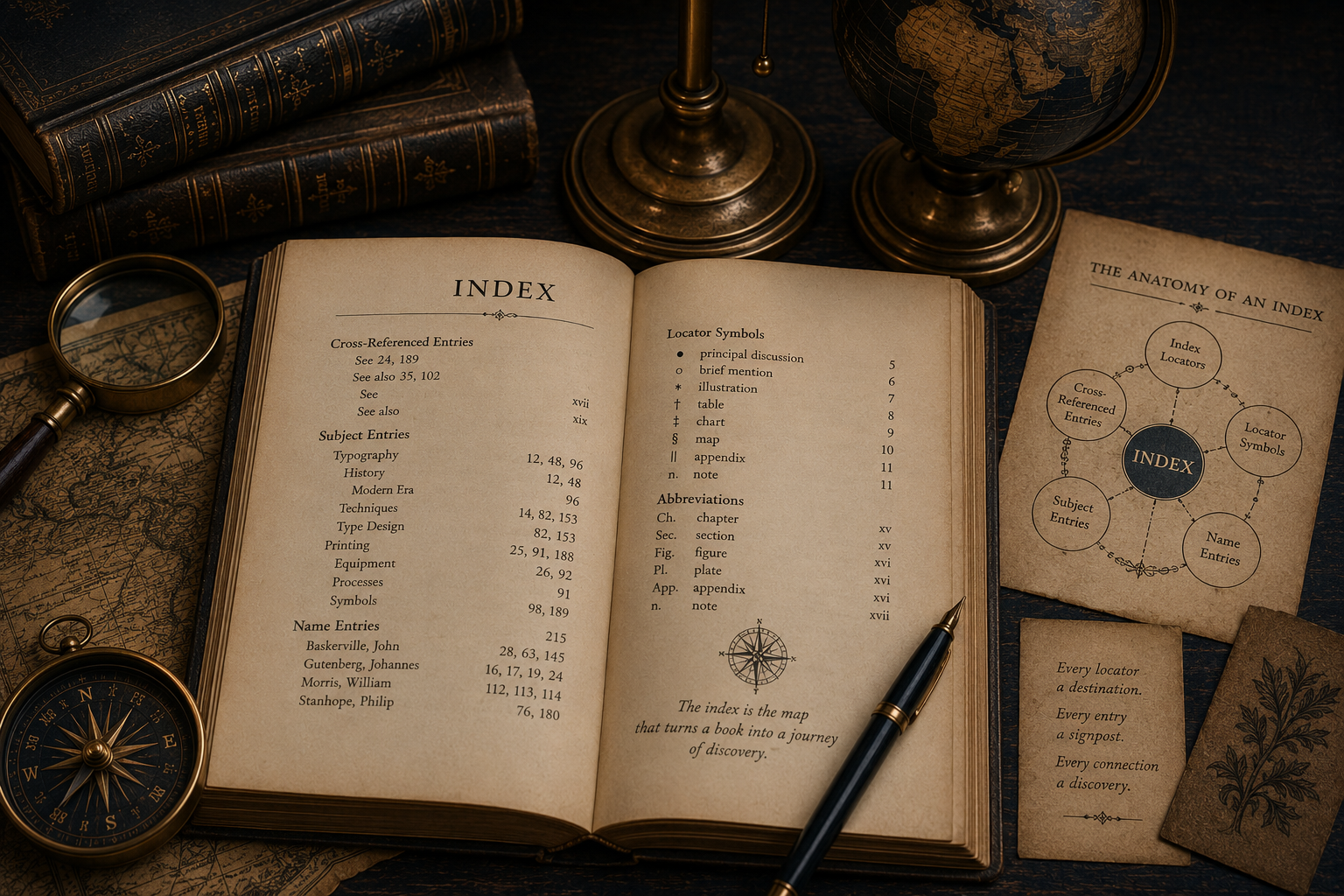

Among the many features hidden within a book, few are as powerful—and as frequently underappreciated—as the index. While readers often admire a book’s prose, illustrations, or design, the index quietly performs a different kind of work. It transforms a book from a linear reading experience into a searchable resource. Instead of requiring readers to journey page by page through an entire volume, an index provides direct pathways to specific information.
The importance of indexing becomes increasingly apparent as books grow larger and more complex. Histories, biographies, encyclopedias, legal texts, scholarly studies, and reference works may contain hundreds or even thousands of pages. Without an effective index, valuable information can become difficult to locate, no matter how carefully it has been written.
Creating an index is both a technical and intellectual task. The indexer must understand the content deeply enough to anticipate what readers will search for and how they will expect that information to be organized. Every entry, every cross-reference, and every locator serves as part of a carefully constructed navigation system.
Though most readers consult an index only when needed, it remains one of the most sophisticated tools ever developed for organizing knowledge within the printed book.
Index Locators
At the heart of every index lies the locator. A locator is the element that directs readers to the precise place where information appears. Most commonly, locators take the form of page numbers, but they may also reference chapters, sections, paragraphs, illustrations, tables, notes, or other structural components of a work.
Without locators, an index would merely be a list of topics. The locator transforms that list into a practical navigational instrument. A reader searching for information about a historical event, a scientific concept, or a particular individual can move directly to the relevant pages without searching through the entire text.
The development of reliable locators became possible only after the widespread adoption of consistent pagination. Once pages could be identified by fixed numbers, publishers gained the ability to create detailed maps of their books. Every page became a destination, and every locator became a coordinate within that intellectual landscape.
Good indexing depends heavily on accurate locators. A misplaced page number can frustrate readers and undermine confidence in the entire index. For this reason, indexing has long been regarded as a discipline requiring exceptional attention to detail.
The locator may appear simple, yet it is the essential bridge between the index and the text itself.
Cross-Referenced Entries
Knowledge rarely fits neatly into a single category. A reader searching for information under one term may discover that relevant material has been organized under another. To address this challenge, indexes employ cross-referenced entries.
These references often appear in the form of instructions such as “See” or “See also.” Their purpose is to guide readers toward related entries, alternative terminology, or broader categories that may contain the information they seek.
A book on typography, for example, might include an entry for “Drop Caps” that directs readers to “Initial Letters.” Similarly, an entry for “Printers’ Flowers” might encourage readers to consult “Fleurons” for additional information. Such connections prevent duplication while ensuring that readers can locate material regardless of the specific terms they use.
Cross-referenced entries reveal one of the central challenges of indexing: readers do not always search for information in the same way. Different individuals may use different vocabulary, possess different levels of expertise, or approach a subject from entirely different perspectives.
The cross-reference acknowledges this reality and provides a flexible system for accommodating multiple paths of inquiry. In doing so, it transforms the index from a simple list into an interconnected network of knowledge.
Subject Entries
The subject entry forms the foundation of most indexes. These entries identify topics, concepts, themes, objects, events, processes, and ideas discussed within a work.
In a history book, subject entries might include wars, political movements, treaties, or economic developments. In a scientific text, they could encompass theories, experiments, species, or technical terminology. In a book devoted to typography, entries might cover typefaces, printing techniques, page design, and editorial conventions.
Creating effective subject entries requires judgment. Not every mention of a topic deserves inclusion. Instead, indexers evaluate the significance of a discussion and determine whether readers are likely to search for it.
Subject entries often include subentries that organize complex topics into smaller categories. A broad subject such as “Printing” may contain subdivisions covering equipment, techniques, historical developments, and notable practitioners. This hierarchy allows readers to move from general concepts to specific details with ease.
The quality of a book’s index often depends upon the strength of its subject entries. Well-chosen entries reveal the intellectual structure of a work and make its contents accessible to future readers.
Name Entries
If subject entries organize ideas, name entries organize people. They provide access to the individuals who appear within a text, whether they are historical figures, authors, artists, scientists, political leaders, or other notable persons.
Name entries are especially important in biographies, historical studies, literary criticism, and scholarly works. Readers frequently seek information about specific individuals rather than general subjects, making accurate name indexing essential.
A name entry may simply list page references where a person is mentioned, but more detailed indexes often distinguish between passing references and substantial discussions. Significant figures may receive extensive entries with multiple subcategories covering different aspects of their lives and contributions.
The preparation of name entries can become surprisingly complex. Historical figures often possess multiple names, titles, honorifics, or alternative spellings. Indexers must determine which form readers are most likely to consult while also providing cross-references from related variants.
Through careful organization, name entries transform a book into a valuable research tool. They enable readers to trace the presence and influence of individuals throughout an entire work, revealing patterns and connections that might otherwise remain unnoticed.
Locator Symbols
While page numbers remain the most familiar form of locator, many indexes employ additional symbols to communicate specific types of information. These locator symbols provide extra layers of precision and help readers distinguish between different kinds of content.
An italicized page number may indicate an illustration. A bold number might identify a principal discussion of a topic. Parentheses, abbreviations, or specialized symbols can signify maps, tables, charts, footnotes, appendices, or other supplementary material.
The use of locator symbols reflects a broader principle in book design: information becomes more useful when it is organized clearly and efficiently. Rather than forcing readers to discover the nature of a reference through trial and error, symbols provide immediate guidance.
Although these conventions vary among publishers and disciplines, their purpose remains consistent. They enrich the index by communicating not only where information can be found but also what kind of information readers can expect to encounter.
For experienced researchers, locator symbols often become invaluable shortcuts, enabling them to identify relevant material at a glance.
Mapping the Contents of a Book
An index is often described as a map, and the comparison is an apt one. Like a cartographer charting a landscape, the indexer identifies significant features, establishes relationships, and creates routes through complex terrain. The resulting system allows readers to travel directly to the information they seek rather than wandering through the entire work.
Index locators provide destinations. Cross-referenced entries create connections. Subject entries organize ideas. Name entries identify individuals. Locator symbols add precision and context. Together, these elements transform a collection of pages into an accessible and navigable body of knowledge.
The best indexes are rarely noticed. Readers simply find what they need and continue reading. Yet behind that apparent simplicity lies an extraordinary amount of intellectual labor and typographic craftsmanship. Every entry represents a decision, every cross-reference a connection, and every locator a carefully placed signpost.
In many ways, the index represents the final act of hospitality performed by a book. After all the writing, editing, and printing have been completed, the index remains behind to greet readers and help them find their way.
Member discussion