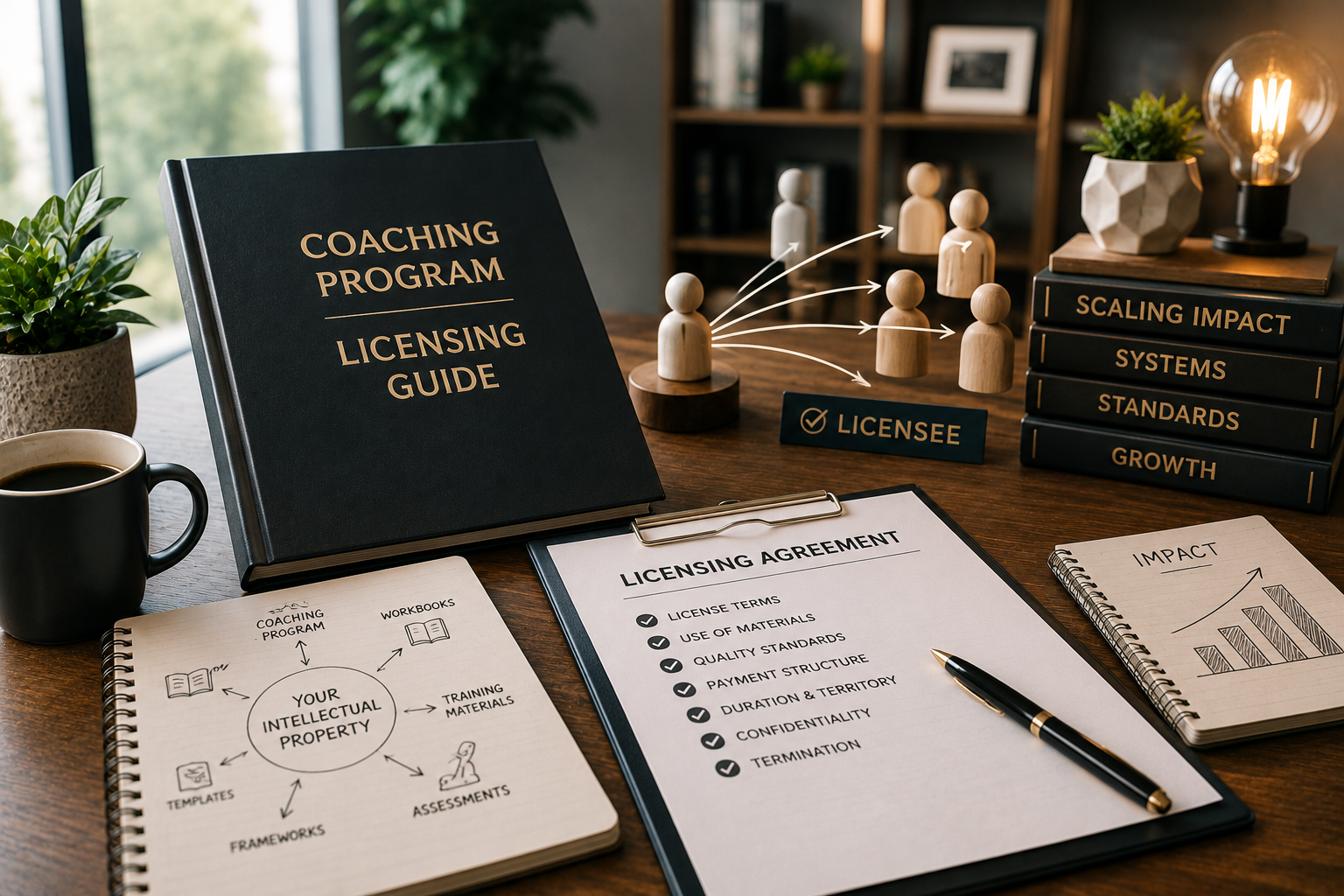

Many experts believe there are only two ways to earn money from their expertise. The first is to work directly with clients through coaching, consulting, mentoring, or professional services. The second is to package that expertise into products such as books, courses, workbooks, or digital resources that individuals can purchase. While both models can create successful businesses, there is a third opportunity that is often overlooked.
Instead of selling your expertise directly to end customers, you can license it to other professionals and organisations, allowing them to use your intellectual property while you retain ownership. Licensing transforms your knowledge from something you simply sell into something that other people can build their businesses around.
What Does It Mean to License Intellectual Property?
Licensing is the process of granting someone permission to use your intellectual property under clearly defined conditions while you continue to own it. Rather than selling your coaching programme outright, you give another coach the right to deliver it. Instead of transferring ownership of your workbook, you allow another organisation to distribute it to its clients. Rather than creating a custom framework for every consultant, you license your existing methodology so they can incorporate it into their own services.
Ownership remains with you. The other party purchases the right to use your work according to the terms you establish. This distinction is important because it allows your intellectual property to continue generating value without leaving your control.
A Coaching Programme Is an Excellent Example
Imagine you’ve spent several years developing a coaching programme that consistently helps entrepreneurs build profitable businesses. The programme includes structured lesson plans, exercises, workbooks, assessment tools, templates, and a proven methodology that delivers reliable results. You could continue coaching clients yourself. Alternatively, you could train other business coaches to deliver the same programme under a licensing agreement.
Those coaches benefit because they receive a complete system instead of having to create one from scratch. Their clients benefit because they receive a tested framework. Meanwhile, you earn licensing revenue while retaining ownership of everything you’ve created. One programme can suddenly reach hundreds or even thousands of people through other professionals.
Many Types of Intellectual Property Can Be Licensed
Licensing extends far beyond coaching programmes. Books can be translated into other languages. Courses can be delivered by certified instructors. Workbooks can be used by training companies. Assessment tools can be integrated into consulting firms. Software can be licensed to businesses. Templates can become part of larger service packages. Educational programmes can be adopted by schools, universities, or professional organisations. Even your proprietary frameworks, methodologies, and branded systems may become valuable licensing opportunities when they solve meaningful problems. Once you begin thinking this way, you realise that almost every form of intellectual property has licensing potential.
Define Exactly What People May Do
Successful licensing depends on clarity. A licence should explain exactly what the other party is allowed to do and, equally importantly, what they are not allowed to do. For example, you might specify whether they may modify the materials, reproduce them, translate them, sell them, use your branding, or deliver them only within their own organisation. You can also define the duration of the licence, the geographical territory it covers, the number of users permitted, and whether the agreement is exclusive or non-exclusive. Clear licensing terms protect both parties and reduce misunderstandings before they occur.
Protect the Quality of Your Brand
When someone uses your intellectual property, they are also representing your work. If the quality of delivery is poor, your reputation may suffer even if you were not personally involved. For this reason, many licensing programmes include quality standards. You may require licensees to complete training before they begin using your methodology. You might provide instructor manuals, implementation guides, certification programmes, or regular updates that ensure consistency across everyone delivering your work. Protecting quality is not about controlling every detail. It is about ensuring that the experience reflects the standards your brand represents.
Create a Business That Can Grow Without You
One of the greatest advantages of licensing is leverage. Traditional coaching businesses grow one client at a time because every client requires your personal involvement. A licensed programme grows differently. Each new licensee can serve dozens or even hundreds of clients using the system you’ve already developed. Instead of delivering every session yourself, you become the creator of the methodology while others handle the implementation. This allows your intellectual property to scale far beyond your personal availability. Your knowledge reaches more people without requiring you to work proportionally more hours.
Continue Improving Your Intellectual Property
Licensing is not the end of development. The most successful licensors continuously refine their programmes, update their resources, improve their workbooks, expand their assessment tools, and incorporate new research and experience. Every improvement increases the value of the intellectual property for both existing and future licensees. Rather than building something once and leaving it unchanged, you create a living system that becomes stronger over time. This ongoing innovation also makes your intellectual property much more difficult for competitors to replicate.
Think Like the Owner of a Valuable Asset
Many entrepreneurs see themselves primarily as service providers. Licensing encourages a different perspective. Instead of asking how many clients you can personally serve, you begin asking how many professionals could benefit from using your expertise. Instead of viewing your coaching programme as something you deliver, you begin seeing it as an asset that can be licensed, expanded, translated, certified, and distributed in ways that reach audiences you could never serve alone. That shift changes the role of your business. You move from being only the expert to becoming the creator of intellectual property that empowers other experts.
Build Something Worth Licensing
Not every coaching programme is ready to be licensed. Before other professionals can confidently deliver your work, your methodology must be clear, repeatable, well documented, and capable of producing consistent results. Your processes should be structured, your resources professionally designed, and your frameworks easy to understand and apply. The effort required to reach that level is significant, but the reward is equally substantial. Rather than building a business that depends entirely on your own calendar, you begin building a business around assets that other people can use to create value. Your expertise evolves from a personal service into intellectual property with the potential to reach far beyond your own clients.
When your knowledge becomes something that others can successfully deliver while you retain ownership, you’ve created more than a coaching programme. You’ve created an asset that has the potential to grow, generate recurring revenue, strengthen your brand, and multiply your impact for years to come.
Member discussion