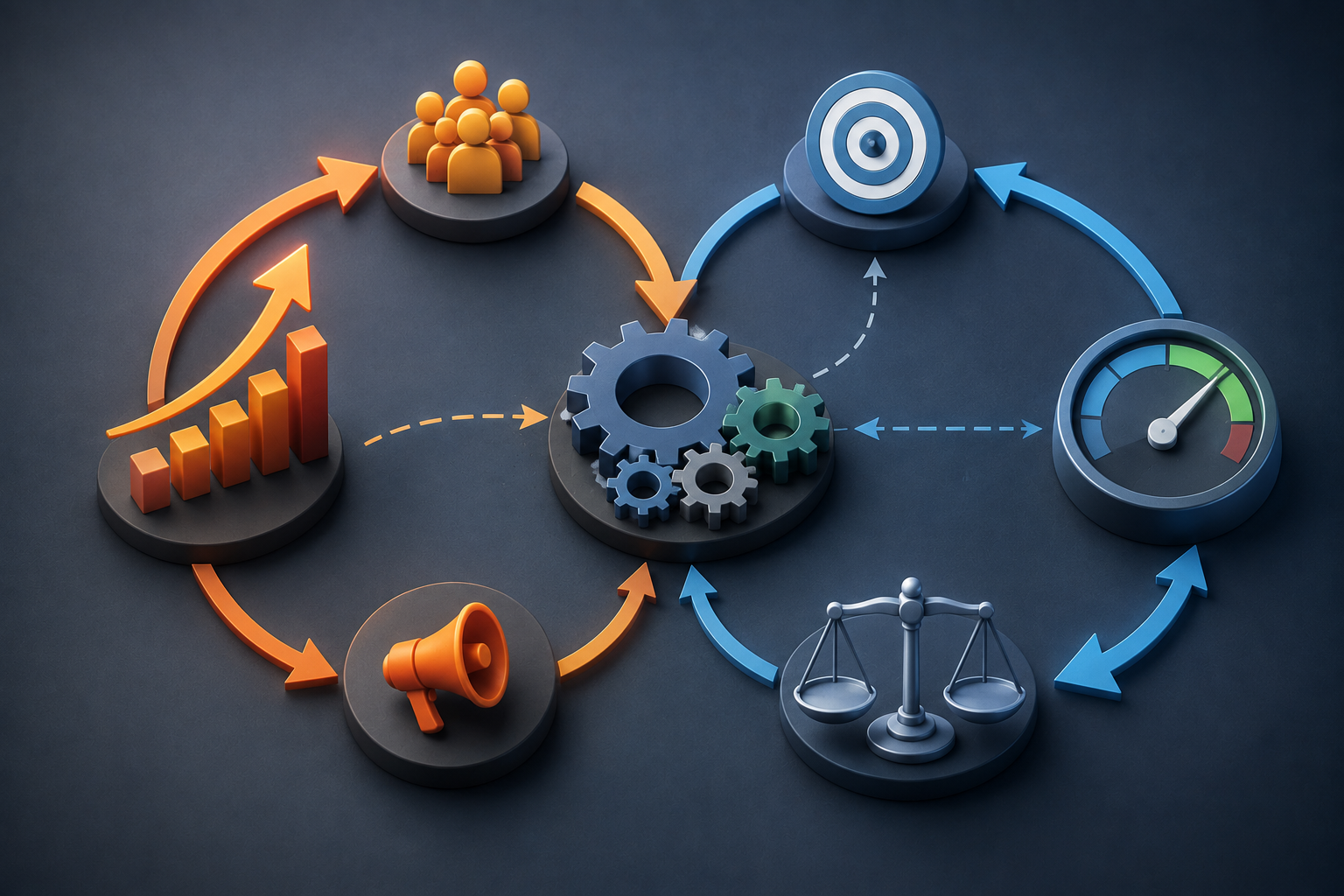

Feedback loops are one of the central concepts in systems thinking because they explain how actions and changes within a system can influence what happens next. Rather than viewing events as isolated causes and effects, systems thinking examines circular patterns in which the consequences of an action can eventually influence the conditions that produced the original action. These interconnected relationships help explain why systems can grow, stabilize, accelerate, decline, or behave in unexpected ways over time.
What Is a Feedback Loop?
A feedback loop occurs when a change in one part of a system produces an effect that travels through other parts of the system and eventually influences the original condition. This creates a circular chain of cause and effect rather than a simple linear sequence. For example, increased demand for a product can lead a company to increase production, which can make the product more available, potentially encouraging further sales and creating additional demand.
The important feature of a feedback loop is that the relationship is circular. The output of a process becomes an input that affects subsequent behavior. This means that understanding an individual event is often insufficient to understand the behavior of the system because the consequences of that event can feed back into the system and alter future conditions.
Reinforcing Feedback Loops
A reinforcing feedback loop amplifies change within a system. When an initial change produces effects that lead to further change in the same direction, the process can generate exponential growth or decline. Reinforcing loops are sometimes called positive feedback loops, although “reinforcing” is often preferred in systems thinking because the loop does not necessarily produce a desirable outcome.
Consider a company that gains customers through word-of-mouth recommendations. More customers can generate more recommendations, which can attract additional customers, creating a cycle of continued growth. The same structure can operate in the opposite direction. Losing customers may reduce recommendations, which can lead to fewer new customers and produce further customer losses.
Balancing Feedback Loops
A balancing feedback loop works to reduce change and move a system toward a desired condition or equilibrium. When a change creates a response that counteracts the original change, the system tends to resist movement away from its current state or toward a particular target.
A thermostat provides a simple example. When the temperature falls below the desired setting, the heating system turns on and raises the temperature. As the temperature approaches the target, the heating system reduces or stops its activity. The resulting loop counteracts the initial change and helps maintain a relatively stable temperature.
Balancing loops do not necessarily mean that a system remains completely static. Instead, they describe processes that regulate behavior by responding to differences between the current condition and a desired or reference condition. Such loops are common in biological regulation, organizational management, economics, and engineered systems.
Feedback Loops and Time
Feedback loops are particularly important because their effects often unfold over time. A decision may produce an immediate result, but its consequences can take longer to travel through the system and influence future behavior. This delay can make systems difficult to understand because the cause and its eventual consequences may be separated by weeks, months, or even years.
For example, a company may reduce employee training to lower short-term costs. Initially, the decision may appear successful because expenditure falls. Over time, however, reduced training can contribute to lower employee capability, poorer performance, and increased errors, which may eventually create higher costs. The delayed consequences can therefore make the original decision appear beneficial in the short term while producing undesirable outcomes later.
Feedback and System Behavior
The interaction of reinforcing and balancing loops helps produce the characteristic behavior of a system. Growth, decline, stability, oscillation, and recurring patterns can often be understood by examining which feedback structures dominate and how quickly they operate.
A population, for instance, may grow through a reinforcing process in which more individuals produce more offspring. At the same time, limited resources can create balancing pressures through competition, disease, or reduced food availability. The resulting population behavior depends on how these different feedback processes interact. Looking at only one relationship would provide an incomplete explanation of the overall pattern.
Unintended Consequences
Feedback loops also help explain why interventions can produce unintended consequences. When a change is introduced into a system, it can alter relationships beyond the immediate target of the intervention. Those changes may then feed back into the original problem, sometimes reinforcing it rather than solving it.
For example, increasing road capacity may initially reduce traffic congestion. However, improved travel conditions can encourage more people to drive, increase development in areas served by the expanded roads, and generate additional traffic. Over time, the intervention may therefore recreate some of the congestion it was intended to reduce. The problem is not necessarily the intervention itself but the feedback structure within the wider transportation system.
Feedback Loops and Systems Thinking
Feedback loops shift the focus of analysis from isolated events to patterns of interaction over time. Instead of asking only what caused a particular outcome, systems thinking asks what structures keep producing that outcome and how the consequences of actions influence future conditions.
This perspective encourages people to look for reinforcing and balancing processes, delays, unintended effects, and connections between different parts of a system. By identifying these relationships, it becomes possible to understand why a system behaves as it does and to identify points where relatively small changes may produce significant effects.
Conclusion
Feedback loops are fundamental to systems thinking because they show how cause and effect can operate through interconnected and recurring relationships. Reinforcing loops amplify change, while balancing loops counteract change and contribute to regulation or stability. Both types can operate simultaneously within the same system, producing complex patterns of behavior.
Understanding feedback loops allows us to move beyond linear explanations and recognize that today’s outcomes can become tomorrow’s causes. Whether examining organizations, economies, ecosystems, technologies, or social systems, identifying the feedback structures within them provides a deeper understanding of how systems evolve and why interventions can produce both expected and unexpected results.
Member discussion