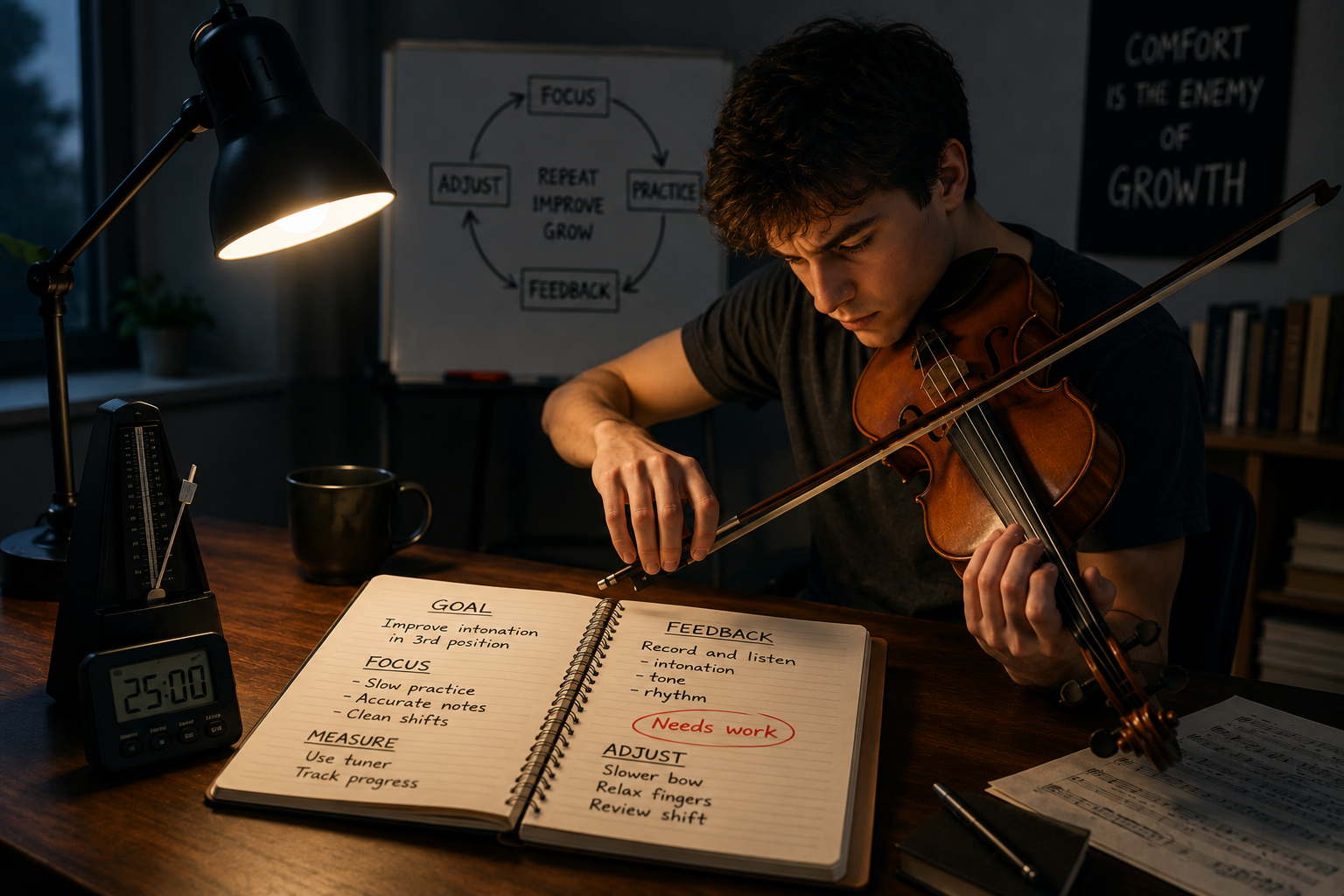

Most people believe that mastery comes from spending enough time on an activity. The common advice is simple: practice more. The assumption is that if you repeat something often enough, improvement will naturally follow. While repetition certainly has its place, experience shows that time alone is a poor predictor of expertise. Many people spend years performing the same task without becoming significantly better at it.
The mental model of deliberate practice offers a different explanation. It argues that improvement is not driven by the amount of practice, but by the quality of that practice. Progress comes from intentionally working on the parts of a skill that are weakest, receiving immediate feedback, and continuously making small adjustments. In other words, mastery is the result of focused refinement rather than mindless repetition.
What Is Deliberate Practice?
Deliberate practice is a structured approach to learning that focuses on purposeful improvement. Instead of repeating what you already know, you deliberately challenge yourself just beyond your current level of ability. Every practice session has a specific objective, and every mistake becomes valuable information about what needs to improve next.
This approach is common among elite athletes, musicians, chess players, surgeons, and pilots. Their goal is not simply to accumulate hours of experience but to ensure that every hour contributes to measurable progress. They spend far more time correcting weaknesses than repeating strengths.
The distinction is important because simply performing a task over and over again often leads to automatic behavior rather than continuous improvement.
Why Repetition Isn’t Enough
Imagine someone who has been driving a car for twenty years. Although they have accumulated thousands of hours behind the wheel, few would claim they have become twenty times better than they were after their first year. Once a skill becomes automatic, improvement slows dramatically because the brain no longer needs to adapt.
The same principle applies to almost every discipline. A programmer who writes the same type of code every day may become efficient without becoming more capable. A pianist who only plays familiar pieces may perform them beautifully while making little progress toward mastering more challenging techniques.
Without focused effort, practice gradually becomes routine. Routine builds consistency, but it rarely builds excellence.
The Role of Feedback
One of the defining characteristics of deliberate practice is feedback. It is remarkably difficult to improve if you cannot identify your mistakes. Feedback provides the information necessary to close the gap between current performance and desired performance.
This feedback may come from a teacher, a coach, a mentor, objective measurements, or careful self-analysis. Regardless of its source, it allows each practice session to become a cycle of observation, correction, and refinement.
The shorter the feedback loop, the faster improvement tends to occur. Small corrections made consistently often produce extraordinary results over time.
Embracing Discomfort
Deliberate practice is rarely enjoyable in the moment because it requires operating at the edge of your current abilities. This is where mistakes become frequent, progress feels slow, and success is uncertain.
Ironically, these uncomfortable moments are often the most productive. If an activity feels effortless all the time, it usually means you are practicing what you already know rather than developing new capabilities.
Growth occurs where competence ends and challenge begins.
Deliberate Practice in Everyday Life
Although the concept is often associated with elite performers, its principles apply to almost any skill. Learning a language, public speaking, writing, programming, drawing, leadership, and even communication can all improve through deliberate practice.
A writer, for example, may spend an entire session improving dialogue rather than writing another chapter. A programmer might focus exclusively on algorithms they find difficult instead of building features they already understand. A public speaker may repeatedly practice transitions between ideas rather than delivering an entire presentation from beginning to end.
In each case, improvement comes from isolating weaknesses and addressing them directly instead of hoping they disappear with experience.
Combining Deliberate Practice with Other Mental Models
Deliberate practice becomes even more powerful when combined with other ways of thinking. Bottleneck analysis helps identify the single weakness that is limiting progress the most. First-principles thinking breaks complex skills into their fundamental components so they can be practiced individually. Feedback loops provide continuous information about improvement, while compounding reminds us that small gains, repeated consistently, eventually produce remarkable results.
Together, these models transform learning from a passive process into a deliberate system of continuous improvement.
The Limits of Deliberate Practice
Deliberate practice is exceptionally effective, but it is also demanding. It requires sustained concentration, honest self-assessment, and the willingness to repeatedly confront personal weaknesses. Because of its intensity, it is difficult to maintain for long periods without rest.
Furthermore, not every activity benefits equally from deliberate practice. Some forms of creativity, exploration, and innovation require experimentation rather than structured repetition. The challenge is knowing when to practice with precision and when to explore freely.
Conclusion
The mental model of deliberate practice reminds us that mastery is not measured by the number of hours we spend working, but by how intentionally we use those hours. Improvement comes from focusing on weaknesses, seeking feedback, embracing challenges, and making continuous adjustments over time.
Anyone can repeat a skill. The people who become exceptional are those who repeatedly improve it. Excellence is rarely the product of experience alone; it is the result of practicing with purpose.
Subscribe for free and receive a six-part email course that walks you through the process of turning your expertise into a product, helping you move beyond selling your time for money.
Member discussion