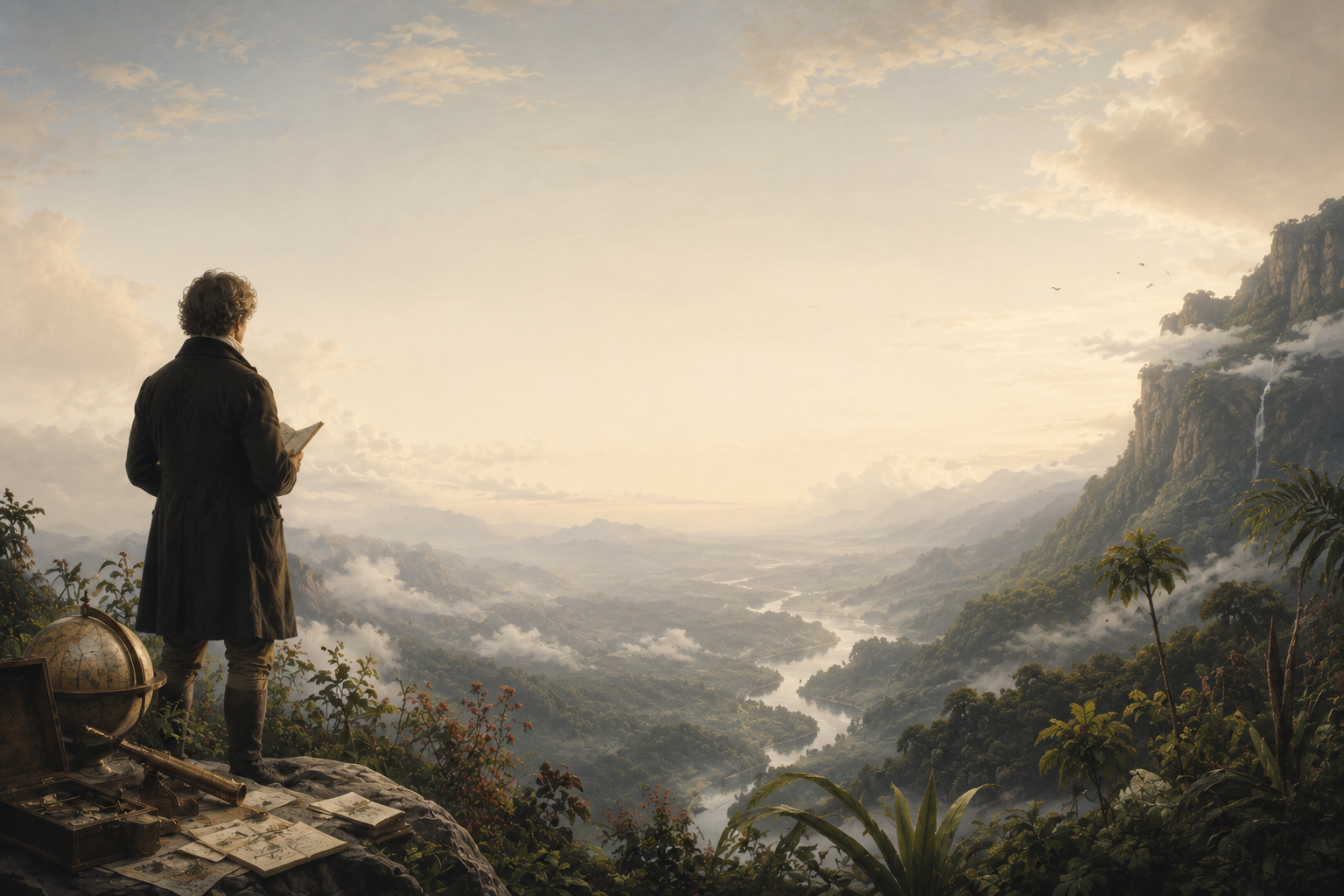

In the summer of 1802, a German explorer stood high on the slopes of Chimborazo, a towering volcano in present-day Ecuador. At nearly 6,000 meters above sea level, breathing had become difficult. His lips were bleeding from the altitude, the cold was relentless, and every step required tremendous effort. Most people would have been focused solely on survival.
Alexander von Humboldt was busy taking notes.
As he climbed higher and higher into the thin mountain air, he carefully observed the plants growing around him. He measured temperature, air pressure, humidity, and altitude. He compared what he saw on the mountain to landscapes thousands of kilometers away. While others looked at nature as a collection of separate objects, Humboldt was beginning to recognize something profound: The world was connected.
The forests, rivers, mountains, oceans, climate, plants, animals, and even human societies were all part of a vast network of relationships. Changes in one place could affect another. Nature was not a machine made up of isolated pieces but a living system whose parts continuously influenced one another.
Today, this idea forms the foundation of ecology, environmental science, and climate research. Yet more than two hundred years ago, it was revolutionary. Humboldt did not merely discover new places. He changed the way humanity understands the Earth itself.
A Childhood Defined by Curiosity
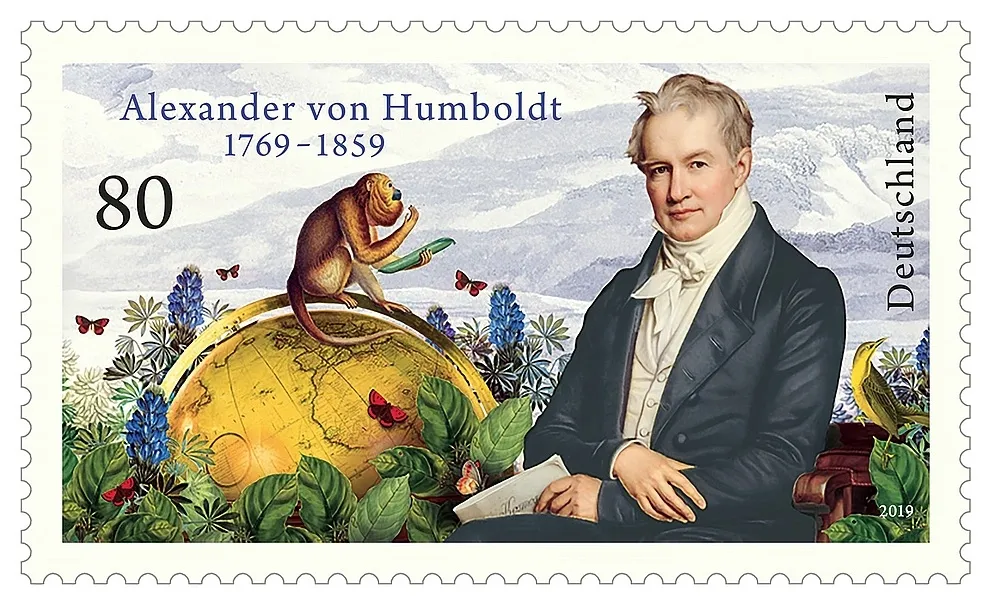
Alexander von Humboldt was born in Berlin on September 14, 1769, into a wealthy Prussian family. From an early age, he displayed a fascination with the natural world that bordered on obsession.
While other children occupied themselves with games and social activities, Humboldt spent his time collecting plants, insects, rocks, and animal specimens. Every walk through the countryside became an opportunity to investigate something new. He wanted to know not only what things were but why they existed where they did and how they related to everything around them.
His family expected him to pursue a respectable career in government service, and he dutifully followed the educational path laid out before him. Yet his interests ranged far beyond what was expected of a young aristocrat. He studied economics, geology, chemistry, astronomy, botany, and mining engineering. Rather than specializing in a single subject, he immersed himself in many.
This broad education would later become one of his greatest strengths. At a time when scientists increasingly focused on narrow disciplines, Humboldt developed the ability to see connections across fields of knowledge. He was not content to study nature from books alone. He wanted to experience it firsthand.
The Great Expedition into the Unknown
The turning point in Humboldt’s life arrived in 1799 when he received permission from the Spanish crown to travel through its colonies in the Americas. For most Europeans, large parts of South America remained mysterious. Maps were incomplete, scientific observations were scarce, and vast regions were largely unknown to the outside world. Humboldt saw an opportunity unlike any other.
Together with the French botanist Aimé Bonpland, he embarked on what would become one of the most significant scientific expeditions in history. Over the next five years, they traveled through present-day Venezuela, Colombia, Ecuador, Peru, Cuba, and Mexico, covering thousands of kilometers by foot, horseback, canoe, and ship. The journey was physically brutal.
The two men crossed dangerous mountain passes, navigated rivers infested with crocodiles and electric eels, endured tropical diseases, and survived extreme weather conditions. Yet wherever they went, Humboldt collected data with almost obsessive determination.
He measured temperatures and elevations. He documented plants and animals. He studied geological formations. He examined indigenous cultures and recorded observations about economics, agriculture, and society. His notebooks grew thicker with every passing month.
Unlike many explorers of his era, Humboldt was not motivated by conquest or wealth. His goal was understanding. He wanted to uncover the hidden patterns that governed the natural world.
Discovering Nature’s Invisible Patterns
As Humboldt traveled through different environments, he began noticing recurring relationships. Plant species changed with altitude in predictable ways. Climate influenced vegetation. Ocean currents affected weather patterns. Mountain ranges shaped ecosystems. Geography influenced both nature and human civilization.
These observations may seem obvious today, but in Humboldt’s time they represented a radically new way of thinking. Most scientists focused on classification. They collected specimens and organized them into categories. Humboldt did that as well, but he wanted to answer a deeper question.
Why? Why did certain plants grow in one place but not another? Why did climates differ between regions? Why did environmental conditions produce specific forms of life?
The more data he gathered, the more convinced he became that nature operated as an interconnected whole. Rather than studying individual pieces separately, he sought to understand the relationships between them. This perspective would eventually transform modern science.
The Mountain That Changed Everything
One of Humboldt’s most famous scientific achievements emerged from his attempt to climb Chimborazo. During the ascent, he carefully recorded how vegetation changed at different elevations. As the environment shifted, different plant communities appeared and disappeared. The higher he climbed, the more he realized that altitude could mimic the effects of traveling across entire continents.
A mountain, in a sense, compressed multiple climate zones into a single vertical journey. From this insight emerged one of the most influential scientific illustrations ever created.
Humboldt produced a detailed diagram known as the Naturgemälde, a visual representation showing how temperature, altitude, climate, and plant life interacted. The illustration combined information from multiple scientific disciplines into a single coherent image. Today it is often regarded as one of the earliest ecological maps.
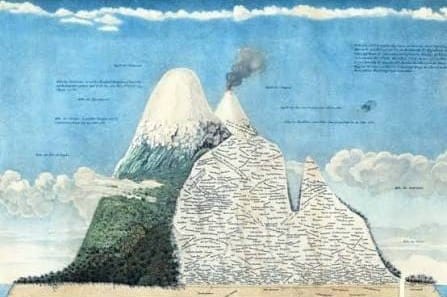
More importantly, it represented a new way of thinking. Instead of isolating individual facts, Humboldt showed how seemingly unrelated phenomena could be understood as parts of a larger system.
The First Environmental Thinker
Perhaps Humboldt’s most remarkable contribution was his recognition of humanity’s impact on nature.
While traveling around Lake Valencia in Venezuela, he observed extensive deforestation. Local forests had been cleared for agriculture, and Humboldt noticed changes in soil quality, water availability, and local climate conditions.
What he concluded was extraordinary for his time. Human beings, he argued, were capable of altering entire ecosystems. This insight emerged more than a century before environmentalism became a political movement and nearly two centuries before climate change entered public debate.
Humboldt understood that humans were not separate from nature. They were participants within it, capable of disrupting the delicate balance of interconnected systems. In many ways, he anticipated some of the most important environmental questions of the modern era.
The Scientist Who Inspired Darwin
Humboldt’s influence extended far beyond his own discoveries. His travel accounts became international bestsellers, captivating readers across Europe and North America. Scientists, artists, writers, and political leaders eagerly consumed his descriptions of distant landscapes and natural wonders.
Among those readers was a young English naturalist named Charles Darwin.
Darwin later described Humboldt’s writings as a major source of inspiration. Reading Humboldt’s accounts awakened his desire to travel and conduct scientific research abroad. When Darwin eventually embarked on the voyage of the HMS Beagle, he carried Humboldt’s books with him.
The influence was profound.
Without Humboldt, Darwin’s journey might never have unfolded in quite the same way. Without Darwin, the development of evolutionary theory would have looked very different. The chain of intellectual influence linking the two men helped shape modern biology.
More Than a Scientist
Although Humboldt is often remembered as a scientist, his interests extended far beyond the natural world. He opposed slavery at a time when many influential Europeans accepted it without question. He criticized colonial exploitation and spoke openly about social injustice. Throughout his travels, he demonstrated a genuine respect for indigenous cultures and frequently challenged the prejudices common among European elites.
He believed knowledge should transcend national boundaries and political rivalries. Science, in his view, belonged to humanity as a whole. This cosmopolitan outlook earned him admirers around the world. By the middle of the nineteenth century, Humboldt had become one of the most famous intellectuals on Earth. His reputation rivaled that of political leaders and royalty.
Cities, rivers, mountains, plants, animals, and even ocean currents were named after him. Very few scientists have ever achieved such global recognition.
Cosmos: A Lifetime of Knowledge
In his later years, Humboldt undertook perhaps his most ambitious project. He began writing a monumental work called Cosmos, an attempt to synthesize everything he had learned about the universe during his lifetime. The project reflected the central idea that had guided his thinking for decades: all knowledge is connected.
Rather than treating astronomy, geology, biology, geography, and physics as separate disciplines, Humboldt sought to weave them together into a single narrative about the universe and humanity’s place within it.
The books became enormously popular and were translated into numerous languages. Readers were captivated by Humboldt’s ability to combine rigorous science with a sense of wonder. He did not merely present facts. He invited people to see the world differently.
Why Humboldt Matters Today
The modern world is increasingly defined by interconnected challenges. Climate change affects ecosystems, economies, politics, and societies simultaneously. Biodiversity loss influences food systems, water resources, and public health. Environmental problems rarely remain confined to one region or one discipline.
The more we learn about the planet, the more Humboldt’s worldview appears remarkably prophetic. His central insight—that everything is connected—lies at the heart of contemporary environmental science.
When scientists study climate systems, biodiversity networks, or ecosystem dynamics, they are working within a framework that Humboldt helped create more than two centuries ago. His ideas remind us that understanding the world requires looking beyond isolated facts and recognizing the relationships that bind them together.
The Legacy of a Visionary
Alexander von Humboldt died in 1859 at the age of eighty-nine, leaving behind thousands of pages of observations, maps, books, and scientific discoveries. Yet his greatest contribution was not a single expedition, theory, or publication.
His greatest contribution was a way of seeing.
He taught humanity that nature is not a collection of separate objects but a web of relationships. He showed that mountains, forests, rivers, climate, plants, animals, and people are connected in ways that often remain invisible until someone takes the time to look closely enough.
More than two hundred years later, the challenges facing our planet have only reinforced the importance of that vision. In an age of environmental uncertainty, Humboldt’s message remains as relevant as ever: the Earth functions as a living whole, and understanding any part of it requires understanding its connection to everything else.
Few explorers have changed our maps. Even fewer have changed our minds. Alexander von Humboldt accomplished both.
Member discussion